If you own a car, bike, or commercial vehicle in Pakistan, you already know the drill — every year (or sometimes for a lifetime), you owe the government a vehicle token tax. But here's the catch: the amount you pay isn't the same everywhere. Punjab, Sindh, KPK, Balochistan, and Islamabad each set their own rates, and the tax itself shifts depending on your engine's cubic capacity (cc).
This guide breaks down exactly how vehicle token tax works across Pakistan, what you'll pay based on your province and engine size, and how to calculate, verify, and pay it online without wasting a day standing in line at an excise office. Whether you drive a 660cc Suzuki Alto or a 1800cc Honda Civic, you'll find your numbers here.
What Is Vehicle Token Tax in Pakistan?
Vehicle token tax is a provincial tax charged by the Excise and Taxation Department of each province (or the ICT administration in Islamabad) for the right to legally drive a registered vehicle on public roads. Think of it as an annual "permission fee" tied to your vehicle's engine capacity, not its market value.
Unlike income tax or sales tax, which are collected federally through the Federal Board of Revenue (FBR), token tax is a provincial subject — meaning Punjab's Excise and Taxation Department, Sindh's Excise and Taxation Department, KPK's Excise, Taxation and Narcotics Control Department, and the Islamabad Excise and Taxation Office all issue their own notifications, rate schedules, and payment portals.
In short: token tax = engine capacity + province you're registered in + vehicle type (private, commercial, hybrid, electric).
Why Token Tax Matters (And Why It Trips People Up)
Every year, thousands of vehicle owners get fined or face registration issues simply because they didn't realize:
- Token tax rates differ by province, so moving your registration or buying a used car from another province can change your bill.
- Some provinces charge annual token tax, while others now offer a lifetime token tax option for smaller engines.
- Missing the due date triggers a surcharge or penalty, which compounds the longer it's unpaid.
- Withholding tax under Section 234 of the Income Tax Ordinance is often collected alongside token tax at the same time — and non-filers pay significantly more than filers.
Understanding this system isn't just about compliance — it directly affects your household budget, especially if you own more than one vehicle.
How Vehicle Token Tax Is Calculated in Pakistan
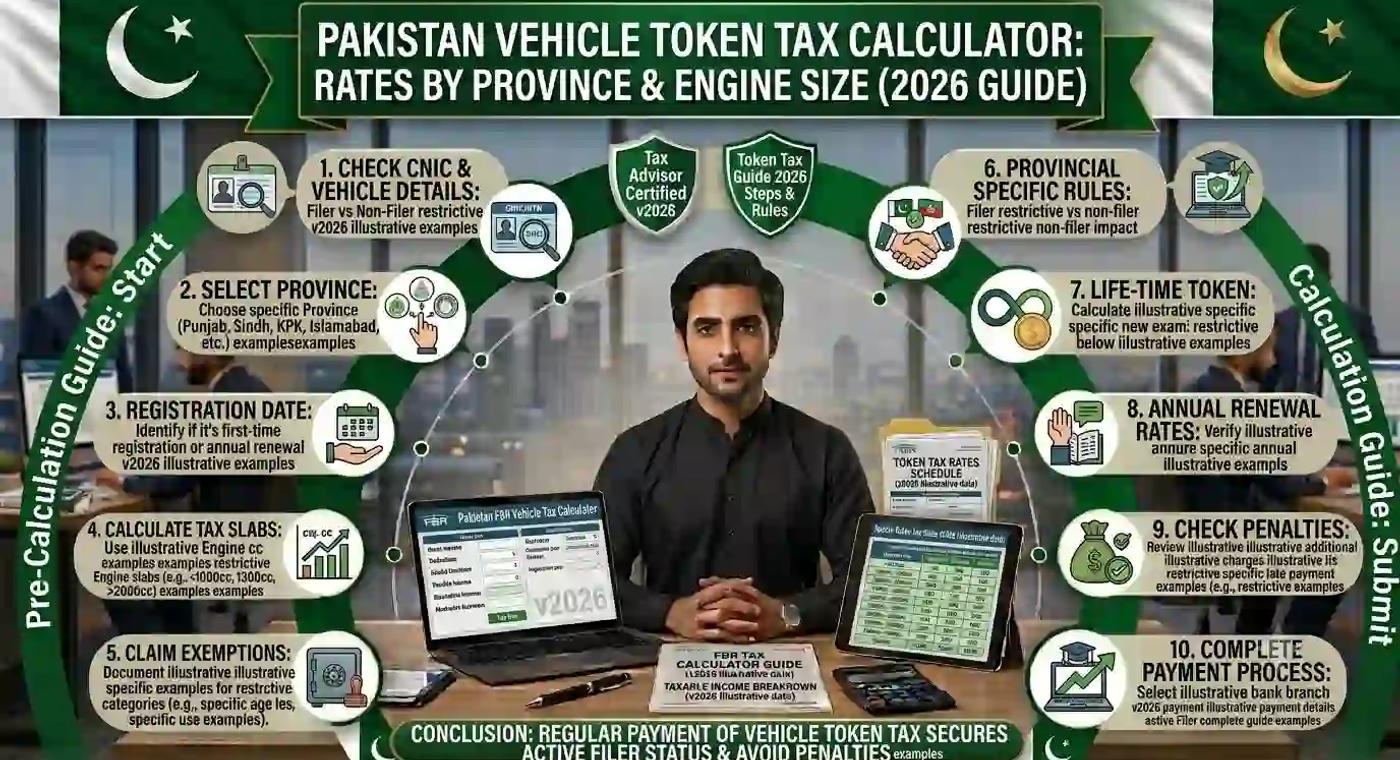
Token tax in Pakistan is calculated primarily on engine capacity (cc), using a slab-based system. Here's the general formula excise departments follow:
- Identify engine capacity (660cc, 1000cc, 1300cc, 1600cc, 1800cc, 2000cc+).
- Match it to the province-specific tax slab.
- Apply vehicle type multiplier (private car, commercial vehicle, motorcycle, jeep, electric/hybrid).
- Add withholding tax (if collected at the same time, based on filer/non-filer status).
- Subtract early-payment discounts or add late-payment surcharges, if applicable.
Most provinces publish these as flat annual amounts per cc bracket rather than a percentage — which is what makes a vehicle token tax calculator genuinely useful. Instead of manually cross-referencing slab tables, you just enter your engine size and province, and it returns your dues instantly.
Vehicle Token Tax Rates by Engine Size (General Slabs)
While exact figures are revised through provincial Finance Acts and notifications each year, the general slab structure used across most provinces looks like this:
| Vehicle Token Tax Rates by Engine Size (General Slabs) | ||
|---|---|---|
| Engine Capacity | Typical Vehicle Examples | Tax Category |
| Up to 1000cc | Suzuki Alto, Cultus, Wagon R | Lowest slab |
| 1001cc–1300cc | Honda City, Toyota Corolla (base) | Mid-low slab |
| 1301cc–1600cc | Corolla Altis, Honda Civic (base) | Mid slab |
| 1601cc–1800cc | Civic Oriel, Toyota Yaris ATIV | Mid-high slab |
| 1801cc–2000cc | Toyota Camry, Fortuner (lower variants) | High slab |
| Above 2000cc | Land Cruiser, Prado, luxury SUVs | Highest slab |
Motorcycles and rickshaws fall into their own lighter slabs, usually a fixed nominal annual fee rather than a cc-based bracket. Because these numbers are updated periodically, always cross-check current rates using an updated car token tax calculator rather than relying on last year's figures.
Province-Wise Token Tax Breakdown
Punjab Token Tax
Punjab's Excise and Taxation Department handles registration and token tax collection through e-Pay Punjab and its MTMIS (Motor Transport Management Information System) portal. Punjab has historically offered vehicle owners the choice between:
- Annual token tax, paid every year, or
- Lifetime token tax, a one-time payment (mostly for smaller cc vehicles) that removes the annual hassle entirely.
If you're verifying details or checking dues specific to Punjab-registered vehicles, our detailed breakdown on Punjab vehicle verification and token tax walks through the MTMIS check process step-by-step.
Sindh Token Tax
Sindh's Excise and Taxation Department manages token tax for Karachi, Hyderabad, and the rest of the province through its own online portal. Sindh's rates and vehicle verification process differ slightly from Punjab's, especially in surcharge structure and the documentation required for online payments.
For a full walkthrough of checking and paying Sindh vehicle tax online, see our guide on Sindh vehicle verification and token tax.
KPK Token Tax
Khyber Pakhtunkhwa's Excise, Taxation and Narcotics Control Department follows its own notification schedule. KPK rates are generally comparable to Punjab's for equivalent cc brackets but are administered through separate regional offices in Peshawar and other district headquarters.
Islamabad (ICT) Token Tax
Vehicles registered in the Islamabad Capital Territory (ICT) are handled by the Excise and Taxation Office, Islamabad — separate from Punjab despite the geographic proximity. Islamabad has its own online verification and token tax portal, with rates that can differ from neighboring Rawalpindi (Punjab) even for identical vehicles.
If you want a side-by-side look at how Islamabad's online verification and payment process compares to other regions, this guide on Excise and Taxation Islamabad online verification and tax payment is a solid starting point.
Balochistan Token Tax
Balochistan's Excise and Taxation Department, based in Quetta, follows the smallest and least digitized system among the provinces. Online payment options are more limited, and many vehicle owners still need to visit district excise offices directly for token tax payment and verification.
Lifetime Token Tax vs. Annual Token Tax: Which Is Better?
This is one of the most searched questions, and the honest answer is: it depends on how long you plan to keep the vehicle.
- Lifetime token tax is a single upfront payment (typically available for smaller engine vehicles) that covers the vehicle for as long as you own it in that province. It's ideal if you're planning to keep the car long-term and want to avoid yearly paperwork.
- Annual token tax is paid every year and may work out cheaper in the short term, especially if you resell the vehicle within a few years or plan to relocate provinces.
If you're comparing the two options in detail, along with real numbers across provinces, our vehicle verification and token tax comparison guide breaks down the trade-offs clearly.
How to Pay Vehicle Token Tax Online in Pakistan
Every province now offers (in varying degrees of maturity) an online payment option. Here's the general process:
- Visit your province's official excise and taxation portal (Punjab's e-Pay Punjab, Sindh's Excise & Taxation site, or the ICT Islamabad Excise portal).
- Enter your vehicle's registration number or chassis number.
- The system pulls up your outstanding token tax, along with any pending withholding tax or surcharge.
- Choose your payment method — bank transfer, mobile wallet, or over-the-counter challan generation.
- Save your digital receipt or challan — this is your legal proof of payment.
For an easy shortcut instead of digging through provincial notification PDFs, use our vehicle token tax calculator, which estimates your dues instantly based on engine size and province before you even go to the payment portal.
Penalties for Late Token Tax Payment
Missing your token tax due date isn't just inconvenient — it costs real money. Most provinces apply:
- A percentage-based surcharge on the original amount owed, increasing the longer the delay.
- Potential registration or transfer issues if the vehicle is sold while token tax dues are outstanding.
- In some cases, fines during traffic police checks for vehicles found with unpaid or expired token tax.
Paying before your due date — often marked clearly on your original registration book or MTMIS record — avoids all of this entirely.
Token Tax Exemptions in Pakistan
Certain categories of vehicle owners may qualify for reduced rates or full exemptions, depending on provincial policy:
- Vehicles owned by persons with disabilities (subject to documentation and provincial approval).
- Government and diplomatic vehicles, which follow separate registration classes.
- Electric vehicles, which several provinces have started incentivizing with reduced or waived token tax to encourage EV adoption.
- Vintage or classic vehicles registered under special heritage categories in some jurisdictions.
Exemption rules vary significantly by province, so it's worth confirming directly with your local excise and taxation office before assuming you qualify.
Token Tax for Electric and Hybrid Vehicles
With Pakistan pushing for greater EV adoption, several provinces have introduced reduced token tax rates for hybrid and fully electric vehicles. The logic is straightforward: since EVs don't use petrol (and therefore don't contribute to the petroleum levy), provinces use lower token tax as an additional incentive. If you're considering an EV or hybrid purchase, always check the current provincial notification, since these incentive rates are revised more frequently than standard combustion-engine slabs.
Token Tax for Commercial Vehicles
Commercial vehicles — trucks, buses, taxis, and ride-hailing cars — are taxed differently from private vehicles. Rates are typically based on:
- Seating capacity (for passenger vehicles)
- Load capacity (for goods vehicles)
- Route classification (intercity vs. intracity)
Commercial vehicle owners often deal with additional route permits and fitness certificates alongside token tax, making the overall compliance process more layered than for private car owners.
Token Tax vs. Property Tax vs. Withholding Tax: What's the Difference?
It's easy to mix these up, so here's a clear breakdown:
- Token tax — a provincial tax on vehicle ownership, based on engine capacity.
- Property tax — a provincial tax on real estate ownership, unrelated to vehicles. See our detailed guide on FBR property tax and DC rates in Pakistan if you're comparing tax obligations across asset types.
- Withholding tax on vehicles — a federal tax under the Income Tax Ordinance, collected at the time of registration, transfer, or token tax payment, and is significantly higher for non-filers than for active tax filers.
If you're not yet a registered filer and want to understand how that status affects the withholding tax portion of your vehicle costs, our guide on how to become a tax filer in Pakistan explains the process and the savings involved.
The Bigger Tax Picture: How Vehicle Tax Fits Into Your Overall Tax Planning
Vehicle token tax is just one piece of the broader tax obligations most working Pakistanis manage each year. If you're a salaried employee, your token tax payment often coincides with salary tax season — making it a good time to review your overall tax position.
- Check your current salary tax bracket using our Pakistan salary tax calculator, or read the 2026 salary tax calculator guide for a full walkthrough.
- Understand how salary tax slabs break down for the current fiscal year.
- If you're confused about terminology, our explainer on salary tax vs. income tax in Pakistan clears up the distinction.
- Looking for legal ways to reduce your tax burden? Our guide on how to reduce salary tax legally in Pakistan covers deductions and credits most people overlook.
FBR, IRIS, and Vehicle Tax: How They Connect
While token tax itself is provincial, the FBR and its online portal, IRIS, still play a role — particularly around withholding tax collected on vehicle registration, transfer, and token tax payments for non-filers.
- New to IRIS? Start with our FBR IRIS login guide.
- For a broader walkthrough of the portal itself, see the FBR IRIS portal guide for 2026–2027.
- Want to check your official filer status before your next token tax payment? Use the FBR Active Taxpayer List (ATL) status check guide.
- For general federal tax calculations beyond vehicles, our FBR tax calculator guide and the latest FBR tax slabs 2026–2027 update are worth bookmarking.
- Filing deadlines matter too — check our roundup on the income tax return deadline in Pakistan so your filer status stays active year-round.
- For a complete overview of income tax calculation, see our Pakistan income tax calculator 2026–2027 guide.
Understanding Excise and Taxation Departments Across Pakistan
Every province's Excise and Taxation Department handles more than just token tax — they also manage vehicle registration, ownership transfer, number plates, and property tax in some cases. For a complete overview of how these departments function nationwide, read our pillar guide on Excise and Taxation in Pakistan.
If you're specifically trying to calculate the total cost of registering a new vehicle — including registration fee, token tax, and withholding tax combined — our detailed breakdown on how to calculate vehicle tax and registration fees puts all three together in one place.
A Quick Word on U.S. and International Readers
While this guide focuses on Pakistan, we know some readers compare tax systems across countries. If you're researching U.S. federal tax obligations for comparison purposes, our U.S. federal income tax calculator guide for 2026 and our explainer on e-commerce sales tax nexus cover how different jurisdictions apply tax obligations — useful context if you're an overseas Pakistani managing tax responsibilities in more than one country.
Frequently Asked Questions
What is vehicle token tax in Pakistan? Vehicle token tax is a provincial tax charged annually (or as a one-time lifetime payment) for the legal right to operate a registered vehicle, based mainly on engine capacity.
How is token tax calculated in Pakistan? It's calculated using a slab system based on engine capacity (cc), the province of registration, and vehicle type, with withholding tax sometimes added depending on filer status.
Is token tax the same in every province? No. Punjab, Sindh, KPK, Balochistan, and Islamabad each set independent rates and payment systems through their own excise and taxation departments.
How do I pay my vehicle token tax online? Through your province's official excise and taxation portal, using your vehicle registration or chassis number, followed by online payment via bank, mobile wallet, or generated challan.
What is lifetime token tax, and is it better than annual token tax? Lifetime token tax is a one-time payment (usually for smaller engine vehicles) that removes yearly renewal requirements — a good option if you plan to keep the vehicle long-term.
Do electric and hybrid vehicles pay lower token tax? In several provinces, yes. Reduced or exempted token tax rates for EVs and hybrids are part of broader incentives to encourage cleaner vehicle adoption.
What happens if I don't pay my token tax on time? You'll typically face a late-payment surcharge, and unpaid token tax can complicate vehicle transfer, resale, or lead to fines during routine traffic checks.
Final Thoughts: Use a Calculator, Not Guesswork
Vehicle token tax in Pakistan isn't complicated once you understand the two core variables: your engine's cc and your province of registration. But because rates get revised through provincial notifications, manually tracking the latest numbers isn't practical for most vehicle owners.
That's exactly why we built our vehicle token tax calculator — enter your engine capacity and province, and get an accurate, up-to-date estimate in seconds. Pair it with our other tools, including the income tax calculator, property tax calculator, and FBR tax calculator, to get a complete, accurate picture of your tax obligations for the year — vehicle, income, and property, all in one place.
Important disclaimer
This article is for educational planning only. It does not provide professional tax, legal, accounting, payroll, customs, or financial advice. Tax rules can change and final results may depend on your personal facts. Always verify important tax decisions with official sources or a qualified professional.
About the author
This article was written by the Tax Calculators Team, the group behind TaxCalculators.tools. Learn more about our team and editorial process.
Last reviewed: July 8, 2026