
Introduction: Your Salary, Your Tax — Let's Talk Numbers
Every month, millions of salaried Pakistanis watch a chunk of their hard-earned money disappear before it even hits their bank account. Yet most people have no idea exactly how that deduction is calculated, which tax slab applies to them, or whether they are being taxed correctly by their employer.
If you have ever asked yourself — "how much salary tax will I pay in Pakistan in 2026?" — this article gives you every answer you need, slab by slab, with real rupee examples.
The Federal Board of Revenue (FBR) has updated the income tax slabs for FY 2026-27 under the Finance Act 2026, and there is actually some good news this year: Finance Minister Muhammad Aurangzeb announced meaningful rate cuts for salaried individuals in the federal budget presented on June 12, 2026. The controversial surcharge on salaried persons has also been abolished.
Whether you earn PKR 50,000 a month or PKR 500,000 a month, this guide will show you exactly where you stand, what you owe, and how to calculate it yourself — step by step.
What Is Salary Tax in Pakistan? A Simple Explanation
Salary tax in Pakistan is a form of direct tax levied by the federal government on income earned from employment. It falls under the Income Tax Ordinance 2001, administered by the Federal Board of Revenue (FBR). This is the legal backbone of Pakistan's individual taxation system, and every salaried worker — whether in a government department, a private company, or a multinational — is subject to it.
Pakistan follows a progressive tax system, which means the more you earn, the higher the percentage of your income that gets taxed. However — and this is a point most people miss — you do not pay the highest rate on your entire income. You only pay each rate on the portion of income that falls within that specific bracket.
This system is often called tax deduction at source or withholding tax on salary. Your employer is legally required to deduct the applicable income tax from your monthly salary before paying you, and remit it directly to the FBR. You never touch that money. It goes straight to the government.
Key distinction: The FBR tax slabs for salaried persons are different from those for non-salaried individuals and business owners. If your salary income exceeds 75% of your total taxable income, you qualify as a "salaried individual" and get the salaried-class rates — which are generally more favorable.
Why Understanding Your Tax Slab Matters in 2026
Here is a fact that should concern every salaried Pakistani: according to FBR data cited by The Express Tribune, salaried individuals paid over PKR 605 billion in income tax during FY 2024-25 alone — a 55% year-on-year increase. That is more than what the entire retail sector contributes, despite retailers earning far more in aggregate.
The reason? Withholding at source. Your salary is documented, transparent, and taxed automatically. Retailers and informal sector businesses often fly under the radar.
The FY 2026-27 budget delivered partial relief by reducing rates across four income slabs and abolishing the salaried-class surcharge. Understanding these changes means:
- You can verify your employer is deducting the right amount
- You can plan your finances and investments smartly
- You can file your income tax return correctly and avoid FBR notices
- You may discover you are entitled to a tax refund
Whether you are in Lahore, Karachi, Islamabad, Rawalpindi, or Peshawar — the FBR income tax slabs apply uniformly across Pakistan for federal income tax. Provincial taxes like those administered by SRB (Sindh Revenue Board) or PRA (Punjab Revenue Authority) cover services and sales tax, not salary income.
FBR Income Tax Slabs for Salaried Persons 2026-27: The Complete Table
These are the official income tax slab rates for salaried individuals effective from July 1, 2026, under the Finance Act 2026-27. These supersede the FY 2025-26 rates announced in the previous budget.
Annual Taxable Income — Tax Rate
Up to PKR 600,000 — 0% (Zero Tax)
PKR 600,001 to PKR 1,200,000 — 1% of amount exceeding PKR 600,000 PKR
1,200,001 to PKR 2,200,000 — PKR 6,000 + 11% of amount exceeding PKR
1,200,000 PKR 2,200,001 to PKR 3,200,000 — PKR 116,000 + 20% of amount exceeding PKR 2,200,000 (reduced from 23%) PKR 3,200,001 to PKR 4,100,000 — PKR
316,000 + 25% of amount exceeding PKR 3,200,000 (reduced from 30%) PKR
4,100,001 to PKR 5,600,000 — PKR 541,000 + 29% of amount exceeding PKR
4,100,000 (reduced from 35%) PKR 5,600,001 to PKR 7,000,000 —
PKR 976,000 + 32% of amount exceeding PKR 5,600,000 PKR 7,000,001 to PKR 10,000,000 — PKR 1,424,000 + 35% of amount exceeding PKR 7,000,000 Above PKR 10,000,000 — PKR 2,474,000 + 35% of amount exceeding PKR 10,000,000
Note: The 9% surcharge on salaried individuals with income exceeding PKR 10 million has been abolished from FY 2026-27 onward.
What Changed in Budget 2026-27 for Salaried Persons?
The Budget 2026-27, presented by Finance Minister Muhammad Aurangzeb on June 12, 2026, brought these specific changes for the salaried class:
- Four slab reductions confirmed: The rate for annual income of PKR 2.2 million to PKR 3.2 million was reduced from 23% to 20%. Income of PKR 3.2 million to PKR 4.1 million dropped from 30% to 25%. The PKR 4.1 million to PKR 5.6 million bracket dropped from 35% to 29%. These are material reductions for upper-middle income earners.
- Surcharge abolished: The 9% surcharge on salaried persons earning above PKR 10 million annually has been removed, providing relief at the highest income levels.
- Minimum wage increased: A 10% rise in the minimum wage was announced alongside a 7% increase in salaries and pensions for federal government employees.
- IMF context matters: These relief measures were agreed within the framework of Pakistan's active 37-month IMF Extended Fund Facility. The FBR revenue target for FY 2026-27 stands at PKR 15.267 trillion — roughly PKR 1.84 trillion above the revised FY 2025-26 estimate. Every rupee of relief must be compensated by broader tax base expansion, including agricultural income tax and retail sector formalization.
Slab-by-Slab Tax Calculation: Real Examples in Pakistani Rupees
Let us walk through what different salary levels actually cost you in income tax. This is how progressive tax works in practice.
Example 1: Monthly Salary of PKR 40,000 (Annual: PKR 480,000)
Annual income: PKR 480,000 Tax threshold: PKR 600,000 Result: PKR 0 tax — you fall in the zero tax bracket Pakistan 2026
Monthly deduction: ZERO. You keep your full salary.
Example 2: Monthly Salary of PKR 70,000 (Annual: PKR 840,000)
Annual income: PKR 840,000 First PKR 600,000: PKR 0 Remaining PKR 240,000 taxed at 1%: PKR 2,400 Total annual tax: PKR 2,400 Monthly tax deduction: PKR 200
Take-home monthly: PKR 69,800. Very light burden for this income level.
Example 3: Monthly Salary of PKR 100,000 (Annual: PKR 1,200,000)
Annual income: PKR 1,200,000 First PKR 600,000: PKR 0 Next PKR 600,000 at 1%: PKR 6,000 Total annual tax: PKR 6,000 Monthly tax deduction: PKR 500
Effective tax rate: just 0.5% of gross income. This is the tax on PKR 1.2 million salary Pakistan threshold — right at the top of Slab 2.
Example 4: Monthly Salary of PKR 150,000 (Annual: PKR 1,800,000)
Annual income: PKR 1,800,000 First PKR 600,000: PKR 0 Next PKR 600,000 at 1%: PKR 6,000 Next PKR 600,000 at 11%: PKR 66,000 Total annual tax: PKR 72,000 Monthly tax deduction: PKR 6,000 Take-home monthly: PKR 144,000 Effective tax rate: 4%
Example 5: Monthly Salary of PKR 200,000 (Annual: PKR 2,400,000)
Annual income: PKR 2,400,000 First PKR 600,000: PKR 0 Next PKR 600,000 at 1%: PKR 6,000 Next PKR 1,000,000 at 11%: PKR 110,000 Remaining PKR 200,000 at 20%: PKR 40,000 Total annual tax: PKR 156,000 Monthly tax deduction: PKR 13,000 Take-home monthly: PKR 187,000 Effective tax rate: 6.5%
Example 6: Monthly Salary of PKR 350,000 (Annual: PKR 4,200,000)
Annual income: PKR 4,200,000 Through slab 1 to 3: PKR 116,000 PKR 3,200,001 to 4,100,000 (PKR 900,000 at 25%): PKR 225,000 PKR 4,100,001 to 4,200,000 (PKR 100,000 at 29%): PKR 29,000 Total annual tax: PKR 370,000 Monthly tax deduction: PKR 30,833
Example 7: Monthly Salary of PKR 500,000 (Annual: PKR 6,000,000)
Annual income: PKR 6,000,000 Through slabs: PKR 976,000 (at the PKR 5,600,000 milestone) PKR 400,000 remaining at 32%: PKR 128,000 Total annual tax: PKR 1,104,000 Monthly tax deduction: PKR 92,000 Effective tax rate: 18.4%
To quickly verify your own numbers, use the advanced free Pakistan Salary Tax Calculator — it applies the latest FBR 2026-27 slabs automatically.
How Is Salary Tax Calculated in Pakistan? Step-by-Step Formula
Many people wonder whether Pakistan charges tax on monthly salary or annually. The answer: tax liability is calculated annually, but deducted monthly in twelve equal installments from your paycheck.
Here is the exact step-by-step formula:
Step 1: Add up all salary components for the year — basic pay, house rent allowance, conveyance allowance, medical allowance, bonuses, and other cash benefits. Note: certain allowances like medical reimbursements up to prescribed limits may enjoy partial exemptions.
Step 2: Subtract any allowable deductions and exemptions available under the Income Tax Ordinance 2001.
Step 3: Match your annual taxable income against the FBR income tax slabs 2026-27.
Step 4: Apply the progressive tax rates slab by slab. Never apply one flat rate to your entire income.
Step 5: Divide the total annual tax by 12. That is your monthly withholding tax on salary — what your employer deducts every month.
Step 6: Your employer deposits this deduction with the FBR on your behalf, usually through monthly withholding tax statements.
For complete precision, the FBR Income Tax Calculator handles all these steps instantly.
Salaried vs. Non-Salaried: What Is the Difference?
This distinction matters enormously for how much tax you pay.
Salaried individuals are those whose income from salary exceeds 75% of total taxable income. They get preferential tax slabs — generally lower rates — because their income is fully documented and taxed at source.
Non-salaried individuals — business owners, self-employed professionals, freelancers — face slightly different brackets and are responsible for filing advance tax quarterly. They can, however, deduct business expenses before arriving at taxable income, which salaried workers generally cannot do.
Freelancers working for foreign clients have a different regime entirely in some cases — check FBR's latest notifications on this, as the freelancer tax structure has been evolving. You can also explore our dedicated guide on Pakistan Salary Tax Calculator 2026 for a more detailed treatment.
Tax Exemptions and Deductions Available to Salaried Persons
Many salaried Pakistanis overpay because they do not claim the exemptions available to them. Here are the key ones under the Income Tax Ordinance 2001 as applicable in 2026:
Medical Allowance: Up to 10% of basic salary received as medical allowance is exempt from tax, provided it is shown in your salary certificate. If your employer provides medical facilities or reimbursement instead of a cash allowance, separate treatment may apply.
Zakat Deducted at Source: If Zakat is automatically deducted from your bank accounts under the Zakat and Ushr Ordinance, it is deductible from your taxable income.
Tax Credit on Donations: Donations to approved nonprofit institutions and government bodies can qualify for a tax credit, reducing your actual tax liability.
Provident Fund Contributions: Contributions to a recognized provident fund may reduce taxable salary components, depending on scheme structure.
House Rent Allowance: HRA is partially exempt in some cases — check with your employer's payroll department for the current applicable limits.
For questions related to property taxes and their interaction with income tax, our article on FBR Property Tax DC Rates Pakistan 2026 provides an in-depth look at the property side of the equation.
How to File Your Income Tax Return as a Salaried Person
Even if your employer is deducting the right tax every month, you are legally required to file an income tax return in Pakistan if your annual income exceeds PKR 600,000. Filing makes you an FBR Active Taxpayer List (ATL) member — which has significant financial benefits.
Why becoming an ATL filer matters:
- Non-filers pay higher withholding tax rates on bank transactions, property purchases, vehicle registrations, and more
- Filers pay lower ATL surcharge rates
- Being a filer protects you from certain FBR notices and penalties
- It is required for obtaining NTN (National Tax Number) which banks and institutions increasingly require
How to file:
- Register on the FBR's IRIS portal (iris.fbr.gov.pk) and obtain your NTN
- Use the FBR income tax return form for salaried persons — there is a simplified return specifically for salary income
- Enter your annual salary, tax deducted at source (from your salary certificate), and any other income sources
- Claim any eligible deductions
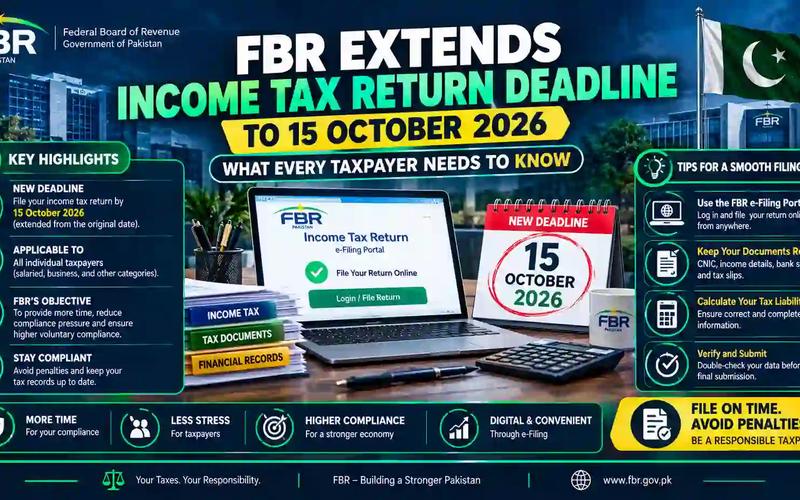
- Submit before the deadline — typically September 30 of each year (extensions are sometimes announced by FBR)
The FBR Tax Asaan mobile app also allows salaried return filing from your phone. For any withholding-related queries, the FBR Withholding Tax Calculator is a useful resource.
Location Spotlight: Pakistan's Major Cities and Salary Tax
Federal income tax rates are uniform across all provinces — whether you work in Lahore, Karachi, Islamabad, Rawalpindi, Peshawar, Faisalabad, Multan, or Quetta. The FBR administers salary tax at the federal level, and the same progressive slab system applies everywhere.
However, provincial taxes do intersect with your financial life:
Punjab employees may encounter PRA (Punjab Revenue Authority) on service transactions. Check our guide on Excise and Taxation Pakistan for provincial context.
Sindh employees dealing with vehicle taxes or token taxes should refer to our Sindh Vehicle Verification Token Tax guide.
Punjab vehicle owners have their own structure — see Punjab Vehicle Verification Token Tax for how vehicle-related taxes work alongside your salary tax obligations.
KPK and Balochistan follow the same FBR federal income tax slabs for salary purposes, with provincial revenue authorities handling their respective service taxes separately.
If you own a vehicle alongside your salary income, understanding vehicle registration fees is also important — our Calculate Vehicle Tax Registration Fee article covers this comprehensively.
Salaried Class vs. Retail Sector: The Ongoing Tax Inequity
It would be incomplete to discuss salary tax in Pakistan without addressing the elephant in the room. Salaried individuals paid PKR 605 billion in income tax in FY 2024-25 — a 55% year-on-year increase — while the retail sector, despite generating massive revenues, contributed a fraction of that amount according to FBR data.
This structural inequity exists because salary income is fully documented and withheld at source. There is no room for underreporting. Retailers, informal traders, and even some professionals in the non-salaried category operate with limited documentation, lower effective tax rates, and far less scrutiny.
Pakistan's IMF Extended Fund Facility has made expanding the tax base — particularly through agricultural income tax at the provincial level and formalizing retail taxation — a conditionality of continued financial support. The FBR revenue target of PKR 15.267 trillion for FY 2026-27 cannot be met on the backs of salaried workers alone.
For salaried individuals in the e-commerce sector or those earning through online sales, understanding how e-commerce sales tax nexus rules interact with your income tax is becoming increasingly important as Pakistan formalizes its digital economy.
The World Bank identified this structural inequity in a 2023 policy note, calling it a systemic problem in Pakistan's fiscal architecture — not an accidental outcome.
Frequently Asked Questions (FAQ)
What is the tax-free income limit in Pakistan 2026?
For FY 2026-27, the minimum taxable income threshold for salaried individuals is PKR 600,000 per year. If your annual salary is PKR 600,000 or below, you pay zero income tax. This is often called the zero-rated income tax slab Pakistan 2026 or the income tax exemption limit for salaried class Pakistan 2026.
How much income tax do I pay on a salary of PKR 100,000 per month?
Your annual income is PKR 1,200,000. The first PKR 600,000 is tax-free. The remaining PKR 600,000 is taxed at 1%, giving you PKR 6,000 per year — or PKR 500 per month. Your net take-home salary is PKR 99,500 per month.
Is the salary surcharge still applicable in 2026-27?
No. The 9% surcharge on salaried individuals with annual income exceeding PKR 10 million has been abolished effective July 1, 2026, as part of the Budget 2026-27 announced by Finance Minister Muhammad Aurangzeb.
What is the difference between salaried and non-salaried tax rates in Pakistan?
Salaried individuals — those whose salary income is more than 75% of their total taxable income — are taxed under specific FBR salaried person tax slabs, which tend to have lower rates. Non-salaried individuals (business owners, AOP, self-employed) face different slab rates and must also pay advance tax. Salaried workers' tax is deducted at source by the employer; non-salaried individuals file and pay tax themselves.
When is the last date to file an income tax return in Pakistan?
The standard deadline for income tax return filing in Pakistan is September 30 of each year. FBR has announced extensions in past years, sometimes pushing the date to October 31 or beyond. Always check the FBR website or the IRIS portal for the confirmed deadline for the relevant tax year. Failing to file attracts a late filing penalty and default surcharge on any unpaid tax.
Does FBR deduct tax automatically from my salary?
No — the FBR does not deduct tax directly. Your employer acts as a withholding agent and is legally required to calculate and deduct income tax from your monthly salary before payment, then deposit it with FBR on your behalf. The FBR receives the payment from your employer. You receive a salary certificate or tax deduction certificate at the end of the year showing the total deducted.
Can I reduce my salary tax legally in Pakistan?
Yes. Legal tax reduction strategies for salaried persons include: claiming medical allowance exemptions, contributing to recognized provident or pension funds, making charitable donations to approved institutions for tax credits, claiming Zakat deducted at source, and ensuring all eligible exemptions under the Income Tax Ordinance 2001 are properly reported in your return. Using the FBR Tax Calculator helps you understand your true liability before and after deductions.
What happens if my employer deducts the wrong amount of salary tax?
If your employer under-deducts, you remain personally liable for the shortfall and must pay the difference when filing your return. If they over-deduct, you can claim a refund when filing. This is one key reason why understanding your own tax bracket is so important — do not assume your payroll department always gets it right.
Conclusion: Know Your Slab, Own Your Money
Pakistan's salary tax system in 2026-27 is more favorable for the salaried class than it has been in recent years — rate cuts across four slabs, abolished surcharge, and a continued zero-tax threshold of PKR 600,000. But the fundamental structural reality remains: salaried workers are Pakistan's most taxed demographic, precisely because they are fully documented and have zero ability to underreport.
The most powerful thing you can do as a salaried individual is understand exactly which tax slab you fall in, verify your monthly deduction is accurate, file your income tax return on time to gain ATL filer status, and claim every legal exemption and deduction you are entitled to.
Do not leave money on the table. Do not assume your employer's payroll system is error-free. And do not wait until September 30 to scramble through your return.
Ready to calculate your exact tax liability right now? Use the Advanced Free Pakistan Salary Tax Calculator offered by Tax Calculators — it applies the latest FBR 2026-27 income tax slabs in real time, shows your monthly deduction, your annual liability, and your exact take-home pay. No guesswork. No waiting. Just accurate numbers instantly.
For deeper research, the FBR's official website at fbr.gov.pk remains the primary authority on all tax ordinances, return forms, and notifications — always verify rate changes directly with FBR or a qualified tax consultant before making financial decisions.
Author Note: This article is written for informational and educational purposes. Income tax slabs are set by the annual Finance Act and may be adjusted by FBR notifications. Always verify current rates at fbr.gov.pk or consult a qualified tax professional before calculating your liability.
Important disclaimer
This article is for educational planning only. It does not provide professional tax, legal, accounting, payroll, customs, or financial advice. Tax rules can change and final results may depend on your personal facts. Always verify important tax decisions with official sources or a qualified professional.
About the author
This article was written by the Tax Calculators Team, the group behind TaxCalculators.tools. Learn more about our team and editorial process.
Last reviewed: June 23, 2026