If you sold stock this year, flipped a rental property, or cashed out crypto, one question probably crossed your mind: how much of that profit does the IRS actually take? The answer depends almost entirely on one thing — how long you held the asset before selling it.
This guide breaks down capital gains tax in plain English: what counts as a capital gain, how short-term and long-term rates differ in 2026, how the IRS actually calculates what you owe, and legitimate ways to lower your bill. Whether you're selling shares, a house, or a business, you'll walk away knowing exactly where you stand.
What Is Capital Gains Tax?
Capital gains tax is the tax you pay on the profit from selling a capital asset — stocks, bonds, real estate, mutual funds, cryptocurrency, collectibles, or a business. You're not taxed on the full sale price. You're taxed only on the gain: the difference between what you sold the asset for and your cost basis (generally what you originally paid, plus certain adjustments).
There are two important distinctions to understand right away:
- Realized vs. unrealized gains — You only owe tax when you actually sell an asset and "realize" the gain. If your stock portfolio doubled in value but you haven't sold anything, you owe nothing yet. That's an unrealized gain.
- Capital gains vs. ordinary income — Capital gains are treated differently from wages, salary, or business income. Depending on how long you held the asset, your gain is taxed either at special preferential rates or at your regular income tax rate.
That second point is the whole ballgame, and it's what the rest of this article is about.
Short-Term vs. Long-Term Capital Gains: The Core Difference
The IRS draws a hard line at exactly one year of ownership.
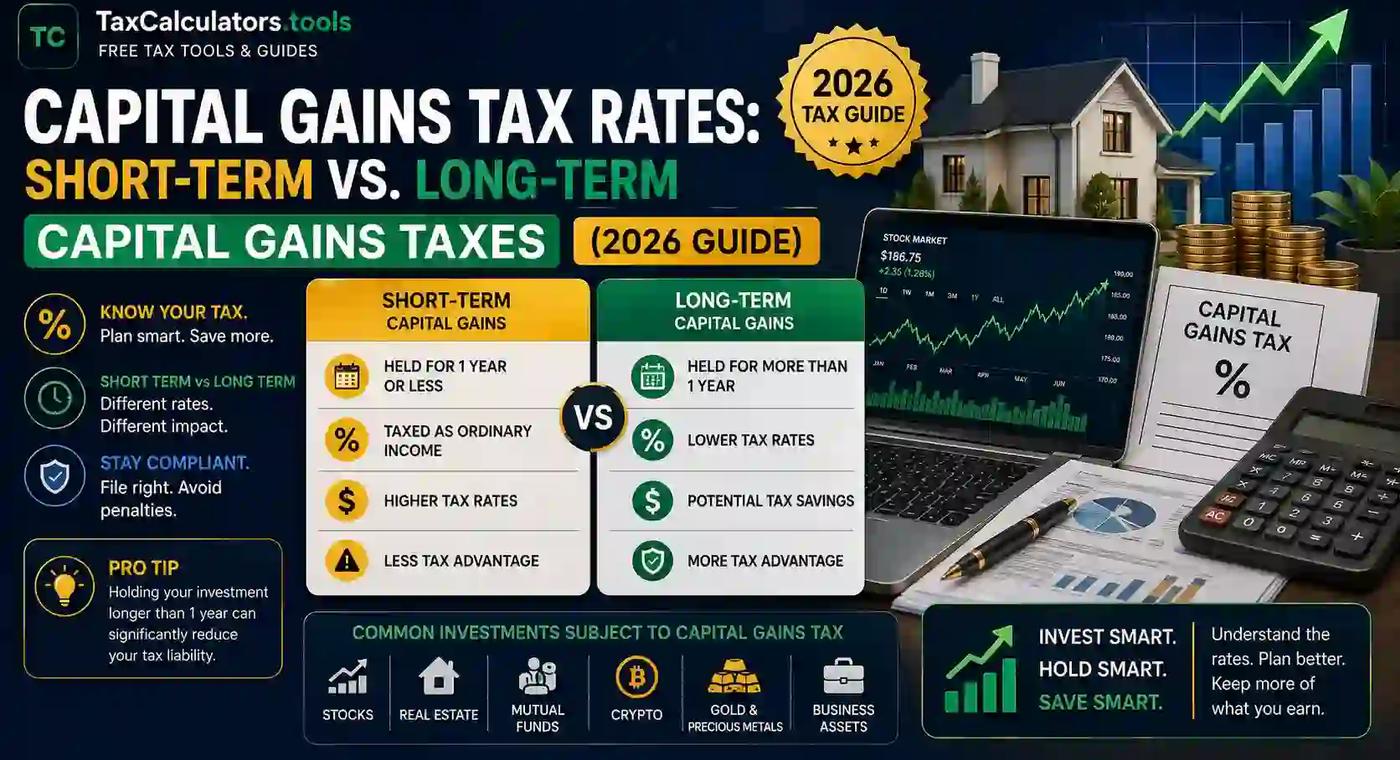
- Short-term capital gains apply to assets held for one year or less. These gains are taxed at your ordinary income tax rate — the same rate that applies to your paycheck.
- Long-term capital gains apply to assets held for more than one year. These gains get preferential tax treatment at 0%, 15%, or 20%, depending on your total taxable income.
This holding-period rule is the single most important concept in capital gains planning. Selling one day before the one-year mark versus one day after can mean paying nearly double the tax on the exact same profit.
"The clock starts the day after you acquire the asset and ends on the day you sell it. Hold it for 366 days instead of 364, and you may qualify for a dramatically lower tax rate on the same dollar of profit."
For a full breakdown of how ordinary income brackets work in general, this federal tax brackets guide is a useful companion read, since short-term gains simply slot into those same brackets.
2026 Short-Term Capital Gains Tax Rates
Short-term gains don't have their own rate schedule. They're added to your other taxable income (wages, interest, self-employment income) and taxed at your marginal ordinary income tax rate. For 2026, the seven federal brackets are:
- 10%
- 12%
- 22%
- 24%
- 32%
- 35%
- 37%
The top 37% bracket kicks in above roughly $640,600 in taxable income for single filers and roughly $768,700 for married couples filing jointly. Because short-term gains stack on top of your other income, a large short-term gain can push you into a higher bracket for that portion of your income — and it may also affect other parts of your return, like eligibility for certain deductions.
If you're self-employed and realize short-term trading gains, it's also worth checking whether those gains change your quarterly estimated tax obligations — see this quarterly estimated tax guide for the self-employed for the mechanics.
2026 Long-Term Capital Gains Tax Rates
This is where the tax code rewards patience. Long-term gains — assets held more than one year — are taxed at just three rates: 0%, 15%, or 20%. For 2026, the taxable income thresholds are:
0% rate:
- Single filers: taxable income up to $49,450
- Married filing jointly: taxable income up to $98,900
15% rate:
- Single filers: taxable income up to $545,500
- Married filing jointly: taxable income up to $613,700
20% rate:
- Single filers: taxable income above $545,500
- Married filing jointly: taxable income above $613,700
These brackets are adjusted every year for inflation, which is why the 2026 figures are slightly higher than 2025's. The IRS confirmed these updated numbers in Revenue Procedure 2025-32.
Here's the part people often miss: your long-term capital gains "stack" on top of your ordinary income to determine which rate applies. The IRS fills your taxable income bucket with wages and other ordinary income first, then layers your capital gains on top. So if your ordinary income already puts you near the top of the 0% bracket, even a modest gain can push part of it into the 15% bracket.
Quick example: A single filer with $40,000 in ordinary taxable income sells stock for a $20,000 long-term gain. The first $9,450 of that gain fills the remaining space in the 0% bracket. The remaining $10,550 gets taxed at 15%. The result isn't "all 0%" or "all 15%" — it's blended.
Net Investment Income Tax (NIIT): The Hidden Extra 3.8%
Higher earners face one more layer on top of the standard capital gains rate: the Net Investment Income Tax, sometimes called the Medicare surtax. This adds an extra 3.8% on investment income — including capital gains, dividends, interest, and rental income — once your modified adjusted gross income (MAGI) crosses:
- $200,000 for single filers
- $250,000 for married filing jointly
Unlike the capital gains brackets, these NIIT thresholds are fixed by statute and are not adjusted for inflation, so more taxpayers get pulled into it every year as incomes rise. Stack it together and a gain taxed at the top long-term rate can effectively cost 23.8%, while a top-bracket short-term gain can effectively approach 40.8%.
How Capital Gains Tax Is Calculated (Step-by-Step)
Calculating what you owe isn't complicated once you break it into steps:
- Determine your cost basis — what you originally paid for the asset, plus commissions, fees, and certain improvements (for real estate).
- Determine the sale price — what you received, minus selling costs like broker commissions or closing costs.
- Subtract cost basis from sale price to get your capital gain (or loss).
- Classify the holding period — one year or less is short-term; more than one year is long-term.
- Apply the correct rate — ordinary income brackets for short-term, or the 0%/15%/20% schedule for long-term.
- Check for NIIT exposure if your income is above the thresholds above.
- Report it on IRS Schedule D and Form 8949, which reconcile every individual sale before rolling the totals into your Form 1040.
If you'd rather skip the manual math, our capital gains tax calculator runs these steps automatically — you enter your income, filing status, and gain, and it estimates the federal tax owed under the current 2026 brackets. It pairs well with our broader federal income tax calculator guide if you want to see how the gain interacts with your total tax picture for the year.
Capital Gains Tax on Stocks
When you sell shares of stock, ETFs, or mutual funds at a profit, the short-term/long-term rule applies exactly as described above. A few nuances specific to stock investors:
- Qualified dividends are taxed at the same preferential 0%/15%/20% rates as long-term capital gains, while non-qualified (ordinary) dividends are taxed as regular income.
- The wash sale rule disallows a tax loss if you sell a security at a loss and buy a substantially identical one within 30 days before or after the sale — a common trap for people trying to harvest losses too aggressively.
- Tax-loss harvesting lets you sell losing positions to offset gains elsewhere in your portfolio, which is one of the few fully legal ways to actively reduce your bill.
- Capital losses can offset capital gains dollar-for-dollar, and up to $3,000 of net losses can offset ordinary income each year, with any excess carried forward to future tax years.
Capital Gains Tax on Real Estate
Selling a house or investment property follows the same core rule — but with a few valuable exceptions.
The home sale exclusion (Section 121): If you sell your primary residence and you've owned and lived in it for at least two of the last five years, you can exclude up to $250,000 of gain ($500,000 for married couples filing jointly) from capital gains tax entirely. This is one of the most generous tax breaks available to ordinary taxpayers, and it applies whether you've owned the home five years or thirty.
Investment and rental property: No home-sale exclusion applies here. Gains are taxed under the standard short-term/long-term rules, and if you've claimed depreciation on the property, a portion of the gain may be subject to depreciation recapture, taxed at a rate of up to 25%.
1031 exchanges: Real estate investors can defer capital gains tax entirely by rolling proceeds from one investment property into another "like-kind" property, as long as strict IRS timelines and rules are followed.
If you're weighing whether to itemize deductions related to a real estate sale, our standard vs. itemized deductions guide walks through how that decision affects your overall taxable income — which, as shown above, directly determines your capital gains bracket.
Capital Gains Tax on Cryptocurrency
The IRS treats cryptocurrency as property, not currency, which means every sale, trade, or use of crypto to buy goods is a taxable event. The same short-term/long-term distinction applies: crypto held one year or less before selling is taxed at ordinary rates, while crypto held longer qualifies for the 0%/15%/20% long-term rates. Because crypto transactions can be frequent and complex, keeping a clean transaction log with dates, cost basis, and sale prices is essential — this is one area where the IRS has significantly increased enforcement in recent years.
Capital Gains Tax on Inherited Property
Inherited assets get a major benefit called the step-up in basis. Instead of using what the deceased person originally paid, your cost basis becomes the asset's fair market value on the date of death. If you sell shortly after inheriting, there may be little or no taxable gain at all — even if the original owner held the asset for decades and it appreciated enormously. Inherited property is also automatically treated as long-term, regardless of how briefly you actually held it before selling.
Does Capital Gains Tax Vary by State?
Yes — significantly. Federal capital gains tax applies everywhere, but state treatment varies widely:
- No state capital gains tax: Alaska, Florida, Nevada, South Dakota, Tennessee, Texas, and Wyoming have no state income tax at all, so gains aren't taxed at the state level.
- New Hampshire taxes only certain interest and dividend income, not capital gains from asset sales.
- Washington State has no general income tax but does apply a state capital gains excise tax to long-term gains above an inflation-adjusted threshold for high earners — an important exception if you live there.
- Most other states (including California and New York) tax capital gains as ordinary income at their regular state income tax rates, on top of federal tax.
If you're comparing your total tax burden by location, our state income tax calculator can help you see how state-level treatment stacks on top of the federal numbers covered here.
Strategies to Legally Reduce Capital Gains Tax
There's no way to avoid capital gains tax if you have a genuine profit and no applicable exclusion — but there are several legitimate ways to reduce or defer it:
- Hold assets longer than one year to qualify for long-term rates instead of ordinary income rates.
- Harvest losses to offset gains elsewhere in your portfolio before year-end.
- Time your sale for a year when your other income is lower, potentially landing in the 0% long-term bracket.
- Use the home sale exclusion if you're selling a primary residence you've lived in for two of the past five years.
- Consider a 1031 exchange for investment real estate to defer gains into a replacement property.
- Donate appreciated securities directly to charity instead of cash — you avoid the capital gains tax entirely and may still get a charitable deduction.
- Hold investments until death when possible, so heirs receive a stepped-up basis.
- Max out tax-advantaged accounts like 401(k)s and IRAs, where gains grow without triggering annual capital gains tax.
None of these require aggressive or questionable tax positions — they're standard planning tools recognized by the IRS.
Real-World Example: Same Gain, Two Different Tax Bills
Consider two investors, both single filers with $70,000 in other taxable income, each selling an asset for a $30,000 profit:
Investor A held the asset for 10 months (short-term). The $30,000 gain is taxed as ordinary income, stacking on top of their $70,000 in wages — pushing a chunk of it into the 22% bracket. Their federal tax on the gain alone could run close to $6,000–$7,000.
Investor B held the identical asset for 13 months (long-term). Because their combined taxable income of $100,000 falls mostly within the 15% long-term bracket, their federal tax on the same $30,000 gain is roughly $4,500.
Same asset, same profit, same income level — but three extra months of holding time saved Investor B over a thousand dollars. That's the entire logic behind long-term capital gains treatment in a single comparison.
Final Thoughts: Timing Is Everything
Capital gains tax isn't about avoiding tax on your investments — it's about understanding the rules well enough to keep more of what you legitimately earn. The one-year holding period is the single biggest lever most investors control directly, and knowing where your income lands within the 0%/15%/20% brackets can shape when you choose to sell.
Before you file, run your numbers through our free capital gains tax calculator to see exactly how a sale affects your federal tax bill under the current 2026 brackets. And if you want the bigger picture of how capital gains interact with your total return, explore our advanced free tax calculators covering federal income tax, self-employment tax, and state-by-state comparisons.
For official guidance straight from the source, the IRS Topic No. 409 – Capital Gains and Losses page is the authoritative reference for current rules, and a licensed tax professional can help you apply these strategies to your specific situation.
Frequently asked questions
What is the capital gains tax rate for 2026?
Long-term capital gains are taxed at 0%, 15%, or 20% depending on taxable income and filing status. Short-term gains (assets held one year or less) are taxed at ordinary income rates ranging from 10% to 37%.
Is capital gains tax the same as income tax?
Not exactly. Short-term capital gains are taxed at the same rates as ordinary income, but long-term capital gains get their own preferential 0%/15%/20% rate schedule, which is typically lower than standard income tax brackets.
How do I avoid capital gains tax legally?
Common legal strategies include holding assets longer than one year, harvesting investment losses, using the primary residence exclusion, donating appreciated stock to charity, and using tax-advantaged retirement accounts.
What qualifies as a long-term capital gain?
Any profit from selling a capital asset you owned for more than one year before the sale date. Inherited assets automatically qualify as long-term regardless of how long you personally held them.
Do seniors pay capital gains tax?
Yes — there is no blanket age-based exemption from capital gains tax. However, seniors selling a primary home can still use the standard $250,000/$500,000 home sale exclusion, and many retirees fall into lower income brackets that qualify for the 0% long-term rate.
What states have no capital gains tax?
Alaska, Florida, Nevada, South Dakota, Tennessee, Texas, and Wyoming have no state income tax, so state-level capital gains tax doesn't apply. Washington has no general income tax but does tax high earners' long-term gains above a set threshold.
Can capital losses offset ordinary income?
Yes, but only up to $3,000 per year ($1,500 if married filing separately) after fully offsetting any capital gains. Any remaining losses carry forward to future tax years indefinitely.
Important disclaimer
This article is for educational planning only. It does not provide professional tax, legal, accounting, payroll, customs, or financial advice. Tax rules can change and final results may depend on your personal facts. Always verify important tax decisions with official sources or a qualified professional.
About the author
This article was written by the Tax Calculators Team, the group behind TaxCalculators.tools. Learn more about our team and editorial process.
Last reviewed: August 29, 2026