If you have ever looked at your payslip and wondered why there is a deduction labeled "income tax" — or heard a colleague argue that "salary tax and income tax are two different things" — you are not alone. This is one of the most searched and most misunderstood tax questions in Pakistan.
Here is the short answer: salary tax is not a separate tax. It is simply income tax applied specifically to salary income. But the way it works, the rates that apply, and what you can deduct? That is where everything gets interesting — and where most Pakistanis unknowingly overpay thousands of rupees every year.
This guide breaks it all down in plain language. Whether you are a government employee in Islamabad, a private sector professional in Karachi, a contractual worker in Lahore, or an overseas Pakistani trying to understand your tax obligations — this article covers everything you need to know for FY 2025–26.
What Is Income Tax in Pakistan?
Income tax in Pakistan is a direct tax levied by the Federal Government under the Income Tax Ordinance 2001, administered by the Federal Board of Revenue (FBR). It applies to the worldwide income of resident individuals and to Pakistan-source income of non-resident individuals.
Under the Income Tax Ordinance 2001, all income is divided into five heads:
- Salary — income received from employment
- Business income — income from trade, profession, or commerce
- Property income — rental income from immovable property
- Capital gains — profit from disposal of assets
- Income from other sources — dividends, profit on debt, etc.
Income tax applies to all five heads. The rates, however, differ significantly depending on which head your income falls under. This is the critical point that most people miss.
As the PwC Pakistan Tax Summary explains, the tax rates that apply where income from salary exceeds 75% of taxable income are separate — and generally more favorable — than the rates applied to non-salaried or business income earners. You can verify the latest official framework directly at fbr.gov.pk.
What Is Salary Tax in Pakistan?
Salary tax is not a standalone tax code. It is income tax — specifically calculated and collected under Section 149 of the Income Tax Ordinance 2001 — on income that falls under the head "Salary."
The FBR defines salary income broadly. Under Section 12 of the Income Tax Ordinance 2001, salary includes:
- Basic pay and wages
- Leave pay and overtime
- Bonuses and commissions
- Gratuity and compensation payments
- House rent allowance (HRA)
- Medical allowances
- Conveyance and travel allowances
- Perquisites — company car, subsidized housing, employer-paid utilities
- Pension and annuity payments
- Golden handshake and termination payments
"Any salary received by an employee in a tax year, other than salary that is exempt from tax under this Ordinance, shall be chargeable to tax in that year under the head Salary." — Income Tax Ordinance 2001, Section 12(1)
In plain terms: everything your employer gives you — cash or kind — is counted as salary unless FBR has specifically exempted it.
To understand exactly how your Pakistan salary tax is calculated under the latest FBR rules, visit our detailed guide: Pakistan Salary Tax Calculator 2026 Guide.
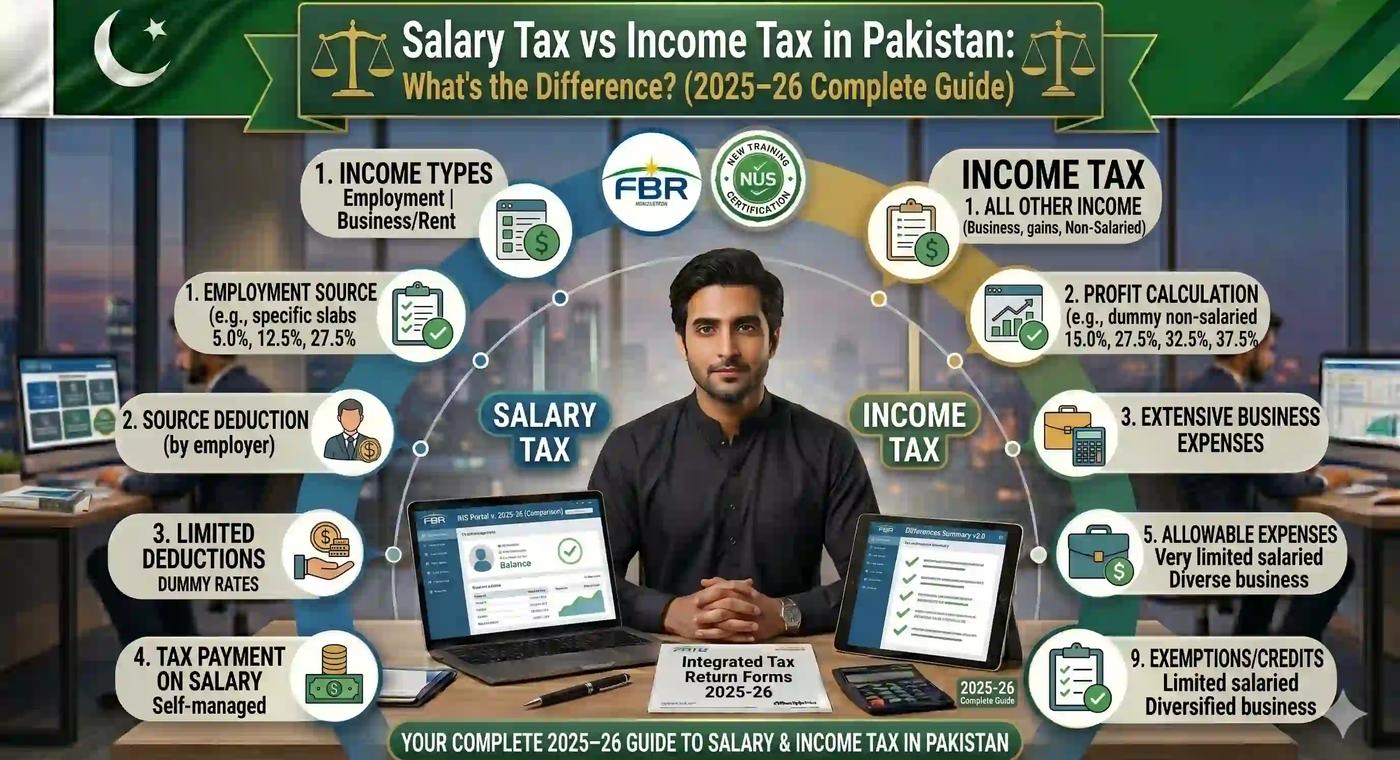
Salary Tax vs Income Tax in Pakistan: What Is the Actual Difference?
Let us settle this once and for all with a clear comparison.
| Salary Tax vs Income Tax in Pakistan: What Is the Actual Difference? | ||
|---|---|---|
| Factor | Salary Tax | Income Tax (Non-Salaried) |
| Legal name | Income tax under head "Salary" | Income tax under head "Business" or "Other Sources" |
| Who it applies to | Employees receiving salary | Businessmen, traders, freelancers, AOPs |
| Tax rates (2025–26) | Lower, preferential rates (1%–35%) | Slightly higher rates at equivalent income |
| Collection method | Employer withholds monthly (Section 149) | Self-assessed, advance tax payments |
| Tax return required? | Yes (by September 30 each year) | Yes (by September 30 each year) |
| Surcharge | 9% on income above PKR 10 million | 10% on income above PKR 10 million |
| FBR definition of taxpayer | Salary constitutes more than 75% of total taxable income | Business/other sources constitute 75% or more of income |
The bottom line: salary tax and income tax are the same legal tax. The difference lies in which income slab rates apply to you, how the tax is collected, and what deductions you are entitled to claim.
For a full breakdown of how these tax slabs have evolved year by year, read our detailed post: Pakistan Salary Tax Slabs Breakdown.
Who Is a Salaried Person Under FBR Pakistan?
This is a question with a very specific legal answer that matters enormously for your tax calculation.
According to the Income Tax Ordinance 2001, you are treated as a salaried individual if:
- Your income from salary exceeds 75% of your total taxable income for the year
- You receive a regular payslip, pay cheque, or remuneration from an employer
- You are a government servant, public sector employee, private sector employee, or contractual employee on payroll
- You are a teacher or researcher at a recognized educational institution
If you earn a salary but also run a side business, your dominant income source determines your tax category. If business income crosses the 25% mark of your total income, you may no longer qualify for the preferential salaried tax rates — and this can significantly change your tax bill. In such situations, always consult a certified tax advisor.
FBR Income Tax Slabs for Salaried Persons 2025–26
The Finance Act 2025 delivered the most significant rate reductions for the salaried class in recent years. Here are the official FBR income tax slabs for salaried individuals effective from July 1, 2025 to June 30, 2026:
| FBR Income Tax Slabs for Salaried Persons 2025–26 | ||
|---|---|---|
| Annual Income | Tax Rate | Tax Payable |
| Up to Rs. 600,000 | 0% | Nil — fully tax-free |
| Rs. 600,001 – Rs. 1,200,000 | 1% | 1% of amount exceeding Rs. 600,000 |
| Rs. 1,200,001 – Rs. 2,200,000 | 11% | Rs. 6,000 + 11% of excess over Rs. 1,200,000 |
| Rs. 2,200,001 – Rs. 3,200,000 | 23% | Rs. 116,000 + 23% of excess over Rs. 2,200,000 |
| Rs. 3,200,001 – Rs. 4,100,000 | 30% | Rs. 346,000 + 30% of excess over Rs. 3,200,000 |
| Above Rs. 4,100,000 | 35% | Rs. 616,000 + 35% of excess over Rs. 4,100,000 |
Important: An additional 9% surcharge applies to salaried individuals whose taxable income exceeds PKR 10 million per year.
Real-World Salary Tax Examples (2025–26)
Let us translate these slabs into actual rupees.
Example 1: Rs. 50,000 monthly salary (Rawalpindi, government employee)
- Annual income: Rs. 600,000
- Tax: Rs. 0
- Monthly deduction: Rs. 0
- Fully tax-free under current slabs.
Example 2: Rs. 100,000 monthly salary (Lahore, private sector)
- Annual income: Rs. 1,200,000
- Tax calculation: 1% × (1,200,000 − 600,000) = Rs. 6,000 per year
- Monthly deduction: Rs. 500
- Saving vs 2024–25: Rs. 9,000 per year
Example 3: Rs. 150,000 monthly salary (Karachi, corporate professional)
- Annual income: Rs. 1,800,000
- Tax calculation: Rs. 6,000 + 11% × (1,800,000 − 1,200,000) = Rs. 72,000 per year
- Monthly deduction: Rs. 6,000
Example 4: Rs. 500,000 monthly salary (Islamabad, senior executive)
- Annual income: Rs. 6,000,000
- Tax calculation: Rs. 616,000 + 35% × (6,000,000 − 4,100,000) = Rs. 1,281,000 per year
- Monthly deduction: Rs. 106,750
Don't want to calculate manually? Use the free Advanced Salary Tax Calculator at Tax Calculators to get your exact monthly and annual tax in seconds.
Income Tax Slabs for Non-Salaried Individuals and AOPs (2025–26)
For comparison, here are the tax rates that apply to non-salaried individuals — businessmen, sole proprietors, freelancers, traders, and Associations of Persons (AOPs):
| Income Tax Slabs for Non-Salaried Individuals and AOPs (2025–26) | |
|---|---|
| Annual Income | Tax Rate |
| Up to Rs. 600,000 | 0% |
| Rs. 600,001 – Rs. 1,200,000 | 2% of excess |
| Rs. 1,200,001 – Rs. 2,200,000 | Rs. 12,000 + 22% of excess |
| Rs. 2,200,001 – Rs. 3,200,000 | Rs. 232,000 + 46% of excess |
| Rs. 3,200,001 – Rs. 4,100,000 | Rs. 692,000 + 60% of excess |
| Above Rs. 4,100,000 | Rs. 1,232,000 + 70% of excess |
Notice the dramatic difference. A business owner earning Rs. 1,200,000 annually pays Rs. 12,000 in income tax — double the Rs. 6,000 that a salaried person at the same income level pays. At higher income levels, the gap becomes even more pronounced.
"Salaried income is the most fully documented income stream in Pakistan's tax system. Employers are legally required to withhold tax before the salary even reaches the employee's bank account, leaving no room for underreporting or delay."
This is precisely why Pakistan's tax policy grants salaried individuals lower rates — their income is already fully documented, reported, and collected automatically.
How Is Salary Tax Collected in Pakistan? (Withholding Tax on Salary)
This is where salary tax differs fundamentally from other forms of income tax in its collection mechanism.
Under Section 149 of the Income Tax Ordinance 2001, your employer is legally required to:
- Estimate your annual salary at the start of each tax year
- Apply the applicable FBR slab rates to calculate your annual tax liability
- Divide that annual tax by 12 to determine your monthly withholding amount
- Deduct the tax from your salary every month before payment
- Deposit the withheld amount to FBR on a monthly basis
- Provide you with a Form 16 (Tax Deduction Certificate) at year-end
- Submit a salary statement to FBR at the close of the tax year
This is called tax deduction at source or withholding tax on salary. You never handle the tax payment yourself — your employer does it on your behalf.
However — and this is crucial — even if your employer is withholding correctly, you are still required to file your own annual income tax return by September 30 each year through the FBR IRIS portal. Filing allows you to claim refunds, maintain filer status, and legally access lower withholding tax rates on hundreds of everyday transactions.
For a step-by-step walkthrough of the IRIS filing process, refer to our complete guide: FBR IRIS Login Guide.
Tax Deductions That Reduce Your Salary Tax in Pakistan
Here is where most salaried Pakistanis leave money on the table. The FBR allows several legitimate deductions and tax credits that can significantly reduce your taxable income — legally.
1. House Rent Allowance (HRA) Exemption
The lower of 45% of your basic salary or the actual rent paid is exempt from income tax. For example, if your basic salary is Rs. 80,000 and you receive Rs. 40,000 as HRA, you can claim up to Rs. 36,000 (45% of Rs. 80,000) as tax-exempt — provided you keep your rent agreement as proof.
2. Medical Allowance Exemption
Up to 10% of basic salary or Rs. 10,000 per month (whichever is lower) qualifies as tax-exempt medical allowance. If your basic pay is Rs. 60,000, that is Rs. 6,000 per month or Rs. 72,000 per year exempt from income tax.
3. Zakat Deduction (Section 60)
Compulsory Zakat deducted under the Zakat and Ushr Ordinance 1980 is fully deductible from your taxable salary income. This directly reduces your net taxable income before FBR slab rates are applied.
4. Pension Fund Contributions (Section 63)
Voluntary contributions to an approved pension fund are eligible for tax credits. The deduction is allowed for the lower of 20% of your taxable income or Rs. 500,000 per year. This is one of the most powerful legal tax-saving tools available to salaried persons in Pakistan.
5. Life Insurance Premium Tax Credit (Section 62)
Premiums paid on life insurance policies are eligible for a tax credit — up to Rs. 150,000 or 100% of the premium paid, whichever is lower, under Section 62 of the Income Tax Ordinance 2001.
6. Charitable Donations Tax Credit
Donations to FBR-approved charitable organizations and institutions listed in the Second Schedule of the Income Tax Ordinance are deductible — subject to a limit of 30% of your taxable income.
7. Teacher and Researcher Special Rebate
If you are a teacher or researcher at a recognized educational institution, you are entitled to a 25% reduction on your calculated income tax liability. This is not a full exemption — but it results in significant annual savings for educators across Pakistan, from Peshawar to Karachi.
8. First Home Loan Interest (Section 64A)
Interest paid on a housing loan for your first home is deductible up to Rs. 2 million per year. A highly underutilized relief for first-time homebuyers.
Filer vs Non-Filer in Pakistan: Why It Matters for Salary Tax
The difference between being a tax filer (appearing on FBR's Active Taxpayer List / ATL) and a non-filer goes far beyond annual tax return compliance. It directly affects how much you pay on dozens of everyday financial transactions.
| Filer vs Non-Filer in Pakistan: Why It Matters for Salary Tax | ||
|---|---|---|
| Transaction | Filer Rate | Non-Filer Rate |
| Bank profit tax | 15% | 35% |
| Property purchase withholding tax | 3% | 10.5% |
| Vehicle registration tax | Normal rate | Double rate |
| Dividend income tax | 15% | 30% |
| Foreign card transactions | 1% | 2% |
"Being an active filer literally saves you money on every major financial transaction. The cost of not filing your return is often far higher than any tax you might owe."
For salaried employees in Islamabad, Lahore, Karachi, Multan, Faisalabad, and across Pakistan — becoming a filer is one of the most financially sensible decisions you can make. Filing your return through IRIS at iris.fbr.gov.pk takes less time than most people think, and the financial benefits compound year after year.
If you have questions about property-related tax obligations, our guide on FBR Property Tax DC Rates Pakistan 2026 gives you the full picture.
Income Tax 2024–25 vs 2025–26: How Much Did the Salaried Class Save?
The Finance Act 2025-26 delivered meaningful relief to Pakistan's salaried middle class. Here is a side-by-side comparison for common salary levels:
| Income Tax 2024–25 vs 2025–26: How Much Did the Salaried Class Save? | |||
|---|---|---|---|
| Monthly Salary | Annual Tax (2024–25) | Annual Tax (2025–26) | Annual Saving |
| Rs. 50,000 | Rs. 0 | Rs. 0 | Rs. 0 |
| Rs. 100,000 | Rs. 15,000 | Rs. 6,000 | Rs. 9,000 |
| Rs. 150,000 | Rs. 66,000 | Rs. 72,000 | Slight increase |
| Rs. 200,000 | Rs. 141,000 | Rs. 116,000 | Rs. 25,000 |
| Rs. 300,000 | Rs. 346,000 | Rs. 232,000 | Rs. 114,000 |
The most dramatic relief was in the second slab — the rate dropped from 2.5% to just 1% for income between Rs. 600,001 and Rs. 1,200,000. The National Assembly Standing Committee on Finance specifically advocated for this reduction following strong pressure from the salaried class advocacy groups.
Tax on Specific Salary Components: What Is Taxable and What Is Not?
Not everything on your payslip is taxable. Here is a practical breakdown:
Generally taxable components:
- Basic pay and wages
- Overtime pay
- Bonuses and performance incentives
- Commission income
- Employer-paid vehicle perquisite value (as per FBR schedule)
- Employer-provided housing (above exempt value)
Potentially exempt or partially exempt components:
- House rent allowance — exempt up to 45% of basic salary
- Medical allowance — exempt up to 10% of basic salary or Rs. 10,000/month
- Conveyance allowance — partially exempt under FBR rules
- Gratuity — exempt up to specified limits on retirement
- Pension — generally exempt from tax for government employees
- EOBI contributions — not taxable
Understanding these distinctions is critical for salaried persons in every sector — from WAPDA employees and army personnel to private sector professionals and contractual workers across Punjab, Sindh, KPK, and Balochistan.
For vehicle-related tax questions — which often come up alongside salary discussions — you can explore our guides on Punjab Vehicle Verification and Token Tax and Sindh Vehicle Verification Token Tax.
How to File Your Income Tax Return as a Salaried Employee in Pakistan
Filing your annual income tax return is not as complicated as it sounds. Here is the step-by-step process:
Step 1 — Register on FBR IRIS Visit iris.fbr.gov.pk and register using your CNIC. You will receive a password via SMS on your registered mobile number.
Step 2 — Collect your documents
- Salary slips for the year
- Form 16 (Annual Tax Deduction Certificate) from your employer
- Bank statements
- Proof of deductions claimed (rent receipts, Zakat certificates, insurance premium receipts)
Step 3 — Log in and select the relevant return form Salaried individuals use the standard individual return form available on IRIS.
Step 4 — Enter salary income details Enter your gross annual salary, allowances received, and all exempt amounts separately.
Step 5 — Claim your deductions Enter Zakat paid, pension contributions, life insurance premiums, and any other eligible deductions under the respective sections.
Step 6 — Reconcile withholding tax Cross-check the withholding tax shown in your IRIS account against your Form 16. If your employer deducted more than your actual liability, a refund will be calculated automatically.
Step 7 — Submit and pay any balance Submit the return by September 30 of each year. If tax is payable, generate a PSID and pay through your bank or via 1-Link on IRIS.
Missing the deadline attracts a penalty of Rs. 1,000 per month (minimum Rs. 10,000) plus a 12% annual default surcharge on unpaid tax. Do not delay.
For a detailed FBR IRIS login and filing walkthrough, read: FBR IRIS Login Guide.
Pakistan Tax System Explained: Direct vs Indirect Tax
Many people confuse salary tax and income tax with other taxes like GST. Here is the distinction at a glance:
Direct taxes — paid directly by the person on whom the tax is levied:
- Income tax (including salary tax)
- Capital gains tax
- Super tax on corporations
Indirect taxes — collected from an intermediary and passed on to the consumer:
- General Sales Tax (GST) — currently 18% on most goods
- Federal Excise Duty (FED)
- Customs duty
Income tax — whether on salary or business income — is always a direct tax. GST on the goods you buy is an indirect tax. These are entirely different legal frameworks. Understanding the broader tax landscape — including Excise and Taxation in Pakistan and Excise and Taxation Islamabad Online Verification — helps you stay compliant across all your tax obligations, not just salary tax.
Why You Should Use a Salary Tax Calculator Pakistan (Not a Manual Guess)
Manual tax calculation is error-prone. With progressive slabs, partial exemptions, Zakat deductions, and pension credits all interacting simultaneously, even a small mistake costs you thousands of rupees — either through overpayment or FBR penalties for underpayment.
A reliable salary tax calculator Pakistan 2025–26 applies the exact FBR-approved slab rates, accounts for all allowances, and shows your take-home salary in real time.
Using the free Advanced Salary Tax Calculator at Tax Calculators you can:
- Enter your monthly or annual gross salary
- Apply all FBR-approved exemptions (medical allowance, HRA, pension)
- Calculate your exact annual and monthly tax liability
- Compare across fiscal years — 2024–25 vs 2025–26 vs 2026–27
- Determine your take-home (net) salary instantly
Whether you are a salaried professional in Karachi, a government officer in Islamabad, a teacher in Peshawar, or an overseas Pakistani trying to understand your local tax obligations — the calculator does the work in under 10 seconds.
👉 Use the Advanced Free Salary Tax Calculator — Tax Calculators
Frequently Asked Questions (FAQs)
Is salary tax the same as income tax in Pakistan?
Yes. Salary tax is not a separate tax. It is income tax applied to salary income under the head "Salary" as defined in Section 12 of the Income Tax Ordinance 2001. The term "salary tax" is commonly used to describe the income tax deducted by employers from employees' salaries each month.
Who qualifies as a salaried person under FBR Pakistan?
Under the Income Tax Ordinance 2001, you qualify as a salaried person if your income from salary exceeds 75% of your total taxable income for the year. This includes government employees, private sector employees, contractual workers, teachers, and researchers at recognized institutions.
What is the tax-free income limit for salaried persons in Pakistan 2025–26?
Annual income up to Rs. 600,000 — which equals Rs. 50,000 per month — is completely tax-free for salaried individuals under the FBR income tax slabs 2025–26.
What is the maximum income tax rate for salaried persons in Pakistan?
The maximum rate is 35%, applicable on the portion of annual income exceeding Rs. 4,100,000. Additionally, a 9% surcharge applies to salaried individuals whose total taxable income exceeds Rs. 10 million per year.
What changed in income tax slabs from 2024–25 to 2025–26?
The Finance Act 2025 reduced tax rates significantly across lower and middle income brackets. Most notably, the second slab rate dropped from 2.5% to 1% (for income Rs. 600,001 to Rs. 1,200,000), and the third slab rate dropped from 15% to 11%. A salaried person earning Rs. 100,000 per month now saves Rs. 9,000 per year compared to 2024–25.
Can I file my own income tax return as a salaried employee in Pakistan?
Absolutely. The FBR IRIS portal at iris.fbr.gov.pk allows salaried individuals to file their annual returns online using either the Wizard view (for beginners) or the normal view (for professionals). Self-filing is free, straightforward, and keeps you on the Active Taxpayer List (ATL) — which saves you money on dozens of everyday transactions.
What is the difference between a filer and non-filer in Pakistan?
A filer is registered on FBR's Active Taxpayer List (ATL) and files their annual income tax return. Filers enjoy significantly lower withholding tax rates on property purchases, vehicle registration, bank profits, dividends, and investments. Non-filers pay double or higher rates on most of these transactions — making non-filer status financially very costly over time.
What is withholding tax on salary in Pakistan?
Withholding tax on salary is the income tax deducted by your employer from your monthly salary before payment, under Section 149 of the Income Tax Ordinance 2001. Your employer calculates your estimated annual tax, divides it by 12, and deducts that amount every month. The total is deposited to FBR on your behalf.
Is Zakat deductible from income tax in Pakistan?
Yes. Compulsory Zakat deducted under the Zakat and Ushr Ordinance 1980 is fully deductible from your taxable salary income under Section 60 of the Income Tax Ordinance 2001. This reduces your net taxable income before FBR slab rates are applied.
Do teachers get a tax rebate in Pakistan?
Yes. Teachers and researchers employed at recognized educational institutions qualify for a 25% reduction on their calculated income tax liability. This is not a full exemption but represents a meaningful annual saving for educators throughout Pakistan.
Conclusion: Your Salary Tax, Simplified
Let us wrap it up simply.
Salary tax and income tax in Pakistan are the same thing. Salary tax is just income tax applied to employment income, collected monthly by your employer through withholding, and governed by the Income Tax Ordinance 2001. The rates are preferential for salaried persons compared to non-salaried or business income — a deliberate policy choice because salaried income is fully documented and automatically reported.
For FY 2025–26, the Finance Act has brought meaningful relief — especially for middle-income earners between Rs. 600,000 and Rs. 3.2 million annually. Filing your tax return is not just a legal obligation; it is a financial strategy that puts real money back in your pocket through lower withholding rates and refund claims.
The smartest thing a salaried person in Pakistan — whether in Karachi, Lahore, Islamabad, Rawalpindi, Peshawar, Quetta, or anywhere in between — can do right now is two things:
- Know your correct tax slab — and make sure your employer is calculating it right
- File your annual return — and claim every legal deduction you are entitled to
Not sure where your salary falls? Don't guess.
👉 Use the Advanced Free Salary Tax Calculator at Tax Calculators — Calculate Your Exact Tax in Seconds
Also explore our related guides for complete tax compliance across all areas:
- Pakistan Salary Tax Slabs Breakdown — Year by Year
- FBR IRIS Login Guide — How to File Your Return
- FBR Property Tax DC Rates Pakistan 2026
- Punjab Vehicle Verification and Token Tax
- Sindh Vehicle Verification Token Tax
- Excise and Taxation Pakistan — Complete Overview
- Vehicle Tax Registration Fee Calculator Pakistan
- Vehicle Verification Token Tax Pakistan — Province Comparison
Disclaimer: All tax slabs and rates in this article are based on the Finance Act 2025-26 and official FBR notifications effective July 1, 2025. Tax laws are subject to change. Always verify current rates at fbr.gov.pk or consult a qualified chartered accountant before making financial decisions.
Important disclaimer
This article is for educational planning only. It does not provide professional tax, legal, accounting, payroll, customs, or financial advice. Tax rules can change and final results may depend on your personal facts. Always verify important tax decisions with official sources or a qualified professional.
About the author
This article was written by the Tax Calculators Team, the group behind TaxCalculators.tools. Learn more about our team and editorial process.
Last reviewed: June 26, 2026