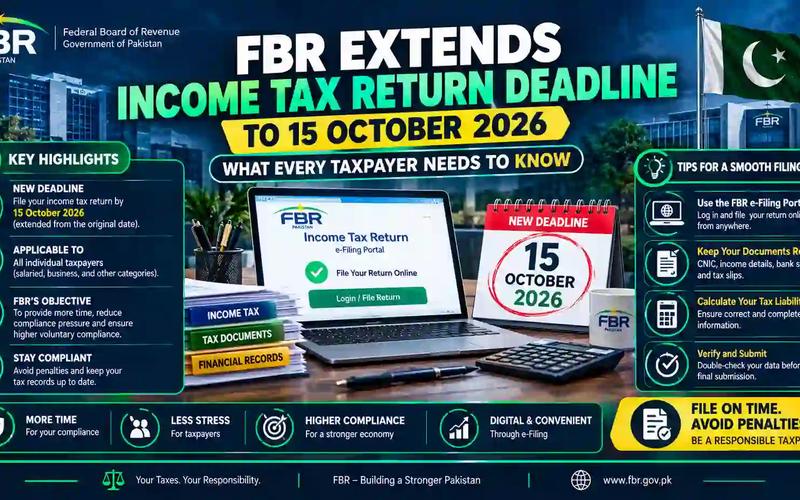

If you earn a salary, run a business, or own property in Pakistan, one date matters more than almost any other on your financial calendar: September 30, 2026. That's the official FBR income tax return deadline for Tax Year 2026, and missing it costs real money — starting at Rs. 1,000 per day plus loss of your Active Taxpayer List status.
This guide breaks down exactly who must file, the exact deadlines for every taxpayer category, what penalties actually apply under the law, and how to file correctly the first time. Whether you're a salaried employee, a freelancer, an AOP partner, or a company director, you'll find the answer you need here — in plain language, backed by the Income Tax Ordinance 2001.
What Is the Income Tax Return Filing Deadline in Pakistan for 2026?
The Federal Board of Revenue has set September 30, 2026 as the last date to file income tax returns in Pakistan for individuals, salaried persons, and Associations of Persons (AOPs). Companies with a June 30 year-end get extra time, until December 31, 2026.
Tax Year 2026 covers income earned between July 1, 2025 and June 30, 2026. So when you sit down to file in September, you're reporting everything you earned during that twelve-month window — salary, rental income, business profit, capital gains, and anything else taxable under Pakistani law.
This isn't a new rule invented for 2026. FBR uses the same September 30 / December 31 pattern almost every year, though it has occasionally granted short extensions through an SRO notification when the IRIS portal gets overloaded or when tax authorities want to give late registrants breathing room.
Why the FBR Tax Return Deadline Actually Matters
Filing on time isn't just about avoiding a fine. It's the gateway to your Active Taxpayer List (ATL) status, which directly affects how much tax gets withheld on your everyday transactions — bank profit, property purchases, vehicle registration, and even mobile phone bills.
A filer on the ATL typically pays a fraction of what a non-filer pays on the same transaction. Miss the deadline, and you're automatically bumped into non-filer territory until you pay a separate surcharge to get reinstated.
For businesses, there's a second layer: staying compliant with FBR keeps you eligible for government contracts, smoother banking relationships, and fewer chances of a formal notice or audit.
Key Dates for Tax Year 2026 at a Glance
Here's the full picture so you don't have to hunt for it elsewhere:
- Tax Year 2026 period: July 1, 2025 – June 30, 2026
- IRIS filing window opens: July 1, 2026
- Deadline for individuals, salaried persons, AOPs: September 30, 2026
- Deadline for companies (June year-end): December 31, 2026
- Deceased taxpayers: Return due by the standard deadline, or within 6 months of the legal representative's appointment, whichever is later
- Special tax year (FBR-approved): Return due 6 months after the special year ends
Deadline for Salaried Individuals and AOPs
If you're a salaried employee or part of an Association of Persons, mark September 30, 2026 clearly. This is a hard statutory deadline under the Income Tax Ordinance, and it applies whether you're filing for the first time or the tenth.
Deadline for Companies
Companies with a standard June 30 financial year-end get until December 31, 2026 — three extra months compared to individuals. This gap exists because corporate returns typically require audited financial statements, which take longer to prepare.
Who Falls Under the Tax Year 2026 Window
Anyone who owned property, held bank accounts above a certain threshold, ran a business, earned salary income, or received rental income between July 2025 and June 2026 generally falls under this filing requirement — even if their final tax liability turns out to be zero.
Who Must File an Income Tax Return by September 30, 2026
You're required to file if any of these apply to you for the period July 2025 to June 2026:
- You own land, a house, or other immovable property
- Your annual salary or business income exceeds the taxable threshold
- You hold an NTN and were previously registered as a taxpayer
- You own a motor vehicle above a certain engine capacity
- You're a resident Pakistani earning foreign income
- You want to remain on the Active Taxpayer List voluntarily
Even people whose income falls below the taxable limit often file a nil return simply to preserve their filer status and avoid the higher withholding rates non-filers face on everyday transactions.
Documents You Need Before You Start Filing
Gather these before logging into IRIS, so you're not scrambling mid-filing:
- CNIC and NTN (your CNIC now doubles as your NTN for individuals)
- Salary certificate or employer tax certificate
- Bank statements for the full tax year
- Withholding tax certificates from banks, employers, or clients
- Property ownership documents, if applicable
- Details of assets and liabilities for your wealth statement
Having these ready cuts your filing time from hours to minutes — and it's the single biggest factor in avoiding mistakes that trigger an FBR notice later.
How to File Your Income Tax Return Online in Pakistan (Step-by-Step)
- Visit iris.fbr.gov.pk, FBR's official e-filing portal
- Log in using your CNIC/NTN and password
- Go to Declaration → Income Tax Return → Tax Year 2026
- Fill in your income details across all relevant heads (salary, business, property, capital gains)
- Complete your wealth statement, reconciling how your net worth changed during the year
- Review everything carefully — mismatches between declared income and asset growth are the most common audit trigger
- Submit, and download your acknowledgment receipt (CPR if tax is payable)
If you're new to the portal, our detailed FBR IRIS portal guide 2026-2027 walks through every screen, and the FBR IRIS login guide is worth bookmarking if you ever get locked out or forget your credentials.
Penalties for Late Filing in Pakistan 2026
This is where most people get caught off guard. The penalty structure under the Income Tax Ordinance 2001 has several layers, and they stack.
Section 182 Penalty
Under Section 182, FBR levies an automatic penalty of the higher of 0.1% of tax payable per day, or Rs. 1,000 per day of default — subject to a minimum penalty, typically Rs. 10,000 for individuals. For persistent non-filers who receive a formal notice, penalties can reach up to Rs. 50,000.
Section 205 Default Surcharge
If tax was actually due and unpaid, Section 205 adds a default surcharge calculated on the outstanding amount, compounding the longer it remains unpaid.
Section 114A Notices
For complete non-filers who ignore FBR notices altogether, Section 114A allows further penalties and can escalate into formal assessment proceedings.
Loss of Active Taxpayer List (ATL) Status
Beyond the direct fines, missing the deadline removes your name from the ATL immediately. To get back on the list, you'll need to pay an ATL surcharge — roughly Rs. 1,000 for individuals, Rs. 10,000 for AOPs, and Rs. 20,000 for companies — on top of any other penalty.
Filer vs Non-Filer: What's the Real Cost?
The gap between filer and non-filer status in Pakistan is bigger than most people realize. Non-filers pay significantly higher withholding tax on:
- Bank profit and cash withdrawals above certain limits
- Property purchase and transfer
- Vehicle registration and token tax
- Dividend income
For example, someone buying a mid-range car as a non-filer can pay double the withholding tax compared to an active filer — money that's often non-refundable in practice. If you're planning any major purchase this year, our guide on salary tax vs income tax in Pakistan explains exactly how these categories affect your take-home calculations.
Will FBR Extend the Deadline in 2026?
Historically, FBR has granted short extensions in some years — sometimes by a few weeks — usually announced close to the deadline itself via an SRO notification on iris.fbr.gov.pk. But relying on an extension is a gamble. In at least one recent tax year, FBR publicly declined to extend at all.
The safest strategy: treat September 30 as fixed, and file in August rather than the last week of September, when the IRIS portal typically slows down under heavy traffic.
Special Filing Cases in 2026
Overseas Pakistanis
Non-resident Pakistanis with a Pakistani NTN or taxable Pakistan-source income must still file by September 30. They can file directly through IRIS or authorize a representative via power of attorney. Roshan Digital Account holders also need to declare their RDA balance in the wealth statement.
Nil Returns
If your income is below the taxable threshold but you're already NTN-registered, you're still expected to file a nil return to stay compliant and preserve ATL eligibility.
Filing Back Years
Missed a previous year? FBR generally allows returns to be filed or revised within a 5-year window. Filing back years promptly restores your ATL status and stops further penalties from accruing — but it's worth getting a professional wealth reconciliation done first, especially if your assets grew significantly during the missed years.
How to Avoid Last-Minute Filing Stress
- File in July or August, not the final week of September
- Keep your salary certificate and bank statements ready as soon as your employer issues them
- Register your NTN early if you're a first-time filer
- Use a reliable income tax calculator to estimate your liability before you sit down to file, so there are no surprises
- Double-check your wealth statement against your actual bank balance — this single step prevents most future FBR notices
Why Use a Tax Calculator Before Filing
A good salary tax calculator does more than estimate your bill — it helps you plan cash flow, catch withholding tax already deducted by your employer, and confirm whether you owe additional tax or are due a refund.
If you're a business owner, understanding your applicable salary tax slabs before filing means fewer corrections after submission. And if you're looking for legitimate ways to lower your liability within the law, our guide on how to reduce salary tax legally in Pakistan covers deductible allowances and exemptions many filers miss.
Real-World Example
Consider a salaried professional in Lahore earning Rs. 150,000 a month. Their employer deducts withholding tax monthly, but they still must file a return declaring total annual income, any rental income from a second property, and bank profit earned during the year.
Suppose they miss the September 30 deadline by 20 days. At Rs. 1,000 per day, that's a Rs. 20,000 penalty — plus the ATL surcharge to restore filer status, plus higher withholding on any property or vehicle transaction during the gap period. Filing two weeks early instead would have cost nothing beyond the tax already owed.
Beyond Income Tax: Related Compliance to Keep in Mind
Income tax filing rarely happens in isolation. If you own a vehicle, check your vehicle tax and registration fee obligations alongside your return. Property owners should also review current FBR property tax and DC rates for 2026, since property valuations directly affect wealth statement figures.
If you're registering a vehicle or verifying token tax status in Punjab or Sindh, our regional guides on Punjab vehicle verification and token tax and Sindh vehicle verification and token tax cover the exact verification steps. Residents of Islamabad can check our excise and taxation Islamabad online verification guide, and a broader comparison across provinces is available in our vehicle verification and token tax comparison article. For a general overview of how excise and taxation departments work across Pakistan, see our excise and taxation Pakistan guide.
Business owners with e-commerce operations should also be aware of cross-border obligations — our piece on e-commerce sales tax nexus explains when online sellers trigger tax obligations in different jurisdictions. And if you have U.S. income or dual filing obligations, our U.S. federal income tax calculator guide for 2026 is a useful companion resource.
Future Outlook: Where Pakistan's Tax Compliance Is Heading
FBR has been steadily tightening enforcement — real-time digital invoicing for sales tax, expanded ATL data-sharing with banks, and stricter penalties for non-filers all point toward a more documented economy. For salaried individuals and business owners alike, the trend is clear: filing on time, accurately, and early each year will only become more important, not less. According to the Federal Board of Revenue's official portal, taxpayer compliance data now feeds directly into banking and property transaction systems, making non-filer status increasingly costly to maintain.
Frequently Asked Questions
What is the last date to file an income tax return in Pakistan for 2026? The official deadline is September 30, 2026, for individuals, salaried persons, and AOPs. Companies with a June year-end have until December 31, 2026.
What happens if I miss the FBR tax deadline? You face a penalty starting at Rs. 1,000 per day (or 0.1% of tax payable per day, whichever is higher), immediate removal from the Active Taxpayer List, and an ATL surcharge to regain filer status.
Is there likely to be an extension for Tax Year 2026? FBR has granted short extensions in some past years but has refused them in others. Don't rely on one — file before September 30 to stay safe.
Do overseas Pakistanis need to file a tax return by the same deadline? Yes. Non-resident Pakistanis with an NTN or taxable Pakistan-source income must file by September 30, either directly through IRIS or via an authorized representative.
Can I file previous years' tax returns in Pakistan? Generally, yes — returns can typically be filed or revised within a 5-year window. Filing missed years promptly restores your ATL status and halts further penalties.
What is the difference between a filer and a non-filer in Pakistan? A filer appears on the Active Taxpayer List and pays lower withholding tax on banking, property, and vehicle transactions. A non-filer pays substantially higher rates on the same transactions and faces greater scrutiny from FBR.
Conclusion: File Early, File Right
The FBR income tax return deadline for 2026 isn't complicated — September 30 for individuals and AOPs, December 31 for companies — but the cost of getting it wrong adds up fast through penalties, surcharges, and lost filer benefits. The smartest move is simple: gather your documents in July, estimate your liability with a reliable calculator, and submit well before the last-week rush on IRIS.
Before you file, take five minutes to run your numbers through our free salary and income tax calculators — it's the easiest way to avoid surprises and file with confidence this tax season.
Important disclaimer
This article is for educational planning only. It does not provide professional tax, legal, accounting, payroll, customs, or financial advice. Tax rules can change and final results may depend on your personal facts. Always verify important tax decisions with official sources or a qualified professional.
About the author
This article was written by the Tax Calculators Team, the group behind TaxCalculators.tools. Learn more about our team and editorial process.
Last reviewed: July 4, 2026