
Every June, millions of salaried Pakistanis wait for one number: how much less (or more) tax will land on their payslip come July. This year, that wait paid off. The Federal Board of Revenue's tax slabs for 2026-27 bring genuine relief to the salaried class, and if you've been Googling "FBR tax slabs 2026-27" trying to figure out what changed, you're in the right place.
This guide breaks down the new income tax slabs for Pakistan's fiscal year 2026-27, explains exactly how much you'll save compared to last year, and shows you how to calculate your own tax liability in minutes. No jargon, no confusing tax-speak — just the numbers you need.
What Are the FBR Tax Slabs 2026-27?
The FBR tax slabs 2026-27 are the official income tax brackets set by the Federal Board of Revenue for the fiscal year running from July 1, 2026 to June 30, 2027 — officially known as Tax Year 2027. These slabs determine what percentage of your salary or business income goes to tax, based on which income bracket you fall into.
Finance Minister Muhammad Aurangzeb presented the federal budget for fiscal year 2026-27 in the National Assembly on June 12, 2026, and for salaried individuals, it delivered on a long-promised commitment: income tax rates were reduced across four income slabs, and government employees received a salary increase alongside a rise in the minimum wage. These changes officially take effect from July 1, 2026.
Pakistan uses a progressive tax slab system — meaning your entire salary isn't taxed at one flat rate. Instead, your income is divided into portions, and each portion is taxed only at the rate assigned to that bracket. So if you cross into a higher slab, you don't suddenly pay a higher rate on your whole salary — only on the amount above that threshold.
Why the FBR Tax Slabs 2026-27 Matter (Especially If You're Salaried)
If you're a salaried employee in Pakistan, your tax is deducted at source — meaning your employer withholds it before you even see your paycheck. There's no room to underreport, unlike other income categories. That's exactly why this year's changes matter so much.
Salaried individuals paid over Rs 605 billion in income tax during FY2024-25 — a 55 percent year-on-year jump — largely because withholding at source leaves zero room for underreporting, according to Express Tribune reporting on FBR data. That imbalance — where salaried workers carry a disproportionate tax burden compared to retailers and undocumented sectors — is part of what pushed the government toward offering relief this year.
For context on how big this shift is:
- The tax-free threshold stays exactly where it was: the tax-free threshold remains at Rs. 600,000 annually
- Salaried rates were cut across four slabs: the 23% rate dropped to 20%, the 30% rate dropped to 25%, and the old top rate of 35% was split into three new bands — 29%, 32%, and 35%
- The high-income surcharge on annual income above Rs 10 million continues to apply as before — 9% for salaried individuals — with no change in the Finance Bill
This isn't a minor tweak — it's the most meaningful adjustment to salaried tax slabs in recent years.
FBR Tax Slabs 2026-27: Complete Breakdown for Salaried Individuals
Here's the full salaried tax slab structure for Tax Year 2027, based on the Finance Bill 2026-27:
Slab 1: Annual income up to Rs 600,000 → 0% tax (completely exempt)
Slab 2: Rs 600,001 to Rs 1,200,000 → taxed at 1% of the amount exceeding Rs 600,000
Slab 3: Rs 1,200,001 to Rs 2,200,000 → Rs 6,000 plus 11% of the amount exceeding Rs 1,200,000
Slab 4: Rs 2,200,001 to Rs 3,200,000 → Rs 116,000 plus 20% of the amount exceeding Rs 2,200,000 (down from 23% last year)
Slab 5: Rs 3,200,001 to Rs 4,100,000 → Rs 316,000 plus 25% of the amount exceeding Rs 3,200,000 (down from 30% last year)
Slab 6: Rs 4,100,001 to Rs 5,600,000 → Rs 541,000 plus 29% of the amount exceeding Rs 4,100,000 (part of the old 35% bracket, now split)
Slab 7: Rs 5,600,001 to Rs 7,000,000 → Rs 976,000 plus 32% of the amount exceeding Rs 5,600,000 — this is a brand-new bracket
Slab 8: Above Rs 7,000,000 → Rs 1,424,000 plus 35% of the amount exceeding Rs 7,000,000
A quick note: these figures reflect the Finance Bill as presented and widely reported in the press. The final, notified figures can shift slightly once FBR issues its official SRO, so always cross-check your exact bracket using an updated salary tax calculator before filing.
A Real Example: How Much Will You Actually Save?
Let's say your annual taxable salary is Rs 3,000,000 (Rs 250,000 a month).
Under the old FY 2025-26 slabs, the portion of your income between Rs 2,400,000 and Rs 3,000,000 was taxed at 23%. Under the new FY 2026-27 slabs, that same portion falls in the 20% bracket. On Rs 600,000 of taxable income in that range, that's a straightforward saving of roughly Rs 18,000 a year — just from the rate cut alone, before factoring in any rebates.
For higher earners, the savings come from the restructured upper bands themselves: the 35% top rate now applies only above Rs 7 million, while the 29% and 32% bands replace the old jump from 30% straight to 35% above Rs 4.1 million. Someone earning Rs 12 million a year, for example, benefits from those lower marginal rates on income between Rs 4.1 million and Rs 7 million.
If you want the exact number for your specific salary, don't do this math by hand — plug your figures into our income tax calculator Pakistan 2026-27 guide for an instant, accurate breakdown.
FBR Tax Slabs for Non-Salaried Individuals and Businesses
If you're self-employed, run a business, or earn income outside a fixed salary structure, you fall under a separate, higher slab table. Non-salaried earners face a separate slab table with rates that run higher than salaried slabs at every income band above the exemption threshold, sometimes meaningfully so. And a surcharge continues to apply on top of tax for income above Rs 10 million — 9% for salaried individuals and 10% for non-salaried filers — so confirm the current position against the FBR-notified SRO before filing.
If you're a freelancer, consultant, or small business owner, this distinction matters a lot. Use a dedicated business tax calculator rather than assuming the salaried slab applies to you — it doesn't, and getting this wrong at filing time can mean an unpleasant surprise from FBR.
Special Rate for IT Exporters
If you export IT or IT-enabled services and are registered with the Pakistan Software Export Board (PSEB), you're outside this slab structure entirely. PSEB-registered IT exporters pay a flat 0.25% on foreign-currency receipts, while unregistered exporters pay 1% — a much lower effective rate designed to keep Pakistan's IT export sector competitive.
The Bigger Picture: Why This Relief Comes With Strings Attached
It's worth understanding the fiscal backdrop here, because it explains why this relief isn't unconditional. Pakistan's Budget 2026-27 sits inside an active IMF Extended Fund Facility that requires a primary surplus and an FBR revenue target of roughly Rs 15.267 trillion — about Rs 1.84 trillion above the revised FY26 estimate, according to budget coverage from Geo News.
That means every rupee of relief given to salaried taxpayers has to be recovered somewhere else in the system. The IMF's agreement to these slab reductions was tied to compensatory revenue measures, including expanding agricultural income tax at the provincial level and formalising the retail sector through a fixed tax scheme. In plain terms: the government is betting it can collect more from historically under-taxed sectors so it doesn't have to claw the money back from salaried workers next year.
Whether that bet pays off is genuinely an open question — and worth watching if you're planning your finances more than one tax year ahead.
How to Calculate Your Tax Under the FBR Tax Slabs 2026-27
You don't need an accounting degree to figure out your tax liability. Here's the step-by-step process:
- Calculate your annual taxable income. Multiply your monthly gross salary by 12 (or add up all pay periods if it varies).
- Subtract eligible deductions. This includes things like Zakat payments, approved pension fund contributions, and profit on qualifying loans.
- Find your slab. Match your taxable income against the brackets listed above.
- Apply the formula for that slab. Each bracket has a fixed base amount plus a percentage of income exceeding the lower threshold.
- Add it up to get your total annual tax liability, then divide by 12 for your monthly deduction.
Here's a worked example using the formula directly: if your yearly income is Rs 1,800,000, the portion above Rs 1,200,000 (which is Rs 600,000) gets taxed at 11%, plus the fixed base amount for that slab. That works out to a yearly tax liability of roughly Rs 72,000 in that particular bracket, according to the slab formula.
Doing this manually for every scenario gets tedious fast, especially if your salary changed mid-year or you switched jobs. That's exactly why a proper FBR tax calculator exists — it applies the correct progressive formula automatically and handles partial-year employment, multiple income sources, and mid-year raises without you touching a calculator app.
Why Choose Tax Calculators Over Manual Math
Doing your own tax math by hand is risky for one simple reason: progressive slabs are easy to miscalculate. A lot of people mistakenly apply their top marginal rate to their entire salary instead of just the portion above the threshold — which massively overestimates what they owe (or underestimates their take-home pay expectations).
A good online calculator eliminates that error entirely, and gives you:
- Instant, accurate results without manual formula lookup
- Automatic handling of multiple fiscal years, useful if you changed jobs mid-year
- A full breakdown of gross salary, tax deducted, and net take-home pay
- The ability to compare last year's slabs against this year's to see your exact savings
If you're deciding between filer and non-filer status, or trying to understand your total tax picture beyond just salary — including property, vehicle, or withholding tax — our complete guide on becoming a tax filer in Pakistan walks through the entire process.
Salary Tax vs Income Tax: Are They the Same Thing?
Not exactly, and this trips a lot of people up. "Salary tax" is really just income tax as it applies specifically to salaried employees — deducted at source by your employer under the withholding tax regime. "Income tax" is the broader umbrella that also covers business income, rental income, capital gains, and other income heads. For a clearer breakdown of how these terms differ and where they overlap, check our detailed piece on salary tax vs income tax in Pakistan.
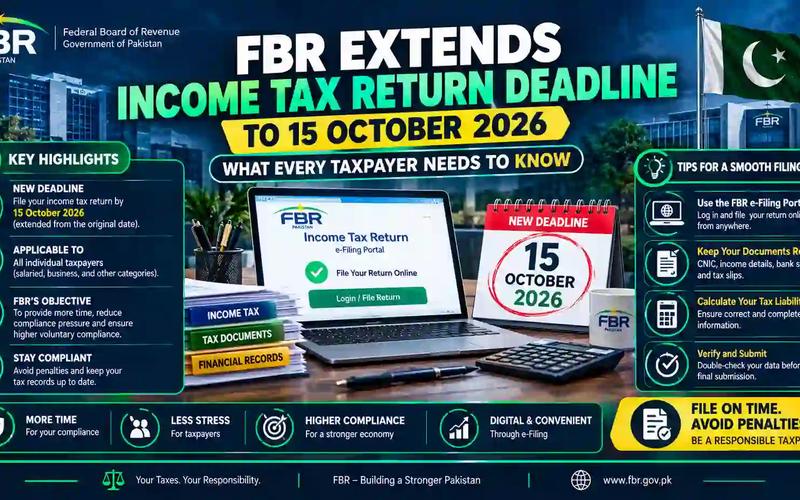
Filing Your Return: Iris, Deadlines, and Filer Status
Once tax year 2026-27 ends on June 30, 2027, you'll need to file your return through FBR's Iris portal. Filing isn't optional if you meet FBR's criteria — and missing the deadline carries real financial consequences.
You're required to file a tax return in Pakistan if you own immovable property with a land area of 500 square yards or more, or if you're a professional such as a doctor, lawyer, or accountant, among several other criteria FBR sets out.
The penalties for skipping this aren't trivial either. The penalty for late filing is a minimum of Rs 40,000, or up to 0.1% of the tax payable for each day of default, while concealment of income can trigger a penalty of up to 200% of the tax evaded.
If you've never filed before or find the Iris portal confusing, our step-by-step FBR Iris login guide and the broader FBR Iris portal guide for 2026-27 cover the entire filing process from registration to submission. And if you're cutting it close to the deadline, bookmark our income tax return deadline Pakistan page so you don't miss it.
Filer vs Non-Filer: What Changes Under FBR Tax Slabs 2026-27
Your salary tax deduction rate is identical whether you're a filer or non-filer — the slabs apply equally. What changes is everything else. Non-filers face higher withholding tax on bank transactions, property purchases, and vehicle registration, and critically, they cannot claim a refund on any over-deducted tax.
If your employer has deducted more tax than you actually owe based on the correct 2026-27 slabs, you can only get that money back by filing a return and being on FBR's Active Taxpayer List. Non-filers simply lose that refund.
Legal Ways to Reduce Your Tax Liability
The good news is that Pakistan's tax code offers several legitimate ways to lower your taxable income before slabs even apply. Under the Income Tax Ordinance 2001, allowable deductions include Zakat, pension fund contributions, and interest on loans from recognized institutions, along with tax credits for education and medical expenses.
Practical steps worth exploring:
- Contribute to an approved pension fund — this reduces your taxable income directly and is one of the most commonly used legal tax-saving tools in Pakistan
- Claim your Zakat deduction if you pay it through a recognized channel
- Keep records of tuition and medical expenses for eligible tax credits
- Check your loan interest if you have financing from a recognized financial institution
For a deeper dive into structuring your finances around these provisions, read our full guide on legally reducing your salary tax in Pakistan.
How FBR Tax Slabs 2026-27 Compare to Previous Years
Context helps here. If you want to see exactly how this year's brackets compare against 2025-26, 2024-25, and earlier years side by side, our Pakistan salary tax slabs breakdown lays out a full historical comparison table — useful if you're tracking how your effective tax rate has shifted over multiple years, or explaining the change to family and colleagues.
Beyond Salary Tax: Other Taxes You Should Know About
Income tax isn't the only tax obligation most people juggle in Pakistan. Depending on your situation, you may also need to handle:
- Property tax — if you own real estate, check current FBR property tax and DC rates for 2026
- Vehicle token tax — annual vehicle registration renewal varies by province; see our guides on Punjab vehicle verification and token tax and Sindh vehicle verification and token tax
- Vehicle registration fees — if you're buying a new car this year, our vehicle tax and registration fee calculator guide breaks down the full cost
- Excise and taxation matters generally — covered comprehensively in our excise and taxation Pakistan overview and the Islamabad-specific excise and taxation guide
- Cross-province comparisons — if you're relocating or just curious how provinces differ, see our vehicle verification and token tax comparison across Pakistan
What About US Taxpayers or Cross-Border Comparisons?
If you're comparing Pakistan's system to how income tax works elsewhere — say, for a relocating employee or a business with international staff — our US federal income tax calculator guide for 2026 covers the American bracket system side by side, which is a genuinely useful reference point given how differently the two systems are structured.
If your business also deals with cross-border sales, our piece on e-commerce sales tax nexus is worth a read too, particularly if you're selling into the US market.
For authoritative primary-source detail beyond what any calculator site can offer, always cross-reference the official Federal Board of Revenue website directly, since FBR periodically issues clarifications and SROs that refine these slabs after the initial Finance Bill announcement. For the macro fiscal context behind these changes, the IMF's Pakistan country page offers useful background on the Extended Fund Facility conditions shaping this year's budget decisions.
Frequently Asked Questions
What is the tax-free income limit in Pakistan for 2026-27? Annual income up to Rs 600,000 remains completely tax-exempt for salaried individuals under the FY 2026-27 slabs — this threshold hasn't changed from the previous year.
Is the high-income surcharge still charged in 2026-27?Not as a change introduced in Finance Bill 2026. A 9% surcharge continues to apply to salaried individuals with taxable income above Rs 10 million, and a 10% surcharge to non-salaried filers, unless the FBR-notified SRO says otherwise. Confirm the current position with FBR or a tax adviser before filing.
What is the top income tax rate under the new FBR slabs? The top marginal rate is 35%, applying to annual salaried income above Rs 7,000,000. This top bracket now starts at a higher threshold than in previous years, since the old Rs 4.1 million cutoff has been raised.
How do I file my tax return through Iris FBR? You register on the Iris portal using your CNIC and mobile number, verify your details, then submit your annual return with income, deduction, and asset details before the deadline. Our complete Iris filing walkthrough covers every step in detail.
Is agricultural income taxed in Pakistan? Agricultural income tax is administered provincially rather than federally, and provincial governments have been expanding collection in this area as part of the broader fiscal reforms tied to Pakistan's IMF programme.
What is the difference between a filer and a non-filer? Both pay the same slab-based tax rate on salary, but non-filers face higher withholding tax on bank transactions, property, and vehicle purchases, and cannot claim refunds on over-deducted tax — filers can.
Final Thoughts
The FBR tax slabs for 2026-27 mark a genuine, if partial, course correction for Pakistan's salaried class after years of carrying a disproportionate tax burden. Four slabs got real rate cuts and the top bracket threshold moved up significantly. Whether this relief holds steady into FY28 depends heavily on whether the government's parallel efforts — taxing agriculture and formalising retail — actually deliver the revenue the IMF program requires.
For now, the smartest move is simple: don't guess your tax liability, calculate it. Head over to our salary tax calculator, plug in your exact monthly or annual income, and get your precise 2026-27 tax breakdown in seconds — no spreadsheets, no manual slab math, no surprises when your payslip lands.
Important disclaimer
This article is for educational planning only. It does not provide professional tax, legal, accounting, payroll, customs, or financial advice. Tax rules can change and final results may depend on your personal facts. Always verify important tax decisions with official sources or a qualified professional.
About the author
This article was written by the Tax Calculators Team, the group behind TaxCalculators.tools. Learn more about our team and editorial process.
Last reviewed: July 5, 2026