If you own a car, a house, or run a business in Pakistan, the Excise and Taxation Department touches your life more than you probably realize. From the moment you register a new vehicle to the annual token tax reminder that lands in your inbox, this department is quietly collecting provincial revenue that funds roads, schools, and public services across the country.
Yet most Pakistanis — whether they live in Lahore, Karachi, Peshawar, or Quetta — still find themselves confused about what they owe, how to calculate it, and how to pay it without standing in a queue for half a day.
This guide changes that. In 2026, with most excise services now digitized, there has never been a better time to understand the system, use the right tools, and stay fully compliant. Let's break it all down.
What Is the Excise and Taxation Department in Pakistan?
The Excise and Taxation Department in Pakistan is a provincial government body responsible for collecting various taxes, duties, and fees on behalf of the provincial government. Each of the four provinces — Punjab, Sindh, KPK, and Balochistan — operates its own independent department under its respective government.
The department also works alongside the Federal government to collect certain federal taxes, such as withholding tax and advance tax on motor vehicles under the Income Tax Ordinance 2001.
In simpler terms, if you drive a car, own property, run a business, or consume certain regulated goods in Pakistan, the Excise and Taxation Department is the agency you answer to at the provincial level.
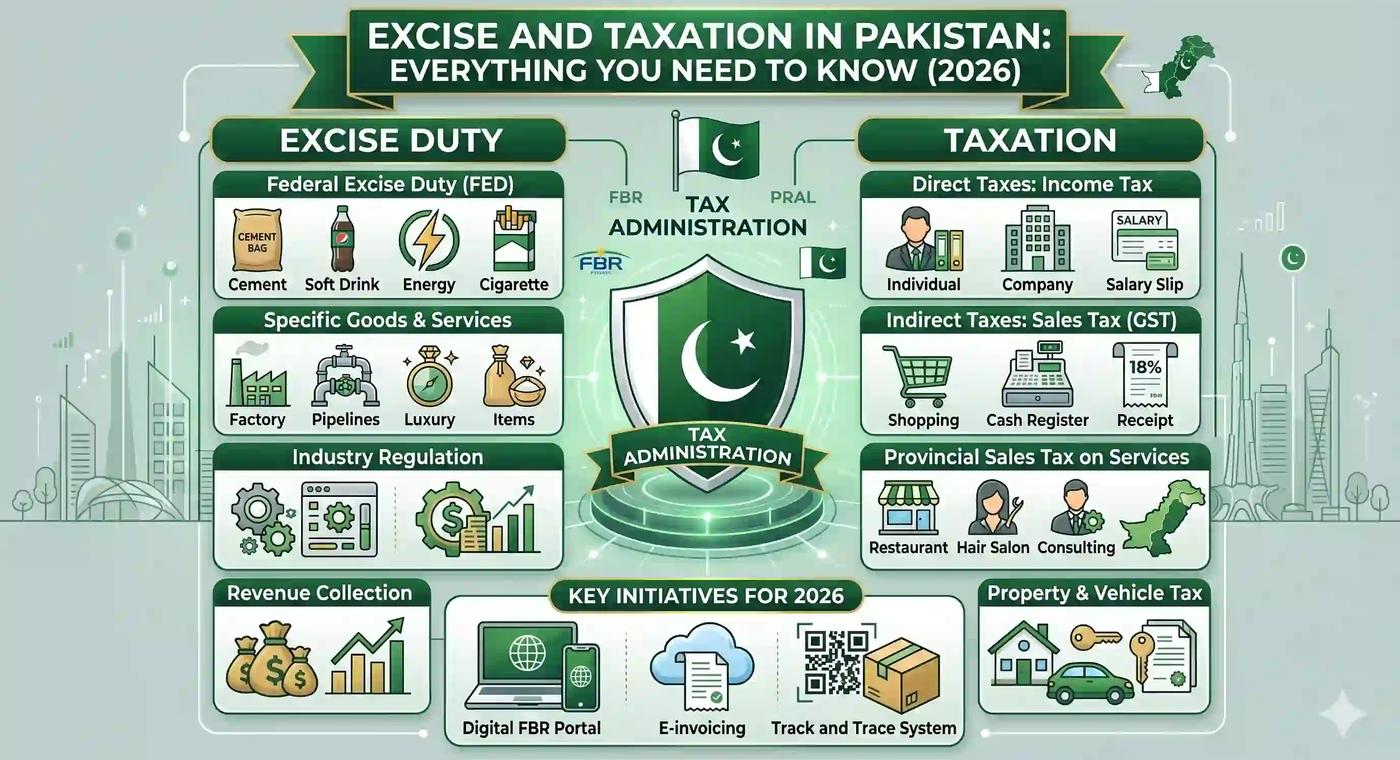
What Taxes Does the Excise Department Collect in Pakistan?
This is one of the most common questions people search for, and the answer is broader than most expect. The excise department in Pakistan collects:
- Motor Vehicle Tax (token tax, registration fee, transfer fee)
- Property Tax (urban immovable property tax / UIPT)
- Professional Tax (on businesses, firms, and employed individuals)
- Excise Duty (on regulated goods like alcohol, tobacco, and certain chemicals)
- Entertainment Duty (on cinemas, amusement parks, and events)
- Luxury House Tax (on high-value residential properties in Punjab)
- Cotton Fee (specific to Punjab's agricultural sector)
- Federal Withholding Tax and Advance Tax on Vehicles (collected on behalf of FBR under Section 231B of the Income Tax Ordinance 2001)
Each province has slight variations in what it collects and at what rate, which is why understanding your specific province matters.
Vehicle Tax in Pakistan 2026: A Complete Breakdown
What Is Motor Vehicle Tax in Pakistan?
Motor vehicle tax is an annual levy imposed on every registered vehicle in Pakistan. It is one of the largest revenue streams for the Excise and Taxation Department across all provinces. It is administered under the Motor Vehicle Ordinance 1965 and the Motor Vehicle Tax Act 1958 — two foundational pieces of legislation that still govern most vehicle taxation rules in Pakistan today.
What Is Token Tax and How Does It Work?
Token tax is the annual vehicle tax that every car, motorcycle, or commercial vehicle owner must pay to keep their vehicle legally compliant. It is called "token tax" because upon payment, owners used to receive a physical token or sticker to display on their vehicle.
The token tax rate depends on:
- Vehicle type (private car, motorcycle, commercial vehicle, tractor)
- Engine capacity (measured in cc — cubic centimeters)
- Province of registration
- Vehicle age
As a general formula used across provinces: Vehicle Tax = (Base Tax Rate × Engine Capacity) + Additional Applicable Taxes
For motorcycles in Punjab, the token tax rates in 2026 remain relatively low for bikes under 100cc, while bikes above 200cc attract progressively higher rates. Commercial vehicles are taxed on a different scale based on load capacity and vehicle age.
Want to calculate your exact token tax right now? Use the free Vehicle Token Tax Calculator at Tax Calculators — it handles Punjab, Sindh, KPK, and Balochistan rates in seconds.
What Is Withholding Tax on Vehicles in Pakistan?
Withholding tax on vehicle purchase is collected under Section 231B of the Income Tax Ordinance 2001, amended significantly by the Finance Act 2021. This tax is charged at the point of purchase or first registration of a new vehicle.
The key rule to understand in 2026 is the filer vs non-filer distinction:
- Filers (those registered on the FBR Active Taxpayers List) pay a lower rate of advance tax
- Non-filers pay a substantially higher rate — sometimes double or more
This withholding tax is adjustable against your annual income tax liability, meaning filers can claim it back. Non-filers cannot. The rate also reduces by 10% each year from the date of first registration in Pakistan, reaching zero after six years.
To calculate exactly how much withholding tax applies to your vehicle purchase, use the free Advance Tax Calculator at Tax Calculators — it factors in filer status, vehicle value, and registration year automatically.
What Is the Difference Between Filer and Non-Filer Vehicle Tax Rates?
This is critically important if you are planning to buy a car in 2026. Being a tax filer in Pakistan significantly reduces the advance tax you pay on vehicle registration and transfer. Non-filers pay a higher prescribed rate under the same Section 231B, and these higher rates apply across all provinces — whether you are registering in Lahore, Karachi, Islamabad, or Peshawar.
The practical takeaway: file your income tax return before buying a vehicle. It saves real money and keeps you legally protected.
How to Register a New Vehicle in Pakistan 2026
Registering a new vehicle involves several steps, and the process varies slightly by province. Here is the standard procedure followed across most excise offices:
- Purchase your vehicle from an authorized dealer
- Obtain the purchase invoice and delivery challan from the dealer
- Visit your provincial excise office or use the online portal if your province supports it
- Submit documents — CNIC, purchase invoice, insurance certificate, fitness certificate (for commercial vehicles)
- Pay registration fee and token tax via designated bank or online portal
- Receive your Smart Card (vehicle registration card) and number plates
Punjab has been progressive in digitizing this process through MTMIS (Motor Transport Management Information System), allowing many transactions to be completed online or via the excise.punjab.gov.pk portal.
In Sindh, the Sindh Excise Tax Portal handles online registration, verification, and payment of vehicle and property taxes for residents of Karachi, Hyderabad, and across the province.
Documents Required for Vehicle Registration in Pakistan
- Original CNIC (National Identity Card)
- Vehicle purchase invoice or bill of sale
- Insurance certificate
- Fitness certificate (for commercial vehicles, issued by a Motor Vehicle Examiner)
- Customs clearance documents (for imported vehicles)
- Form-F for registration (available from the excise office or downloadable from provincial websites)
What Is MTMIS and How Does It Work?
MTMIS stands for Motor Transport Management Information System. It is an online platform launched by the Punjab Excise, Taxation and Narcotics Control Department to manage vehicle registration, tax calculation, verification, and ownership transfer digitally.
Through MTMIS Punjab, you can:
- Verify a registered vehicle by entering the registration number
- Calculate vehicle token tax based on engine capacity and vehicle type
- Check outstanding dues on any vehicle
- Track vehicle ownership history
The system has become one of the most-used government digital tools in Punjab, serving residents of Lahore, Rawalpindi, Faisalabad, Multan, Gujranwala, Sialkot, and beyond.
Sindh has a similar vehicle verification system accessible via excise.gos.pk, while KPK uses the kpexcise.gov.pk portal for vehicle registration and tax calculation.
How to Transfer Vehicle Ownership Online in Pakistan
Transferring a vehicle from one owner to another is one of the most common reasons people visit excise offices. In 2026, Sindh has made this process significantly smoother through biometric verification.
Biometric Verification for Vehicle Transfer in Sindh
The Sindh Excise Department now requires biometric verification for vehicle ownership transfers. Both the buyer and seller must complete biometric authentication at:
- NADRA e-Sahulat Centers (authorized government locations)
- Designated Excise Department offices with biometric equipment
Once biometric verification is complete, the transfer request is submitted online, and the system updates the ownership record accordingly. This digital step has significantly reduced fraudulent transfers and fake documentation.
For Punjab vehicle transfers, visit your nearest excise office in Lahore, Rawalpindi, or any district office. Punjab is also moving toward online transfer facilitation through MTMIS.
Property Tax in Pakistan: What You Need to Know
Is Property Tax Paid to the Excise Department in Pakistan?
Yes. Property tax — officially called Urban Immovable Property Tax (UIPT) — is collected by the Excise and Taxation Department in Punjab. In Sindh, the Excise Department manages property tax challans through the Sindh Excise Tax Portal. In KPK, property tax information and rates are available via the excise department's portal.
Who Is Liable to Pay Property Tax in Pakistan?
Any owner of urban residential, commercial, or industrial property in Pakistan's major cities is liable to pay property tax. This includes:
- Residential houses and apartments
- Commercial offices and shops
- Industrial buildings and warehouses
- Petrol pumps and CNG stations (charged at flat annual rates)
- Educational institutions (with specific exemptions in some provinces)
Property tax rates are calculated based on the Annual Rental Value (ARV) of the property — essentially an estimate of what the property could earn annually if rented out.
What Is UIPT and How Is It Calculated?
UIPT (Urban Immovable Property Tax) is the formal name for the property tax system in Punjab. The UIPT calculator on excise.punjab.gov.pk allows property owners to estimate their annual tax liability based on property location, type, size, and usage.
For Sindh property owners, tax challans can be generated for residential, commercial, and industrial properties through the online portal. Once generated, challans can be paid through designated bank branches or digital payment channels.
If you own property in Punjab or KPK and want to estimate your dues instantly, try the free Property Tax Calculator and KPK Property Tax Calculator — both are available at Tax Calculators with no registration required.
For a deeper dive into property tax DC rates, see this detailed guide: FBR Property Tax DC Rates Pakistan 2026.
What Is PT10 Challan Verification?
The PT10 is the standard property tax challan in Pakistan. It is the document you receive when property tax is assessed and due. Punjab's excise system allows property owners to verify their PT10 challan online through the official excise portal, reducing the need for in-person visits to verify payment status.
What Is Luxury House Tax in Punjab 2026?
The luxury house tax is a special levy imposed on high-value residential properties and farmhouses in Punjab. Properties exceeding a specified value threshold are assessed an additional tax beyond regular UIPT. This tax targets high-end homes and farmhouses typically located in upscale areas of Lahore, Rawalpindi, and other major cities.
Professional Tax in Pakistan: Who Pays It and How?
What Is Professional Tax in Pakistan?
Professional tax is a provincial levy charged on businesses, commercial establishments, professionals, and salaried employees. Both companies and individuals may fall under professional tax obligations depending on their profession, income bracket, and provincial rules.
In Sindh, both businesses and individuals managing commercial activities must register for and pay professional tax through the Excise Tax Portal. Punjab similarly administers professional tax through its excise department.
You can estimate your professional tax obligation using the free Professional Tax Calculator at Tax Calculators.
Excise Duty in Pakistan: What Is It and Who Pays It?
Excise duty is a tax levied on the production, sale, or consumption of certain goods within Pakistan. At the provincial level, excise duty primarily covers regulated goods such as alcohol (for non-Muslim communities and the hospitality industry), certain chemicals, and other controlled substances.
The L-17 License is the key excise license required for businesses involved in regulated goods. Applying for a motor dealer license similarly requires compliance with provincial excise rules.
For businesses that need to calculate their excise liability, the excise.punjab.gov.pk portal provides an Excise Duty Calculator under its Tax Calculators section.
Entertainment duty applies to commercial entertainment venues including cinemas, amusement parks, and public events — collected by the provincial excise department at prescribed rates.
Province-by-Province Guide to Excise and Taxation 2026
Excise and Taxation Punjab 2026
Punjab has the most developed excise infrastructure in Pakistan, serving cities including Lahore, Rawalpindi, Faisalabad, Multan, Gujranwala, Sialkot, Sargodha, and Bahawalpur.
Key highlights for 2026:
- Punjab Excise launched re-registration of vehicles registered outside Punjab in early 2026
- Online vehicle verification, token tax payment, e-registration cards, and number plate requests are all available via excise.punjab.gov.pk
- E-Auction portal for vanity/premium number plates with regular auction schedules
- UIPT and luxury house tax calculators are available online
- Professional tax calculator accessible on the portal
Excise and Taxation Sindh 2026
Sindh Excise, serving Karachi, Hyderabad, Sukkur, and across Sindh, has digitized its core services through the Sindh Excise Tax Portal at excise.gos.pk.
Key Sindh excise services in 2026:
- Vehicle registration and online verification
- Biometric ownership transfer system
- Property tax challan generation and online payment
- Professional tax registration and payment
- Online tax calculator for all vehicle and property categories
- CPLC vehicle verification available for Karachi residents
Excise and Taxation KPK (Khyber Pakhtunkhwa) 2026
KPK residents in Peshawar, Abbottabad, Mardan, and surrounding areas use the kpexcise.gov.pk portal. The KPK excise department offers:
- Vehicle Registration Calculator
- Motor Vehicle Token Tax rates for all vehicle categories
- Property tax information and calculation
- Petrol pumps taxed at flat annual rates (Rs. 25,500 with convenience store; Rs. 11,250 without)
Excise and Taxation Balochistan 2026
Balochistan's excise department at excise.balochistan.gov.pk covers vehicles registered across Quetta and the province. In 2026, the portal calculates:
- Motorcycle tax (updated to February 2026)
- Commercial vehicle tax
- Non-commercial vehicle tax
A critical deadline for Balochistan property owners: pay all due taxes before June 30, 2026 to avoid penalties.
How to Pay Vehicle Tax and Excise Dues Online in Pakistan
The era of standing in long queues at excise offices is largely over in major cities. Here is how to pay online across provinces:
Punjab:
- Visit excise.punjab.gov.pk → Services → Online Payment of Excise Dues
- Enter your vehicle registration number
- View outstanding dues
- Pay via internet banking, mobile banking, or designated bank branches
Sindh:
- Visit the Sindh Excise Tax Portal at taxportal.excise.gos.pk
- Search by CNIC or vehicle registration number
- Generate challan and pay digitally
KPK:
- Use the Vehicle Registration Calculator at kpexcise.gov.pk
- Generate the required challan
- Pay at designated bank branches or via online banking where available
How to Verify a Vehicle Online in Pakistan
Verifying a vehicle's registration status is quick and free. Here is how to do it by province:
- Punjab: Use MTMIS at excise.punjab.gov.pk → Services → Online Verification of Registered Vehicles
- Sindh: Visit excise.gos.pk and enter the registration number or CNIC
- KPK: Use the verification tool at kpexcise.gov.pk
- Karachi specific: CPLC (Citizens-Police Liaison Committee) offers additional vehicle verification for Karachi registrations
Vehicle verification tells you the registered owner's name, registration date, chassis number, engine number, and any outstanding tax dues — all without visiting an office.
Tax Calculators: The Smartest Tool for Pakistani Taxpayers in 2026
Whether you need to calculate vehicle token tax, advance tax on a new car purchase, property tax, withholding tax, or your FBR salary tax, using an accurate online calculator saves time and prevents costly errors.
Tax Calculators offers a full suite of free Pakistan-specific tax tools including:
- Vehicle Token Tax Calculator
- Advance Tax Calculator
- Property Tax Calculator
- KPK Property Tax Calculator
- Withholding Tax Calculator
- FBR Tax Calculator
- Salary Tax Calculator
- Income Tax Calculator
These tools are updated for 2026 tax rates and cover all four provinces. No registration. No login. Just fast, accurate results.
Frequently Asked Questions (FAQs)
What is the excise and taxation department in Pakistan? The Excise and Taxation Department is a provincial government authority in Pakistan responsible for collecting motor vehicle tax, property tax, professional tax, excise duty, and other levies. Each province — Punjab, Sindh, KPK, and Balochistan — operates its own department independently.
How to calculate vehicle tax in Pakistan? Vehicle tax is calculated based on engine capacity, vehicle type, province of registration, and filer/non-filer status. The formula is: Vehicle Tax = (Base Tax Rate × Engine Capacity) + Additional Taxes. Use the free Vehicle Token Tax Calculator at taxcalculators.tools for an instant, accurate result.
What is the difference between filer and non-filer vehicle tax in Pakistan? Filers registered on the FBR Active Taxpayers List pay a lower advance tax rate when purchasing or registering a vehicle under Section 231B of the Income Tax Ordinance 2001. Non-filers pay a significantly higher rate — often double. Filing your tax return before buying a vehicle can save a substantial amount.
How to pay token tax online in Punjab 2026? Visit excise.punjab.gov.pk, go to Services, click Online Payment of Excise Dues, enter your vehicle registration number, view your outstanding token tax, and pay via internet banking or mobile banking app. The process takes under five minutes.
What is MTMIS in Pakistan? MTMIS (Motor Transport Management Information System) is an online vehicle management system operated by Punjab's Excise and Taxation Department. It allows vehicle verification, tax calculation, ownership history checks, and payment of dues online without visiting an office.
Who is liable to pay property tax in Pakistan? Any owner of urban residential, commercial, or industrial property in Pakistan's cities is liable for Urban Immovable Property Tax (UIPT). Tax is calculated based on the Annual Rental Value (ARV) of the property, with rates varying by province and property type.
What is biometric verification for vehicle transfer in Sindh? Sindh Excise requires both the buyer and seller to complete biometric authentication — either at NADRA e-Sahulat Centers or designated excise offices — before any vehicle ownership transfer is processed. This system prevents fraudulent transfers and ensures accurate ownership records.
How to register a new car in Pakistan in 2026? Submit your CNIC, purchase invoice, insurance certificate, and Form-F at your provincial excise office or online portal. Pay the registration fee and token tax via designated bank or online. Your Smart Card (e-registration card) and number plates are then issued.
Conclusion: Stay Compliant, Stay Ahead in 2026
Excise and taxation in Pakistan is a system that affects every vehicle owner, property holder, and business operator across the country. The good news in 2026 is that the system is more accessible than ever — online portals in Punjab, Sindh, KPK, and Balochistan have removed much of the friction that made tax compliance feel impossible.
The key steps are simple: know which taxes apply to you, calculate them accurately, and pay them on time through the official provincial portals.
If you are unsure about any calculation — whether it is vehicle token tax, advance tax on a new car, property tax dues, or withholding tax on a purchase — do not guess. Use the free, advanced tax calculators at Tax Calculators to get exact figures based on 2026 rates in seconds.
Use our free Advanced Tax Calculators at taxcalculators.tools — built for Pakistani taxpayers, updated for 2026, and completely free to use.
For property tax DC rates and valuation tables, read our detailed guide: FBR Property Tax DC Rates Pakistan 2026
Important disclaimer
This article is for educational planning only. It does not provide professional tax, legal, accounting, payroll, customs, or financial advice. Tax rules can change and final results may depend on your personal facts. Always verify important tax decisions with official sources or a qualified professional.
About the author
This article was written by the Tax Calculators Team, the group behind TaxCalculators.tools. Learn more about our team and editorial process.
Last reviewed: June 19, 2026