If you've ever stared at your payslip wondering why your take-home pay shrank again, you're not alone. Every year, millions of Pakistanis search for a reliable FBR tax calculator to make sense of a tax system that feels like it changes every June. With Budget 2026-27 now in effect and the FBR tax slabs for 2026 restructured, understanding exactly how much income tax you owe has never mattered more.
This guide breaks down the income tax calculator Pakistan process in plain language — how the slabs work, how to calculate your own liability by hand or with a tool, and where salaried employees, freelancers, and business owners each stand under the new rules. No jargon, no confusion — just a clear path to knowing your number.
What Is an FBR Tax Calculator and Why It Matters
An FBR tax calculator is simply a tool — online or manual — that applies Pakistan's official, progressive income tax slabs to your annual or monthly income to tell you exactly how much tax you owe. The Federal Board of Revenue (FBR) is the government body responsible for setting and collecting these taxes, and every calculation ultimately traces back to the rates it notifies each fiscal year.
Why does this matter beyond curiosity? A few real reasons:
- Budgeting accuracy. Knowing your net salary tax helps you plan monthly expenses instead of being surprised by a smaller paycheck.
- Filing correctly. If you're calculating your own tax return filing Pakistan figures, an error can trigger notices or delayed refunds.
- Avoiding overpayment. Many salaried employees don't claim deductions they're entitled to — Zakat, pension contributions, or education tax credits — and end up overpaying.
- Filer status planning. Your tax bracket directly affects whether becoming a filer saves you money on other transactions, like property or vehicle purchases.
A good salary tax calculator Pakistan 2026 tool does all this math instantly, but understanding the underlying logic means you can also verify the result yourself — which is exactly what we'll walk through next.
Understanding the FBR Tax Slabs for 2026-27
Pakistan's tax year runs from July 1 to June 30, so the "Tax Year 2027" slabs — announced in the Finance Act 2026 and effective from July 1, 2026 — are what apply to income earned right now. According to FBR's own Salient Features document for Budget 2026-27, this year's changes are meaningful for the salaried class.
Key Confirmed Changes for Tax Year 2027
- The tax-free threshold stays at Rs. 600,000 annually (about Rs. 50,000 monthly) — no change here.
- Income tax rates for salaried individuals have been restructured with additional intermediate slabs, aimed at easing the burden on middle-income earners.
- The threshold for the maximum 35% tax rate has been raised from Rs. 4.1 million to Rs. 7 million — meaning fewer people fall into the top bracket.
- The 9% surcharge that previously applied to individuals earning above Rs. 10 million annually has been fully abolished for salaried taxpayers.
- Two of the middle-income rates were reduced — the bracket previously taxed at 23% has come down to 20%, and the bracket previously at 30% has come down to 25%.
- The old top bracket (above Rs. 4.1 million) has now been split into three intermediate bands before the true 35% rate kicks in above Rs. 7 million.
Salaried Individuals: Confirmed Slab Structure
Here's how the progressive system works for salaried persons under the current tax year, based on FBR's notified structure:
- Up to Rs. 600,000: 0% (fully tax-exempt)
- Rs. 600,001 – Rs. 1,200,000: 1% of the amount exceeding Rs. 600,000
- Rs. 1,200,001 – Rs. 2,200,000: Rs. 6,000 + 11% of the amount exceeding Rs. 1,200,000
- Rs. 2,200,001 – Rs. 3,200,000: Rs. 116,000 + 20% of the amount exceeding Rs. 2,200,000 (down from 23%)
- Above Rs. 3,200,000 up to Rs. 7,000,000: taxed progressively through further reduced intermediate slabs (previously 30%, now 25%, with additional bands introduced between Rs. 4.1 million and Rs. 7 million)
- Above Rs. 7,000,000: taxed at the maximum rate of 35%, with no surcharge added
A quick note on accuracy: because Finance Act notifications sometimes get refined after the initial budget announcement, the exact cumulative Rupee figures for brackets above Rs. 3.2 million can shift slightly in FBR's final notified tables. For a matter this important, always cross-check the final figure against the FBR IRIS portal or FBR's official notifications before filing.
Non-Salaried and Business Individuals
Business tax calculator Pakistan users — freelancers, sole proprietors, and professionals — face a separate, generally higher slab table than salaried employees at equivalent income levels. This is one of the most searched FBR tax slabs for business individuals questions, and the short answer is: yes, non-salaried income is taxed more aggressively than salaried income in Pakistan, partly because salaried tax is withheld and documented automatically, while business income has historically been harder to track.
If you're self-employed, our detailed Pakistan Salary Tax Calculator 2026 Guide breaks down both salaried and non-salaried brackets side by side.
How to Calculate Income Tax on Salary in Pakistan: Step by Step
Here's the exact formula method a monthly salary tax calculator uses internally:
- Determine your annual taxable income. Multiply your gross monthly salary by 12. If you changed jobs mid-year, add income from both employers.
- Subtract allowable deductions. These include Zakat paid, approved pension fund contributions, and certain tax credits (education, medical, or investment in listed shares).
- Identify your slab. Find where your taxable income falls in the table above.
- Apply the formula for that slab. Add the fixed base amount (if any) to the percentage rate applied only to the portion of income above the bracket's starting point — not your entire income.
- Divide by 12 to get your monthly tax deduction.
Worked Example
Say your annual taxable salary is Rs. 1,800,000 (Rs. 150,000/month):
- The first Rs. 600,000 is tax-free.
- The next slice, from Rs. 600,000 to Rs. 1,200,000, is taxed at 1% → Rs. 6,000.
- The remaining Rs. 600,000 (from Rs. 1,200,000 to Rs. 1,800,000) is taxed at 11% → Rs. 66,000.
- Total annual tax: Rs. 72,000, or Rs. 6,000 per month.
Notice you don't pay 11% on your entire salary — only on the portion that falls inside that bracket. This progressive structure is exactly why an effective tax rate (the real percentage of your total income paid in tax) is always lower than your marginal slab rate.
Why Choose Tax Calculators
Doing this math manually every time you get a raise, bonus, or new job offer is tedious and error-prone. This is where a dedicated online tool earns its keep. When you Why choose Tax Calculators for your estimate, you get:
- Instant, accurate results based on the latest notified FBR slabs — no outdated spreadsheets.
- Support for both salaried and non-salaried income types, so freelancers and business owners get correct figures too.
- Multi-year comparison, letting you see how your tax liability changed between 2025-26 and 2026-27.
- Deduction and rebate support for Zakat, pension contributions, and tax credits, so your final number reflects real savings, not just the raw slab rate.
- Free, unlimited use — no signup required to check your numbers as often as you like.
If you want to go a step further and see year-over-year changes, our Advanced free Tax Calculators suite also covers property tax, vehicle token tax, customs duty, and sales tax — everything under one roof.
Filer vs Non-Filer: Why Your FBR Status Matters
Your income tax slab doesn't change based on whether you're a "filer" or "non-filer" — everyone in the same salary bracket pays the same base tax rate. What does change dramatically is withholding tax on everything else you do financially:
- Non-filers pay significantly higher withholding tax on bank transactions, property purchases, and vehicle registration.
- Filers appear on FBR's Active Taxpayer List (ATL), unlocking lower rates across dozens of transaction types.
- Only filers can claim refunds when too much tax has been withheld at source.
For a full breakdown of this distinction, read our guide on How to Become a Tax Filer in Pakistan. And if you're trying to decide whether "salary tax" and "income tax" mean the same thing for your situation, our article on Salary Tax vs Income Tax in Pakistan clears up the confusion in plain terms.
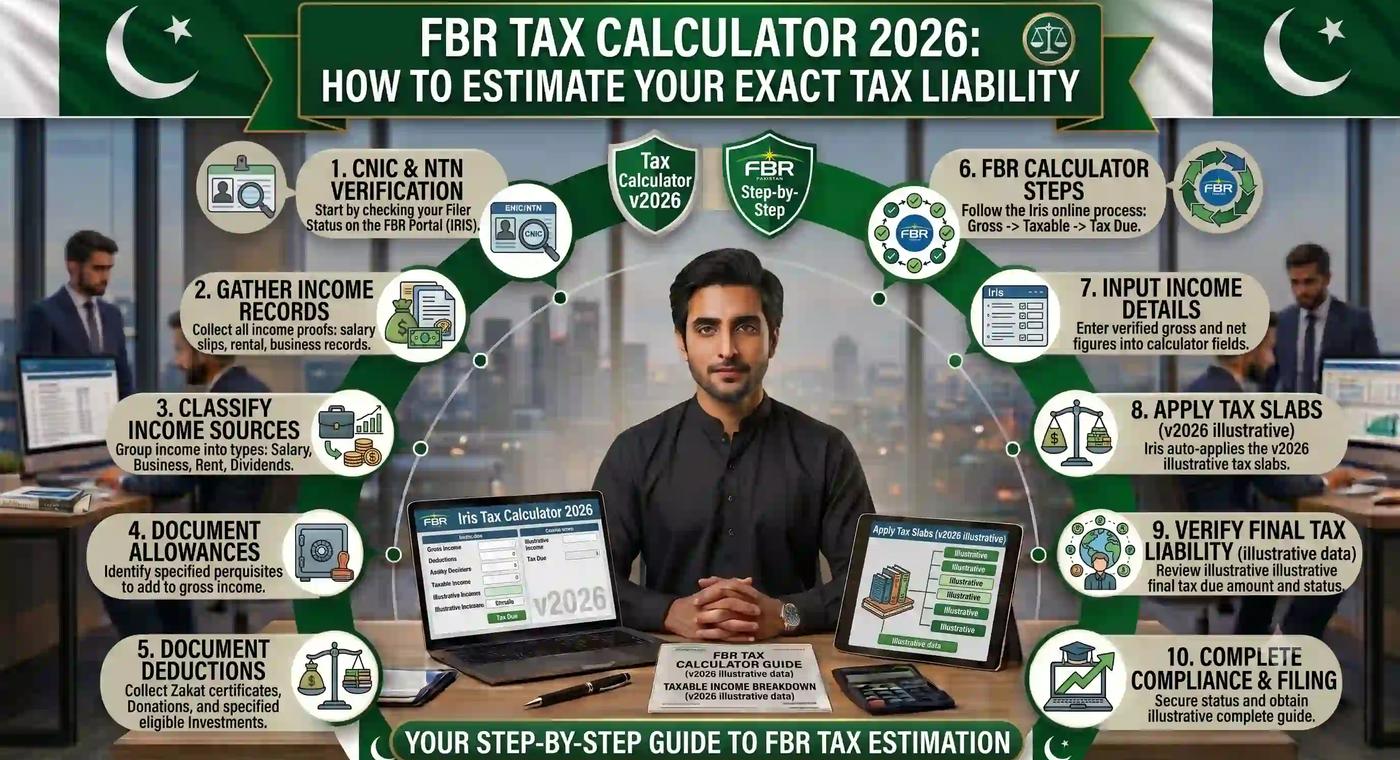
How to Register on FBR IRIS and File Your Return
The FBR IRIS portal (iris.fbr.gov.pk) is the official online system for registration, filing, and refund claims. Here's the basic path:
- Visit the official IRIS FBR portal and register using your CNIC.
- Obtain your National Tax Number (NTN) — this is generated automatically upon registration for most individuals.
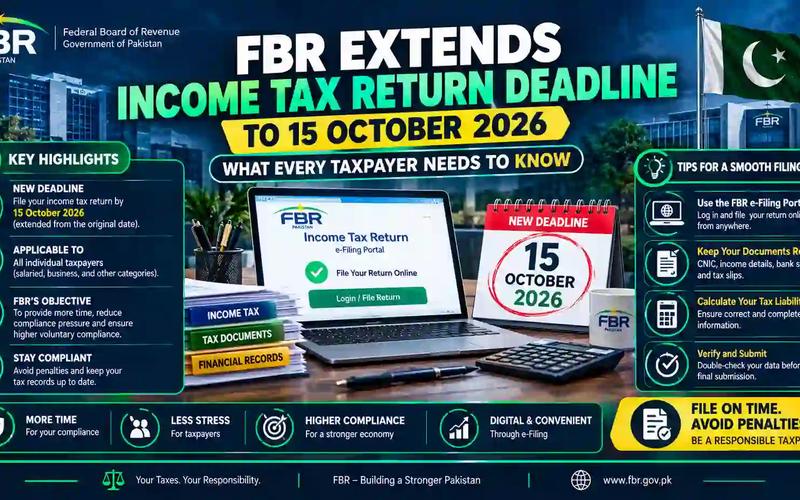
- Log in each tax year to file your income tax return before the September 30 deadline.
- Declare your income, deductions, and any tax already withheld by your employer.
- Submit — if you overpaid through withholding, the excess becomes a refundable claim.
If you're logging in for the first time or run into portal issues, our step-by-step FBR IRIS Login Guide and the more detailed FBR IRIS Portal Guide 2026-2027 walk through common errors and fixes. Missing the deadline carries real penalties, so check our Income Tax Return Deadline Pakistan article well in advance.
Real-World Examples: Different Salary Levels Compared
Let's compare a few common salary bands so you can see where you likely fall:
- Rs. 50,000/month (Rs. 600,000/year): Tax-free. You fall exactly at the exemption threshold.
- Rs. 100,000/month (Rs. 1,200,000/year): Tax due on the Rs. 600,000 portion above the exemption at 1% = Rs. 6,000/year, or Rs. 500/month.
- Rs. 150,000/month (Rs. 1,800,000/year): As calculated earlier, Rs. 72,000/year, or Rs. 6,000/month.
- Rs. 250,000/month (Rs. 3,000,000/year): Falls into the third bracket — tax is Rs. 116,000 plus 20% of the amount over Rs. 2,200,000, giving roughly Rs. 276,000/year, or about Rs. 23,000/month.
For a full breakdown of every bracket with exact figures, our Pakistan Salary Tax Slabs Breakdown and FBR Tax Slabs 2026: Monthly Salary Tax Calculation articles cover every income tier in detail.
Common Mistakes People Make When Estimating Tax
- Applying the marginal rate to the whole salary instead of only the portion inside that bracket — this is the single most common calculation error.
- Forgetting allowable deductions like Zakat, pension contributions, or education tax credits, which can meaningfully lower the final bill.
- Using outdated slab tables from a previous fiscal year — always confirm you're looking at Tax Year 2027 rates, not 2025-26 or earlier.
- Ignoring bonus and overtime taxation. Bonuses are added to your annual income and taxed at your marginal rate for that portion, not a flat separate rate. If you want to see how a bonus month shifts your bracket, see how the Pakistan Salary Tax Calculator 2026 Guide handles variable income.
- Not checking legal ways to reduce liability. Many salaried employees miss legitimate deductions — our guide on how to Reduce Salary Tax Legally in Pakistan lists the credits most people overlook.
Beyond Salary: Other Taxes That Affect Pakistani Taxpayers
Income tax is just one piece of the picture. Depending on your situation, you may also need to account for:
- Property tax — if you own real estate, FBR's DC valuation rates directly affect your tax exposure. See our FBR Property Tax & DC Rates Pakistan 2026 guide.
- Vehicle token tax — an annual provincial tax on car ownership. Our comparison of Vehicle Verification & Token Tax Across Pakistan covers Punjab, Sindh, and Islamabad rules side by side, along with province-specific guides for Punjab Vehicle Verification & Token Tax and Sindh Vehicle Verification & Token Tax.
- Vehicle registration fees — see our guide on how to Calculate Vehicle Tax & Registration Fee.
- Excise and taxation processes more broadly, explained in our Excise and Taxation Pakistan overview, with an Islamabad-specific walkthrough in Excise and Taxation Islamabad: Online Verification & Tax Payment.
- E-commerce sellers should also understand cross-border obligations — our Ecommerce Sales Tax Nexus explainer is useful if you sell internationally alongside your Pakistan-based income.
A Note for US-Based Readers
If you searched for an irs tax calculator or federal income tax withholding calculator while researching this topic, note that the FBR system and the US IRS system are structurally different — different brackets, different filing thresholds, and different deduction rules entirely. The official IRS website remains the authoritative source for US federal tax rates. If you're comparing systems or working across both, our US Federal Income Tax Calculator 2026 Guide walks through the American brackets in the same plain-language style as this article.
FAQs
What is the FBR tax calculator? It's a tool that applies Pakistan's official, progressive FBR income tax slabs to your salary or business income to calculate exactly how much tax you owe for the year.
What are the FBR tax slabs for 2026-27? Income up to Rs. 600,000 is tax-free. Above that, rates rise progressively from 1% up to a maximum of 35%, with the top rate now applying only above Rs. 7 million annual income — up from Rs. 4.1 million previously.
How much tax do I pay on my salary in Pakistan? It depends on which bracket your annual taxable income falls into. Only the portion of income within each bracket is taxed at that bracket's rate — not your entire salary.
What is the difference between a filer and a non-filer? Both pay the same income tax rate on salary, but non-filers face much higher withholding tax on banking, property, and vehicle transactions, and cannot claim tax refunds.
How do I register on FBR IRIS? Visit the official IRIS portal, register using your CNIC, and you'll be issued an NTN automatically. From there, you can file your annual return before the September 30 deadline.
Is the FBR tax calculator accurate? A well-maintained calculator that's updated for the current Tax Year 2027 slabs will match FBR's official figures for standard salary income. For complex cases involving multiple income sources or high-value deductions, it's still wise to confirm the final number with a tax professional or FBR's own notification.
Conclusion
Estimating your exact tax liability doesn't have to feel like guesswork. Once you understand how Pakistan's progressive slab system works — and know where the 2026-27 changes shifted the brackets in your favor — calculating your salary tax becomes a five-minute task instead of a source of yearly anxiety.
Whether you're salaried, self-employed, or running a business, the fastest and most reliable way to get your number is to run it through our free FBR tax calculator — updated for the latest notified slabs, built to match official FBR figures, and free to use as often as you need.
Important disclaimer
This article is for educational planning only. It does not provide professional tax, legal, accounting, payroll, customs, or financial advice. Tax rules can change and final results may depend on your personal facts. Always verify important tax decisions with official sources or a qualified professional.
About the author
This article was written by the Tax Calculators Team, the group behind TaxCalculators.tools. Learn more about our team and editorial process.
Last reviewed: July 5, 2026