
Introduction: Are You Paying More Tax Than You Should?
Every month, millions of salaried employees across Pakistan — from Karachi to Rawalpindi, Lahore to Islamabad — watch a significant chunk of their hard-earned income disappear as income tax. But here is the truth most employees never realize: you are likely paying more salary tax than you actually owe.
The Federal Board of Revenue (FBR) allows several powerful, completely legal allowances and deductions under the Income Tax Ordinance 2001 that can dramatically reduce your taxable income. Whether you earn PKR 50,000 or PKR 500,000 per month, understanding how to legally reduce income tax in Pakistan is one of the smartest financial moves you can make in 2025-26.
This guide walks you through every FBR-approved tax deduction, exempt allowance, and salary restructuring strategy available to salaried persons in Pakistan — with real examples, step-by-step calculations, and direct links to tools that make the process easy.
Let's get into it.
What is Salary Tax in Pakistan and How is it Calculated?
Before you can reduce your salary tax, you need to understand how it works.
Salary tax in Pakistan is a federal income tax levied on income earned from employment. It is governed by the Income Tax Ordinance 2001 and administered by the Federal Board of Revenue (FBR). Each year, the government revises the income tax slabs through the Finance Act.
For the tax year 2025-26 (July 1, 2025 to June 30, 2026), the FBR income tax slabs for salaried individuals are:
0% — Annual income up to PKR 600,000
2.5% — PKR 600,001 to PKR 1,200,000
11% + PKR 6,000 — PKR 1,200,001 to PKR 2,200,000
23% + PKR 116,000 — PKR 2,200,001 to PKR 3,200,000
30% + PKR 346,000 — PKR 3,200,001 to PKR 4,100,000
35% + PKR 616,000 — Above PKR 4,100,000
Additionally, salaried individuals earning above PKR 10 million annually are subject to a 9% surcharge on their total income tax.
Now here is the key point: these slabs apply to your taxable salary — not your gross salary. And that difference is exactly where your tax-saving opportunity lies.
To instantly calculate your exact liability, use the free Salary Tax Calculator Pakistan 2025-26 — it applies the latest FBR slabs and gives you your take-home pay in seconds.
For a deeper breakdown of how these slabs evolved year by year, read: Pakistan Salary Tax Slabs Breakdown — Complete Guide
What is the Difference Between Gross Salary and Taxable Salary in Pakistan?
This is the most misunderstood concept in Pakistani tax law — and understanding it can save you tens of thousands of rupees every year.
Gross salary is everything your employer pays you — basic pay, bonuses, allowances, and benefits combined.
Taxable salary is what remains after legally subtracting all FBR-approved exemptions and deductions from your gross salary.
The formula is simple:
Taxable Salary = Gross Salary − Exempt Allowances − Approved Deductions
The lower your taxable salary, the lower your income tax. And the FBR provides multiple legal avenues to reduce that number — which we will cover in detail below.
FBR-Approved Tax-Exempt Allowances for Salaried Persons in Pakistan 2025-26
The following allowances are legally exempt from income tax in Pakistan under the current FBR regulations. If your salary slip does not show these separately, talk to your HR or payroll department immediately.
1. House Rent Allowance (HRA) — Up to 45% of Basic Salary
House Rent Allowance (HRA) is the single most powerful tax-saving tool for salaried employees in Pakistan. If you receive HRA as a separate component in your salary slip, up to 45% of your basic salary is exempt from income tax.
Example: If your basic salary is PKR 100,000 per month, your annual basic is PKR 1,200,000. The HRA exemption would be PKR 540,000 annually — meaning you do not pay tax on this amount at all.
Keep your tenancy agreement and rent payment receipts safe, as FBR may request verification during audits.
2. Medical Allowance — Up to 10% of Basic Salary
Medical allowance tax exemption in Pakistan allows you to exclude up to 10% of your basic salary (or PKR 10,000 per month, whichever is lower) from taxable income — provided your employer does not separately reimburse your actual medical expenses.
If your basic salary is PKR 60,000, you can claim PKR 6,000 per month (PKR 72,000 annually) as tax-free. If your basic salary exceeds PKR 100,000, the cap is PKR 10,000 per month (PKR 120,000 annually).
Important: Make sure your salary slip shows Medical Allowance as a separate line item. If it is clubbed into basic salary, you lose this exemption.
3. Conveyance Allowance — Up to PKR 50,000 Per Year
Conveyance allowance received from your employer for commuting to work is exempt from income tax up to PKR 50,000 per year under FBR rules. This may seem modest, but when combined with other allowances, it contributes meaningfully to your total tax reduction.
4. Leave Encashment — Within Prescribed Limits
Leave encashment (payment for unused annual leaves) is exempt from tax within certain limits defined under the Income Tax Ordinance 2001. The exact exemption amount depends on your employment terms and service duration.
5. Gratuity — Exempt Within FBR Limits
Gratuity received from an employer upon retirement or termination is exempt from tax up to a specified limit as prescribed by FBR. For government employees, full gratuity is generally tax-free. Private sector employees should verify the applicable limit with a tax professional.
6. Provident Fund Contributions — Tax-Deferred Growth
Contributions to a recognized provident fund by both you and your employer are exempt from tax at the time of contribution. This not only reduces your current taxable income but also allows your savings to grow on a tax-deferred basis.
Legal Deductions That Reduce Your Salary Tax Further
Beyond exempt allowances, Pakistani tax law under the Income Tax Ordinance 2001 allows several deductions and tax credits that directly reduce your tax liability.
Zakat Deduction
If you pay compulsory Zakat under the Zakat and Ushr Ordinance, the full amount is directly deductible from your taxable income. This is a straight deduction — one of the most straightforward tax-saving tools available to Muslim salaried taxpayers.
Can I claim Zakat as a tax deduction in Pakistan? Yes. Compulsory Zakat deducted at source (from your bank account) is fully deductible from your taxable salary income under FBR rules.
Charitable Donations — Tax Credit Up to 30% of Taxable Income
Donations made to FBR-approved non-profit organizations qualify for a tax rebate at the average rate of tax, on the lower of the donation amount or 30% of your taxable income. If you donate to an associate, this limit is reduced to 15% of taxable income.
This is an excellent strategy for high-income earners who also want to give back to society.
Pension Fund Contributions — Tax Credit Up to 20%
Contributions to an approved pension fund are eligible for a tax credit of up to 20% of your taxable income. For someone earning PKR 2 million annually, this could mean a tax credit of PKR 400,000 — a truly significant saving.
If your employer offers a pension scheme enrollment, this alone is worth maximizing every year.
Life Insurance Premiums — Section 62 Tax Credit
Under Section 62 of the Income Tax Ordinance 2001, premiums paid on life insurance policies are eligible for a tax credit. This applies to both personal life insurance and voluntary pension insurance schemes.
EOBI Contributions
EOBI (Employees' Old-Age Benefits Institution) contributions deducted from your salary are treated as deductions and reduce your overall tax burden in the payroll calculation process.
How to Structure Your Salary Package to Minimize Tax in Pakistan
One of the most effective — and completely legal — strategies for reducing monthly salary tax in Pakistan is proper salary structuring. Many private sector employers offer flexibility in how compensation is packaged.
Here is a real-world example:
Without proper structuring:
- Monthly gross salary: PKR 150,000
- Annual taxable income: PKR 1,800,000
- Estimated annual tax: ~PKR 150,000+
With FBR-compliant salary restructuring:
- Basic salary: PKR 90,000/month
- House Rent Allowance: PKR 40,500 (45% of basic)
- Medical Allowance: PKR 9,000 (10% of basic)
- Conveyance: PKR 4,167/month (PKR 50,000/year)
- Total annual exemptions: ~PKR 643,200
- Revised taxable income: ~PKR 1,156,800
- Estimated annual tax: ~PKR 49,000
Result: Potential saving of PKR 100,000 or more per year — legally.
Talk to your HR or payroll team about restructuring your CTC (Cost to Company) to maximize these exemptions. The key is ensuring that all allowances appear as separate line items on your monthly salary slip.
For a step-by-step comparison of salary tax vs income tax, read: Salary Tax vs Income Tax in Pakistan — What's the Difference?
How to Calculate Income Tax on Salary in Pakistan — Step by Step
Calculating your taxable salary and income tax is simpler than most people think. Here are the exact steps:
Step 1: Calculate Your Gross Annual Salary Add up basic salary + all allowances + bonuses + commission received in the tax year.
Step 2: Subtract Exempt Allowances Deduct HRA (up to 45% of basic), medical allowance (up to 10% or PKR 120,000), conveyance (up to PKR 50,000), and any other exempt items.
Step 3: Subtract Approved Deductions Deduct Zakat paid, approved donations, pension contributions, and life insurance premiums.
Step 4: Determine Taxable Salary The remaining amount is your taxable salary.
Step 5: Apply FBR Tax Slab Refer to the 2025-26 tax slabs above and calculate your annual tax liability.
Step 6: Divide by 12 Your employer deducts this monthly amount as withholding tax under Section 149 of the Income Tax Ordinance.
You can skip all manual calculation by using the free FBR Tax Calculator Pakistan — it handles all steps automatically.
Also see the complete guide: Pakistan Salary Tax Calculator 2026 — Full Guide
How to File Salary Income Tax Return on FBR IRIS — Step by Step
Even if your employer correctly deducts tax every month through withholding, you are still required to file your own annual income tax return. Filing is not optional — it is a legal obligation and comes with major financial benefits including lower withholding tax rates on banking transactions, property purchases, and vehicle registrations.
Here is how to file on the FBR IRIS portal:
- Register on IRIS — Visit iris.fbr.gov.pk and register with your CNIC. You can also use the Tax Asaan mobile app (available on Android and iOS).
- Log in to your IRIS account — Use your registered credentials.
- Select Tax Year 2025-26 — covering July 1, 2025 to June 30, 2026.
- Enter your gross salary — Use your annual salary certificate (Form 16) from your employer.
- Enter all applicable exemptions and deductions — Including Zakat, medical allowance, HRA, pension contributions, and charitable donations.
- IRIS auto-calculates your tax liability — Review the amount.
- Pay any remaining tax — Using a Computerized Payment Receipt (CPR) generated through FBR's e-payment system.
- Submit your return and download your acknowledgment — Save this for your records.
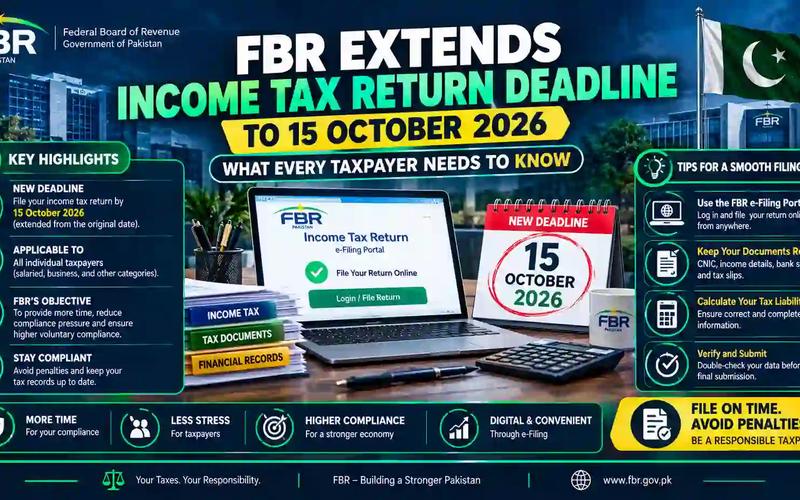
Last date to file income tax return in Pakistan for 2025-26: September 30, 2026.
For a complete IRIS login and filing walkthrough, read: FBR IRIS Login Guide — Step by Step
How to Check if Your Employer is Paying Your Tax to FBR
Many employees assume that once tax is deducted from their salary, the job is done. But your employer is legally required to deposit that withheld tax with FBR on your behalf — and sometimes, they don't.
Here is how to verify:
- Log in to your FBR IRIS account at iris.fbr.gov.pk
- Navigate to the "MIS" tab
- Click on "Payment Details"
- Cross-reference the amounts shown with your salary slips
If there is a discrepancy between what was deducted from your salary and what FBR shows, raise the issue with your employer's finance or payroll department immediately. Your employer is obligated by law to provide you with an annual Form 16 tax deduction certificate at year end.
Filer vs Non-Filer in Pakistan — Why Filing Returns Matters
Being an active taxpayer (filer) in Pakistan is not just about compliance — it literally saves you money on dozens of everyday transactions.
Non-filers pay higher withholding taxes on:
- Bank cash withdrawals
- Property purchases and sales
- Vehicle registration
- Mobile phone SIM card activation
- Imports and exports
Filers enjoy reduced rates on all of the above, meaning simply filing your return can save tens of thousands of rupees annually even if you owe no additional tax.
To check your filer status, visit the FBR Active Taxpayer List (ATL) or search by CNIC on the FBR verification portal.
Location-Specific Note: FBR Tax Rules Apply Uniformly Across Pakistan
Whether you are a salaried employee in Karachi, Lahore, Islamabad, Rawalpindi, Faisalabad, Peshawar, Quetta, Multan, Sialkot, Gujranwala, Hyderabad, Abbottabad, Bahawalpur, Sargodha, or Sukkur — the FBR income tax slabs 2025-26 are federal regulations and apply identically across all provinces and cities.
There is no provincial income tax on salaries in Pakistan. The only significant tax on salaries is federal income tax, administered exclusively by FBR.
That said, some provincial taxes may apply to non-salary income such as property and vehicles. For vehicle-related taxes, explore:
- Punjab Vehicle Verification and Token Tax Guide
- Sindh Vehicle Verification and Token Tax Guide
- Excise and Taxation Pakistan — Complete Overview
What Changed in 2025-26: Important Updates for Salaried Taxpayers
Staying current with FBR updates is essential. Here are the most important changes affecting salaried persons in Pakistan for 2025-26:
Removed Benefits (No Longer Available):
- The 25% tax rebate for full-time teachers and researchers has been abolished effective July 2025 and is no longer applicable.
- Deductions for interest or profit payments on housing loans (both conventional and Islamic banking) have been abolished.
Still Available:
- All major allowance exemptions (HRA, medical, conveyance) remain intact.
- Zakat, charitable donation credits, pension fund, and life insurance credits remain fully operational.
- The surcharge on incomes exceeding PKR 10 million remains at 9% for salaried individuals (10% for non-salaried).
For property-related tax updates, see: FBR Property Tax DC Rates Pakistan 2026
Advanced Tax Planning Strategies for High-Income Salaried Employees
If your annual salary exceeds PKR 2.2 million, you are in the higher tax brackets and should be thinking beyond basic allowance optimization.
Maximize Pension Fund Contributions
A voluntary pension scheme contribution of 20% of your annual income generates a full 20% tax credit — meaning the tax you would have paid on that income is reduced rupee for rupee. For someone in the 30% tax bracket, the combined saving (30% tax rate + 20% credit) is enormous.
Stack Multiple Deductions Strategically
Combine your Zakat deduction + charitable donation credit + pension contribution tax credit + life insurance premium tax credit in a single tax year. Each reduces your effective tax rate from a different angle.
Invest in Approved Schemes
Certain FBR-approved investment instruments qualify for additional deductions. Consult a tax advisor to identify instruments aligned with your risk profile.
Use the FBR Income Tax Calculator Before Year-End
Three months before the end of the tax year (April–June), run your numbers through the Income Tax Calculator Pakistan 2025-26 to estimate your liability and make last-minute legal investments to reduce it.
Common Mistakes Salaried Employees Make That Cost Them Money
Awareness of these errors can immediately protect your income:
- Not having allowances shown separately on the salary slip — If HRA and medical allowance are bundled into basic salary, you lose the exemption entirely.
- Not filing an annual return — Non-filers face higher withholding rates across dozens of transaction types.
- Missing the September 30 deadline — Late filing attracts penalties and late-filing surcharges under FBR regulations.
- Failing to verify employer tax deposits on IRIS — Your employer might be deducting tax but not depositing it to FBR, harming your tax record.
- Not claiming Zakat deduction — If Zakat was deducted from your bank account, it is a direct deduction many employees forget to claim.
- Not providing investment documentation to HR — If you contributed to a pension fund or paid life insurance premiums, give your employer proof before year-end so they adjust your monthly withholding downward.
Frequently Asked Questions (FAQs)
How can I legally reduce my salary tax in Pakistan?
You can legally reduce your salary tax by maximizing FBR-approved exempt allowances (HRA up to 45%, medical allowance up to 10%, conveyance up to PKR 50,000/year), claiming deductions for Zakat, charitable donations, pension contributions, and life insurance premiums under Section 62. Proper salary structuring with your employer is also a highly effective legal strategy.
What allowances are tax-free for salaried persons in Pakistan?
The main tax-exempt allowances for salaried persons in Pakistan are: House Rent Allowance (up to 45% of basic salary), Medical Allowance (up to 10% of basic salary or PKR 10,000/month, whichever is lower), Conveyance Allowance (up to PKR 50,000/year), Leave Encashment (within prescribed limits), and Gratuity (within FBR limits).
What is the tax-free income limit in Pakistan 2025-26?
The tax-free income threshold for salaried persons in Pakistan for 2025-26 is PKR 600,000 per year (PKR 50,000 per month). Income below this amount attracts zero income tax. However, this applies to your taxable income — your actual gross salary could be much higher after claiming all allowances and deductions.
How is income tax calculated on salary in Pakistan?
Income tax is calculated by: (1) determining gross annual salary, (2) subtracting all exempt allowances such as HRA and medical, (3) subtracting approved deductions like Zakat and pension contributions, (4) applying the relevant FBR tax slab rate to the resulting taxable income. Use the FBR Salary Tax Calculator for instant, accurate results.
Is medical allowance taxable in Pakistan 2025-26?
No. Medical allowance up to 10% of your basic salary (or PKR 10,000 per month, whichever is lower) is fully exempt from income tax in Pakistan — provided your employer does not separately reimburse actual medical expenses. If your employer offers direct medical reimbursement, then the allowance itself may become taxable.
What is the highest income tax rate for salaried persons in Pakistan?
The maximum income tax rate for salaried persons in Pakistan for 2025-26 is 35%, applicable on annual taxable income above PKR 4,100,000 (PKR 4.1 million). An additional 9% surcharge applies on total tax liability for incomes exceeding PKR 10 million.
Can pension fund contributions reduce my income tax in Pakistan?
Yes. Contributions to an FBR-approved pension fund qualify for a tax credit of up to 20% of your taxable income. This is one of the most powerful long-term tax saving strategies available to salaried employees in Pakistan.
What is withholding tax on salary in Pakistan?
Withholding tax on salary is the monthly income tax your employer deducts from your pay cheque and deposits directly with FBR on your behalf under Section 149 of the Income Tax Ordinance 2001. It is not an additional tax — it is an advance payment of your annual income tax liability.
What is the last date to file income tax return in Pakistan 2025-26?
The last date to file your income tax return for the tax year 2025-26 (July 2025 to June 2026) is September 30, 2026. Filing after this deadline attracts penalties and late filing surcharges under FBR regulations.
Is gratuity taxable in Pakistan?
Gratuity is exempt from income tax within limits prescribed by FBR. Government employees generally receive full tax-free gratuity. For private sector employees, the taxability depends on whether the gratuity scheme is FBR-approved. Consult your HR department or a certified tax advisor for your specific situation.
Conclusion: Start Reducing Your Salary Tax Today — Legally
Reducing your salary tax legally in Pakistan is not a loophole — it is your legal right under the Income Tax Ordinance 2001. The FBR has built these allowances and deductions into the system specifically to provide relief to salaried employees.
The key steps are straightforward:
- Make sure your salary slip shows all exempt allowances separately
- Claim every deduction you are entitled to — Zakat, pension, donations, life insurance
- File your annual income tax return on time via FBR IRIS
- Verify that your employer is depositing your withheld tax to FBR
- Maintain your active filer (ATL) status to save on dozens of transactions
The difference between a salaried employee who knows these rules and one who doesn't can easily be PKR 100,000 to PKR 300,000 or more in annual savings — all completely legal.
Ready to see exactly how much you owe — and how much you could save?
Use the free, FBR-updated Advanced Salary Tax Calculator Pakistan 2025-26 at Tax Calculators — no registration required, instant results, and fully aligned with the latest FBR slabs.
Also explore our full suite of free tools:
For related reading:
- Vehicle Tax and Registration Fee Calculator Pakistan
- Excise and Taxation Islamabad — Online Verification Guide
- Vehicle Verification Token Tax Pakistan — Full Comparison
Important disclaimer
This article is for educational planning only. It does not provide professional tax, legal, accounting, payroll, customs, or financial advice. Tax rules can change and final results may depend on your personal facts. Always verify important tax decisions with official sources or a qualified professional.
About the author
This article was written by the Tax Calculators Team, the group behind TaxCalculators.tools. Learn more about our team and editorial process.
Last reviewed: June 28, 2026