
If you received your July 2026 payslip and felt confused about why your take-home salary changed, you are not alone. Millions of salaried Pakistanis, freelancers, and business owners are searching for the same answer right now. The Pakistan Income Tax Calculator 2026-2027 is the fastest way to know exactly how much tax you owe — and this guide explains everything behind that number.
From updated FBR tax slabs and the abolished 9% surcharge to the difference between being a filer and a non-filer, this article covers it all in plain language. Whether you earn PKR 50,000 a month or PKR 10 million a year, you will know your exact tax liability, your take-home salary, and how to stay fully compliant with the Federal Board of Revenue by the time you finish reading.
What Is the Pakistan Income Tax Calculator 2026-2027?
A Pakistan income tax calculator for 2026-2027 is an online tool that applies the latest FBR tax slabs to your gross salary or business income and instantly tells you your annual tax liability, monthly tax deduction, and net take-home pay.
Instead of manually reading the Income Tax Ordinance 2001, cross-referencing Section 149 salary tax rates, and doing the math yourself, you enter one number and the calculator does everything in seconds.
The key benefit is accuracy. The Federal Board of Revenue updates its tax slabs every year through the Finance Act, and using an outdated formula can lead to underpayment penalties or overpayment. A properly updated FBR tax calculator 2026-27 uses the exact progressive slab rates notified by the Inland Revenue Service for FY 2026-27 (July 1, 2026 to June 30, 2027).
You can use the Pakistan Salary Tax Calculator for an instant, slab-by-slab breakdown of your monthly and annual deductions.
Why Income Tax Matters More in Pakistan in 2026
Pakistan's tax-to-GDP ratio has historically been among the lowest in the region. The government's answer to this has been a consistent push toward broadening the tax base, tightening enforcement through digital tools, and creating a sharp financial divide between filers and non-filers.
In 2026, that divide is wider than ever. Being off the Active Taxpayer List (ATL) does not just mean you pay more tax. It means:
- You pay double or triple withholding tax on property purchases and sales
- Banks deduct 0.6% withholding tax on cash withdrawals above PKR 50,000 (vs 0% for filers)
- Vehicle registration and transfer costs you significantly more
- FBR can block your SIM card, restrict travel, and initiate audit proceedings
For a practical breakdown of how filer vs non-filer status affects your vehicle taxes specifically, see this detailed guide on vehicle verification and token tax in Pakistan.
The bottom line is simple: understanding and using an accurate income tax calculator Pakistan 2026 is not optional anymore. It is the foundation of financially intelligent living.
FBR Income Tax Slabs 2026-27: What Changed This Year
The Finance Bill 2026 introduced meaningful relief for the salaried class. Here is the complete, updated salary tax slab structure for Tax Year 2027 (July 2026 to June 2027), applicable under Section 149 of the Income Tax Ordinance 2001:
Income Tax Slabs for Salaried Persons — FY 2026-27
Annual income up to PKR 600,000 — Tax Rate: 0% (Tax Free)
Annual income PKR 600,001 to 1,200,000 — Tax Rate: 1% of the amount exceeding PKR 600,000
Annual income PKR 1,200,001 to 2,200,000 — Tax Rate: PKR 6,000 plus 11% of the amount exceeding PKR 1,200,000
Annual income PKR 2,200,001 to 3,200,000 — Tax Rate: PKR 116,000 plus 23% of the amount exceeding PKR 2,200,000
Annual income PKR 3,200,001 to 4,100,000 — Tax Rate: PKR 346,000 plus 30% of the amount exceeding PKR 3,200,000
Annual income above PKR 4,100,000 — Tax Rate: PKR 616,000 plus 35% of the amount exceeding PKR 4,100,000
The biggest change in Budget 2026-27: The 9% surcharge previously applied to individuals earning above PKR 10 million annually has been completely abolished. High earners now pay only the standard progressive rate with no additional surcharge on top. A person earning PKR 1 million per month (PKR 12 million annually) saves over PKR 500,000 per year compared to last year.
The tax-free threshold of PKR 600,000 annually (PKR 50,000 per month) remains unchanged.
For a full side-by-side comparison of last year's rates versus this year's, read the Pakistan salary tax slabs breakdown.
How to Calculate Your Income Tax on Salary in Pakistan 2026
Pakistan uses a progressive tax system, meaning each portion of your income is taxed at its respective slab rate — not your entire income at one flat rate. Many people misunderstand this and end up overestimating their tax liability.
Here is the exact formula step by step:
Step 1: Calculate your annual gross income Multiply your monthly salary by 12. Example: PKR 150,000 × 12 = PKR 1,800,000
Step 2: Identify your tax slab PKR 1,800,000 falls in the third slab (1,200,001 – 2,200,000).
Step 3: Apply the progressive formula Tax = PKR 6,000 + 11% × (1,800,000 − 1,200,000) Tax = PKR 6,000 + 11% × 600,000 Tax = PKR 6,000 + PKR 66,000 Annual Tax = PKR 72,000
Step 4: Calculate monthly deduction Monthly Tax = PKR 72,000 ÷ 12 = PKR 6,000
So on a PKR 150,000 monthly salary, your employer deducts PKR 6,000 per month — and your net take-home is PKR 144,000.
Quick Reference: Tax on Common Salary Levels (2026-27)
Monthly salary PKR 50,000 — Annual income PKR 600,000 — Annual tax PKR 0 — Monthly tax PKR 0
Monthly salary PKR 100,000 — Annual income PKR 1,200,000 — Annual tax PKR 6,000 — Monthly tax PKR 500
Monthly salary PKR 150,000 — Annual income PKR 1,800,000 — Annual tax PKR 72,000 — Monthly tax PKR 6,000
Monthly salary PKR 200,000 — Annual income PKR 2,400,000 — Annual tax PKR 162,000 — Monthly tax PKR 13,500
Monthly salary PKR 300,000 — Annual income PKR 3,600,000 — Annual tax PKR 458,000 — Monthly tax PKR 38,167
Monthly salary PKR 500,000 — Annual income PKR 6,000,000 — Annual tax PKR 1,068,000 — Monthly tax PKR 89,000
These figures assume no deductions or tax credits. To understand how allowances like Zakat, pension fund contributions, and medical allowances reduce your taxable income, read the guide on how to reduce salary tax legally in Pakistan.
Also worth understanding: the difference between salary tax and income tax is not always obvious in Pakistan. This detailed explainer on salary tax vs income tax in Pakistan clears up the confusion.
Filer vs Non-Filer in Pakistan: The Complete 2026 Comparison
This is arguably the most important concept in Pakistani personal finance right now. Your FBR filer status determines not just what you owe in income tax — it determines what you pay on almost every significant financial transaction in your life.
Who is a Filer? A filer is any individual or business whose name appears on the Federal Board of Revenue's Active Taxpayer List (ATL). You get on this list by filing your annual income tax return before the deadline and paying any applicable ATL surcharge if you are a late filer.
Who is a Non-Filer? A non-filer is anyone who has not filed a return or who has filed but remains off the ATL. Non-filers are subject to significantly higher withholding tax rates under almost every provision of the Income Tax Ordinance 2001.
Withholding Tax Rates: Filer vs Non-Filer (2026-27)
Cash withdrawal from bank above PKR 50,000 — Filer: 0% — Non-Filer: 0.6%
Purchase of property — Filer: 1% — Non-Filer: 2%
Sale of property — Filer: 2.75% — Non-Filer: 5.5%
Vehicle purchase and registration — Filer: Standard rate — Non-Filer: Higher rate
Profit on bank savings account — Filer: Lower WHT — Non-Filer: 35% to 40%
Dividend income — Filer: 15% — Non-Filer: 25%
The property transfer rates have actually improved for non-filers in 2026-27 as the government tries to stimulate the construction sector. For purchasers, the rate dropped from 2.5% to 1.25% for filers. But the filer advantage remains substantial across every category.
For location-specific property tax rates, check the official FBR DC rates and property tax guide.
How to Become a Tax Filer in Pakistan in 2026: Step-by-Step
Becoming a filer costs nothing. It takes as little as 30 minutes if you have your documents ready. Here is exactly how to do it:
Step 1: Get Your NTN (National Tax Number)
For individuals, your 13-digit CNIC is your NTN. However, you still need to activate it in the FBR system.
Go to iris.fbr.gov.pk → Click "Registration for Unregistered Person" → Enter your CNIC, name, address, and income source.
FBR will send a One-Time Password (OTP) to your registered mobile number. Once verified, you receive login credentials.
Step 2: Log Into the FBR IRIS Portal
Visit iris.fbr.gov.pk and log in using your CNIC and the password received during registration. The IRIS 2.0 portal is significantly more user-friendly than previous versions.
For a full walkthrough with screenshots and solutions to common login errors, read the FBR IRIS login guide and the complete FBR IRIS portal guide for 2026-2027.
Step 3: Select the Correct Return Form
- Salaried individuals: Form 114 (Salary Income)
- Business income: Form 114 (Business/Non-Salaried)
- Companies and AOPs: Separate forms
Step 4: Declare Your Income
Enter all income heads: salary, rental income, profit on savings, capital gains, and any other sources. Attach your employer's salary certificate for salaried individuals.
Step 5: Submit Your Wealth Statement
The wealth statement (Reconciliation of Net Assets) is mandatory. It is a personal balance sheet showing your total assets (property, vehicles, bank balances, investments) and liabilities at the end of the tax year. If your assets grew, you need to justify the source of funds.
Step 6: Pay Any Tax Due and Submit
If there is a net tax payable after adjusting withholding tax already deducted, you pay online via PSID (Payment Slip ID). Once submitted, FBR issues an acknowledgement receipt. Your ATL status updates the following Sunday.
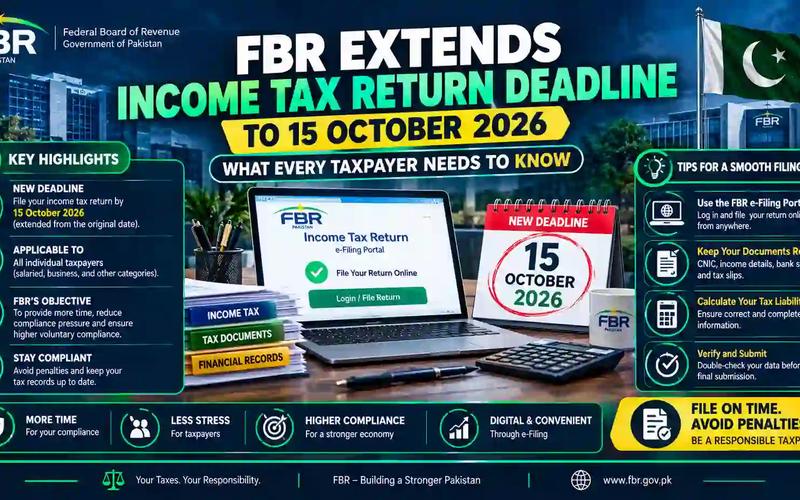
Tax Return Deadline 2026: The standard deadline for individual and salaried filers for Tax Year 2026 (July 2025 to June 2026) is September 30, 2026. FBR frequently grants extensions — monitor fbr.gov.pk for official announcements.
Business Tax Calculator Pakistan 2026: What Business Owners Need to Know
Business income in Pakistan is taxed differently from salary income. If your salary makes up less than 75% of your total taxable income, you are classified as a non-salaried individual and different tax rates apply.
For sole proprietors, partnerships (AOPs), and small business owners, the key concepts are:
Taxable Income Heads for Businesses:
- Income from business (net profit after expenses)
- Rental income from commercial property
- Capital gains on asset sales
- Income from other sources
Super Tax: The super tax, applicable to high-turnover companies and certain other categories, has been revised in the Finance Bill 2026. Individual business owners generally fall outside the super tax bracket, but companies with large revenues must account for it.
Advance Tax: Business owners are required to pay advance tax in quarterly installments during the tax year. If you underpay, you face a default surcharge.
For agricultural income, builder tax, and sector-specific rates, the FBR tax card 2026-27 is the official quick-reference document available on fbr.gov.pk.
Freelancer Income Tax Calculator Pakistan 2026
Pakistani freelancers — whether on Upwork, Fiverr, Toptal, or direct clients — have a uniquely favorable tax structure, but only if they are registered and compliant.
Key rules for freelancers in Pakistan 2026:
- Freelancers registered with PSEB (Pakistan Software Export Board) and earning IT export income enjoy a concessionary tax rate of 0.25% on foreign remittances
- This rate applies only to filers who hold a valid bank encashment certificate showing the remittance source
- Unregistered freelancers who are not on the ATL pay standard income tax rates
- Foreign remittances without documentation can be treated by FBR as unexplained income — a serious audit risk
To file as a freelancer, you declare income under the IT exports head on the IRIS portal, attach your encashment certificate, and maintain PSEB registration for the concessionary rate.
Non-resident Pakistanis earning income in Pakistan must also file if they maintain high-value bank accounts or property here.
Allowable Deductions Before Calculating Income Tax in Pakistan
One of the biggest mistakes taxpayers make is calculating tax on gross income without considering legal deductions. The Income Tax Ordinance 2001 allows several deductions that reduce your taxable income:
Deductions and Tax Credits Available in 2026:
- Zakat: Zakat paid on savings deducted under Section 60 reduces taxable income directly
- Pension Fund Contributions: Contributions to approved pension funds are deductible up to certain limits
- Medical Allowance: Up to 10% of basic salary is generally exempt from salary tax
- Tuition Fee Credit: Tax credit for children's education fees at accredited institutions
- Housing Loan Interest: Interest on loans from recognized banks for residential property
- Investment in Approved Schemes: Certain government savings schemes qualify for tax credit
- Charitable Donations: Donations to approved nonprofit organizations earn a tax credit
Teachers and Researchers: Full-time teachers and researchers at HEC-recognized universities and research institutions are eligible for up to a 25% reduction in their income tax liability, subject to FBR conditions.
Using all eligible deductions and credits can significantly reduce your annual tax. This is not tax avoidance — it is legal tax planning.
How to Check Your ATL Status in Pakistan 2026
Checking your Active Taxpayer List status takes under 60 seconds:
Method 1: SMS Send your 13-digit CNIC number as an SMS to 9966. You will receive a reply confirming whether you are on the ATL.
Method 2: FBR Website Go to fbr.gov.pk → Online Verification Portal → ATL (Income Tax) → Enter your CNIC or NTN.
Method 3: IRIS Portal Log in to iris.fbr.gov.pk and check your taxpayer profile. Your ATL status is visible in the dashboard.
The ATL updates every Sunday. If you filed your return and paid the applicable ATL surcharge, your name should appear on the list within a week.
Vehicle and Property Tax: Why Your Filer Status Changes Everything
Two of the highest-value transactions most Pakistanis make — buying property and registering a vehicle — have dramatically different costs depending on whether you are a filer or non-filer.
Vehicle Token Tax and Registration
Token tax is an annual motor vehicle tax paid to the provincial excise department. It varies by province, engine capacity, and vehicle type. In Punjab, for example, the 2026 token tax rates have been updated, and verification can now be done online.
For Punjab-specific token tax rates and online verification: Punjab vehicle verification and token tax guide.
For Sindh-specific verification: Sindh vehicle verification and token tax guide.
For Islamabad Excise and Taxation online verification and tax payment: Islamabad excise verification guide.
For a complete national comparison of vehicle registration fees and token tax by province: Calculate vehicle tax and registration fee in Pakistan.
For a broader overview of excise and taxation in Pakistan: Excise and Taxation Pakistan guide.
Property Tax and FBR DC Rates
When you buy or sell property, FBR applies withholding tax under Section 236C (seller) and Section 236K (buyer). The tax rate differs based on your ATL status and the FBR District Collector (DC) valuation of the property.
Budget 2026-27 reduced these rates for both buyers and sellers as part of the government's effort to stimulate the construction sector.
Location-Specific Tax Filing in Pakistan: Rawalpindi, Lahore, Karachi, Islamabad
Tax filing in Pakistan is fully digital through the IRIS portal, meaning you can file from anywhere in the country — or from abroad. However, many taxpayers prefer working with a local tax consultant for their first filing.
FBR Regional Tax Offices (RTOs) — Key Cities:
- Islamabad / Rawalpindi: RTO Islamabad (serves the federal capital and Rawalpindi Division)
- Lahore: RTO-I and RTO-II Lahore (Pakistan's busiest tax jurisdiction)
- Karachi: CRTO Karachi (corporate RTO for South Pakistan)
- Multan, Faisalabad, Peshawar, Quetta: Regional RTOs serving each provincial area
For residents of Islamabad and Rawalpindi specifically, excise and taxation services including vehicle token verification, ownership transfer, and registration fee calculation are handled through the Islamabad Excise portal and accessible via the Islamabad excise and taxation guide.
Regardless of your city — whether you are filing income tax in Karachi, registering a business in Lahore, or paying token tax in Faisalabad — the FBR IRIS 2.0 portal is the single gateway for all income tax compliance.
Penalties for Non-Filers in Pakistan 2026: What You Risk
Many people assume that not filing is just a minor inconvenience. The reality in 2026 is far more serious.
Penalties for late or non-filing:
- PKR 1,000 per day of default with a minimum of PKR 40,000 (for individuals)
- For concealment of income: up to 200% of the evaded tax
- Removal from ATL, triggering higher withholding tax rates immediately
- SIM card blockage — FBR can request NADRA/PTA to block mobile numbers of persistent non-filers
- Travel restrictions — non-filers can be placed on the Exit Control List for large tax defaults
- Increased risk of FBR notice, audit, and prosecution
Even if your income is below the PKR 600,000 tax-free threshold, filing a nil return costs nothing and keeps you on the ATL. The protection it gives you across all financial transactions is worth far more than the 30 minutes it takes.
FBR IRIS 2.0 Portal: What's New in 2026
FBR's IRIS 2.0 — built by Pakistan Revenue Automation Limited (PRAL) — is a significant upgrade over the original system. Key improvements include:
- Faster login and OTP-based authentication
- Integrated e-payment via PSID directly within the portal
- Cleaner dashboard showing filing history, ATL status, and pending notices
- Improved mobile responsiveness for filing on smartphones
- Better error messaging for common mistakes during return filing
For a complete step-by-step guide to navigating every section of the portal, including how to handle the most common error messages, see the FBR IRIS portal guide 2026-2027.
The official portal is at iris.fbr.gov.pk. The old eFBR portal (fbr.gov.pk) still serves as the main information hub, but all actual filing, payment, and NTN registration happens exclusively on IRIS.
For Business Owners: eCommerce and Sales Tax Nexus in Pakistan
If you run an eCommerce business in Pakistan — or sell internationally — the concept of sales tax nexus is increasingly relevant. As the government moves toward a more documented digital economy, FBR has extended its monitoring to online transactions, digital services, and cross-border sales.
Understanding when and where you have a sales tax obligation can save you from costly penalties. For a detailed breakdown of eCommerce sales tax nexus rules: eCommerce Sales Tax Nexus Guide.
Frequently Asked Questions (FAQs)
How is income tax calculated in Pakistan 2026-27?
Pakistan uses a progressive tax slab system under Section 149 of the Income Tax Ordinance 2001. Each portion of your annual income is taxed at the rate applicable to that slab — not your entire income at one rate. Multiply your monthly salary by 12, find your annual income's slab, apply the formula, and divide by 12 for your monthly deduction. The tax-free threshold for salaried persons in FY 2026-27 is PKR 600,000 annually.
What are the income tax slabs for salaried persons in Pakistan 2026-27?
The six slabs are: 0% up to PKR 600,000; 1% from PKR 600,001 to 1,200,000; 11% on the amount above PKR 1,200,000 up to 2,200,000 (plus PKR 6,000 fixed); 23% on the amount above PKR 2,200,000 up to 3,200,000 (plus PKR 116,000); 30% on the amount above PKR 3,200,000 up to 4,100,000 (plus PKR 346,000); and 35% on all income above PKR 4,100,000 (plus PKR 616,000).
What is the tax-free income limit in Pakistan 2026?
The tax-free threshold for salaried individuals in FY 2026-27 is PKR 600,000 per year, or PKR 50,000 per month. If your monthly salary is PKR 50,000 or below, you pay zero income tax.
How much income tax is deducted on a PKR 100,000 monthly salary?
On a PKR 100,000 monthly salary (PKR 1,200,000 annual income), the total annual tax is PKR 6,000 — which equals PKR 500 per month. Your net take-home salary is PKR 99,500 per month.
What is the difference between a filer and non-filer in Pakistan?
A filer is any person listed on FBR's Active Taxpayer List (ATL) who has filed their income tax return. A non-filer is anyone not on the ATL. Non-filers pay significantly higher withholding tax rates on bank transactions, property purchases, vehicle registration, and more — sometimes double the filer rate.
How can I become a tax filer in Pakistan in 2026?
Register on the FBR IRIS portal at iris.fbr.gov.pk using your CNIC, file your income tax return before September 30, 2026, submit your wealth statement, and pay any tax due. Your name appears on the ATL the following Sunday. The process is completely free and takes 30–60 minutes for first-time filers.
How do I check my ATL filer status by CNIC?
Send your 13-digit CNIC as an SMS to 9966 for an instant ATL check. Alternatively, visit fbr.gov.pk → Online Verification → ATL (Income Tax) and enter your CNIC.
Is the 9% surcharge still applicable in Pakistan 2026-27?
No. The 9% income surcharge previously applied to individuals earning above PKR 10 million annually has been fully abolished for Tax Year 2027 (FY 2026-27). High earners now pay only the standard progressive slab rates with nothing added on top.
What is the last date to file income tax return in Pakistan 2026?
The standard deadline for individual and salaried income tax return filing in Pakistan is September 30, 2026 (for Tax Year 2026, covering July 2025 to June 2026). FBR frequently grants extensions — always check fbr.gov.pk for any official notifications of deadline changes.
What happens if you do not file income tax return in Pakistan?
You face penalties of PKR 1,000 per day (minimum PKR 40,000), lose your ATL filer status, face higher withholding taxes on all major transactions, risk SIM card blockage, travel restrictions, and increased FBR audit and prosecution risk. Even a nil return should be filed to avoid all these consequences.
What deductions are allowed before income tax in Pakistan?
Allowable deductions include Zakat paid on savings, pension fund contributions, medical allowance (up to 10% of basic salary), tuition fee credits for children's education, housing loan interest, and donations to approved charities. Teachers and researchers at HEC-recognized institutions are eligible for up to a 25% reduction in tax liability.
How do freelancers pay income tax in Pakistan 2026?
Freelancers register on iris.fbr.gov.pk, declare income under the IT exports head, and benefit from a concessionary 0.25% tax rate on foreign remittances if registered with PSEB (Pakistan Software Export Board) and holding a valid bank encashment certificate. Unregistered or non-filer freelancers pay standard income tax rates.
Can I file a nil return on the FBR IRIS portal?
Yes. If your income is below PKR 600,000 or you have no taxable income, you can file a nil return. This keeps you on the Active Taxpayer List and protects you from higher withholding taxes across all transactions.
What is the wealth statement in Pakistan income tax?
The wealth statement — formally called the Reconciliation of Net Assets — is a mandatory section of every income tax return in Pakistan. It is a personal balance sheet listing all your assets (property, vehicles, bank accounts, investments, cash) and liabilities at the end of the tax year. If your assets grew during the year, you must show the source of funds.
Conclusion: File Smart, Save More in 2026-27
Pakistan's tax landscape in 2026-27 has genuinely improved for the salaried class. The abolished surcharge, revised slabs, and reduced property transaction rates are real relief for millions of taxpayers. But none of these benefits reach you automatically — you have to be in the system to take advantage of them.
The difference between a filer and a non-filer in Pakistan today is not just a legal technicality. It is a financial gap that affects every major decision you make, from buying a home to registering a car to withdrawing money from your bank account.
Start by calculating your exact tax liability using our Pakistan Salary Tax Calculator. Then, if you are not yet a filer, register on the FBR IRIS portal today — before the September 30, 2026 deadline closes.
Financial clarity and full tax compliance are not two separate things in Pakistan anymore. They are the same thing.
Use the free advanced tax calculators at Tax Calculators to calculate your salary tax, token tax, property tax, vehicle registration fee, and more — all in one place, updated with the latest FBR rates for 2026-27.
Important disclaimer
This article is for educational planning only. It does not provide professional tax, legal, accounting, payroll, customs, or financial advice. Tax rules can change and final results may depend on your personal facts. Always verify important tax decisions with official sources or a qualified professional.
About the author
This article was written by the Tax Calculators Team, the group behind TaxCalculators.tools. Learn more about our team and editorial process.
Last reviewed: July 1, 2026