If you own a vehicle in Punjab, you've probably heard the term "token tax" more times than you'd like. Between renewing it every year, verifying a used car before buying it, and keeping track of changing rules, the whole process used to mean long queues outside excise offices. That's changed. The Excise and Taxation Department Punjab now runs most of these services online — from vehicle verification to token tax payment — and in 2026, the department has rolled out even more digital upgrades, including biometric verification and faster re-registration for vehicles moving into Punjab from other provinces. This guide walks you through exactly how online vehicle verification and token tax payment work in Punjab right now, what's new this year, and how to avoid the common mistakes that trip people up.
What Is the Excise and Taxation Department Punjab?
The Excise, Taxation and Narcotics Control Department, Punjab is the provincial body responsible for collecting vehicle taxes, property taxes, professional taxes, and excise duties across Punjab. It also manages vehicle registration, ownership transfers, and the database that tracks every registered vehicle in the province.
Historically, this meant a citizen had to physically visit a district excise office for almost everything — registering a new car, paying annual token tax, or confirming whether a used car had a clean tax record. Over the past decade, the department partnered with the Punjab Information Technology Board (PITB) to digitize most of these services. Today, the two pillars of this digital system are MTMIS (Motor Transport Management Information System) for vehicle verification, and e-Pay Punjab for tax payments.
The department doesn't only handle vehicles, either. It also oversees property tax, professional tax, and excise duty collection. If you're a property owner as well, our Property Tax Calculator can help you estimate your dues, and our complete guide to Excise and Taxation in Pakistan breaks down how the system works province by province.
Why Online Vehicle Verification Matters in 2026
Vehicle fraud isn't rare in Pakistan. Cloned number plates, vehicles sold without clearing pending challans, and forged ownership documents are problems buyers run into more often than they'd expect. With the rise of online car marketplaces and increased traffic enforcement through e-challan cameras and Safe City systems, a vehicle's digital record now matters more than its paperwork.
Here's why verification has become a non-negotiable step before any vehicle transaction:
- It confirms the vehicle is genuinely registered and not reported stolen or cloned.
- It shows whether token tax and challans are paid up to date, which protects a buyer from inheriting someone else's unpaid dues.
- It verifies that the chassis and engine numbers match official records, reducing the risk of buying a vehicle involved in a crime.
- It speeds up ownership transfer, since a clean digital record means fewer delays at the excise office.
In short, skipping verification isn't just risky — it's avoidable, since the whole check now takes under a minute online.
What's New in Punjab Excise Rules for 2026
A few meaningful changes are rolling out this year that vehicle owners should know about:
Biometric verification through the Pak Identity App. The department has introduced biometric confirmation for vehicle registration and ownership transfer, tying records directly to a citizen's verified identity. This is meant to close the loophole where vehicles were transferred using forged CNICs or proxy signatures.
Re-registration for vehicles from other provinces. If you've moved to Punjab with a vehicle registered in Sindh, KPK, or Islamabad, the department has streamlined the re-registration process so out-of-province vehicles can be properly added to the Punjab database without the older, more cumbersome paperwork trail.
Continued digitization under the "Apni Gari, Apna Registration Number" initiative, which lets owners choose and reserve a personalized registration number online rather than receiving one at random.
These updates are part of a broader push toward a centralized vehicle database that keeps registration, tax, and ownership records synchronized — reducing the kind of mismatched records that used to cause headaches during resale.
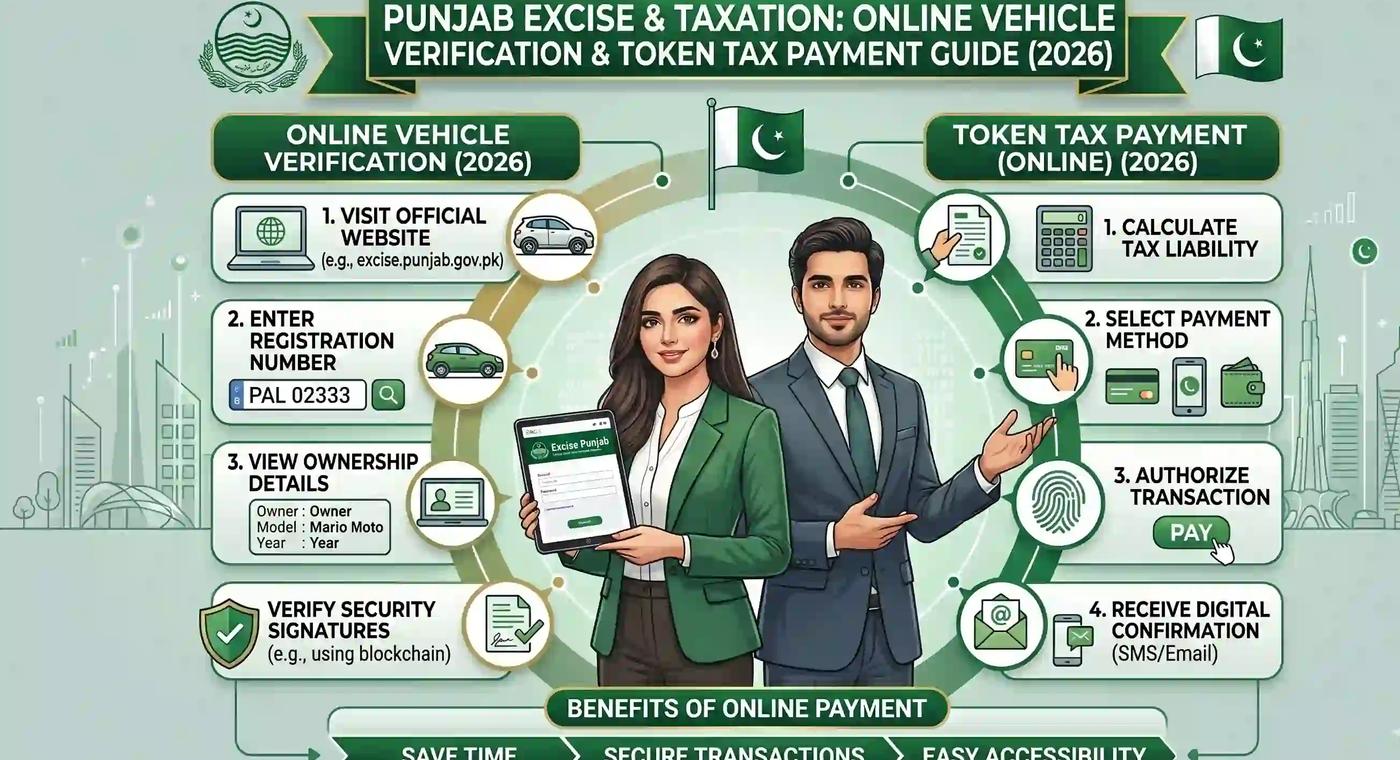
How to Verify a Vehicle Online in Punjab (MTMIS Step-by-Step)
MTMIS is the backbone of Punjab's vehicle verification system, built by PITB in partnership with the Excise Department. You can verify a vehicle in three main ways.
Verification by Registration Number
- Visit the official MTMIS Punjab portal.
- Select the vehicle verification option.
- Enter the registration number exactly as it appears on the number plate or smart card — formatting matters, so try with and without dashes if the first attempt doesn't return results.
- Complete the captcha and submit.
- The system displays the vehicle's make, model, color, chassis number, engine number, registered owner, and current token tax status.
Verification by CNIC
If you want to check every vehicle registered under a specific CNIC (useful when verifying a seller's full ownership history), the portal also supports CNIC-based lookup. Enter the 13-digit CNIC without dashes, complete the captcha, and the system returns all vehicles linked to that identity.
SMS-Based Verification
For a quicker check without internet access, the department also offers an SMS verification channel — you send the vehicle's registration number as a text message to the designated short code, and receive ownership and tax details back instantly. This is particularly handy when you're physically inspecting a car and want a fast second opinion before negotiating a price.
Whichever method you use, treat verification as a mandatory pre-purchase step, not an optional one. A five-minute check can save you from a legal and financial mess down the line.
How to Pay Token Tax Online in Punjab (e-Pay Punjab Step-by-Step)
Token tax is the annual fee every registered vehicle owner in Punjab must pay to legally use public roads. Missing the deadline triggers late fees, and in some cases, your vehicle can be flagged during a routine police check. Thankfully, you no longer need to visit an excise office to pay it.
Using the e-Pay Punjab App
- Download the e-Pay Punjab app from the Google Play Store or Apple App Store, or use the e-Pay Punjab web portal.
- Register using your name, CNIC, and mobile number.
- Log in and navigate to the Excise and Taxation Department section.
- Select "Token Tax" and enter your vehicle's registration number.
- The app pulls your vehicle's record from MTMIS and displays the exact amount due, including any late fee.
- Generate a challan, which produces a unique PSID (Payment Slip ID) number.
- Pay using your preferred method — debit/credit card, mobile wallet, or online banking.
- Save the digital receipt as confirmation; you'll typically also get an SMS once the payment reconciles in the system.
Paying Through Bank Channels Using the PSID
Once you have the PSID, you're not limited to the app. You can also pay through:
- Internet banking (almost all major Pakistani banks support PSID-based government payments)
- ATM transactions
- Over-the-counter payment at any partner bank branch
- Mobile wallets like JazzCash or Easypaisa
This flexibility is one of the biggest advantages of the e-Pay system — the PSID works the same way regardless of which channel you choose, and the payment reflects in MTMIS shortly afterward.
How Token Tax Is Calculated in Punjab
Token tax amounts depend on a combination of factors: engine capacity, vehicle type (private, commercial, motorcycle), whether the vehicle is locally manufactured or imported, and in some categories, the vehicle's invoice value rather than just engine size. In recent budgets, the province has shifted parts of the calculation toward value-based taxation for certain engine capacity brackets, alongside the traditional cc-based slabs that still apply to smaller vehicles and motorcycles.
Because these rates are revised in the provincial budget — usually announced each June or July — the exact figures can shift from year to year, and even small changes in vehicle classification can affect what you owe. Rather than relying on outdated rate tables, the safest approach is to check the current rate directly. You can get an accurate, up-to-date estimate using our Vehicle Token Tax Calculator, which is updated to reflect the latest Punjab rates, or cross-check the amount through the MTMIS portal before making a payment.
If you're also dealing with advance tax on a vehicle purchase or transfer, our Advance Tax Calculator can help you estimate that separately.
Documents Required for Token Tax Payment and Vehicle Verification
Keep these on hand before starting either process:
- Vehicle registration number (as printed on the smart card or registration book)
- CNIC of the registered owner
- Chassis and engine number, in case the system asks for secondary verification
- Previous token tax receipt, if you have one, for reference
- Smart card or registration book, for any in-person follow-up if the online record needs correction
For ownership transfers, you'll additionally need the seller's CNIC, a signed transfer application, and in 2026, biometric confirmation through the Pak Identity App for both parties.
Common Problems and How to Fix Them
Even a well-built digital system runs into friction. Here are the issues people report most often, and what actually fixes them:
Vehicle not found in the system. This is almost always a formatting issue. Try the registration number with and without dashes or spaces, and double-check you're not mixing up similar-looking characters (like 0 and O).
Payment made but record not updated. MTMIS updates typically take a few days to sync after payment, especially during high-traffic periods near the tax deadline. Keep your digital receipt — if the record still isn't updated after a week or two, you can follow up with your local excise office using the receipt as proof.
Ownership shows the previous owner after transfer. Transfers involving biometric verification can take longer to process than a simple tax payment. If it's been more than two weeks, visit the excise office with both parties' CNICs and the transfer receipt.
Challans not appearing alongside token tax. Older challans sometimes sync separately from the main token tax record. If a challan you know exists isn't showing up, report it directly to the excise office rather than assuming it's been waived.
Late fee looks miscalculated. Late fees are usually calculated automatically based on how many months have passed since the due date. If the number looks off, it's worth verifying the original due date on your registration documents before assuming it's an error.
District-Wise Excise and Taxation Offices in Punjab
Punjab's excise services are decentralized at the district level, so while most transactions can be done online, you may still need an in-person visit for transfers, smart card issuance, or correcting database errors. Major district offices include:
- Lahore — multiple zonal offices, including Region-A and DHA Lahore
- Rawalpindi — handles vehicle registration and token tax for the Rawalpindi division
- Faisalabad — covers central Punjab's industrial belt
- Multan — based at MDA Chowk, serving South Punjab
- Gujranwala — serves the Gujranwala division
- Sialkot — handles registration and verification for Sialkot district
- Bahawalpur — covers South Punjab's Bahawalpur division
- Sargodha — serves central-north Punjab
If you're unsure which office handles your vehicle's district, the Excise, Taxation and Narcotics Control Department, Punjab website lists contact details and office locations under its regional directory.
Excise and Taxation Punjab vs Other Provinces
Each province in Pakistan runs its own excise and taxation system, and the rules don't always match. Sindh's excise department operates a separate online verification and token tax portal for vehicles registered in Karachi, Hyderabad, and other Sindh cities. KPK's Excise, Taxation and Narcotics Control Department runs its own system out of Peshawar, with different rate structures for token tax. Islamabad, being a federal territory, has its own excise and taxation office handling token tax separately from Punjab, even though many ICT-registered vehicles are driven daily within Punjab.
The practical takeaway: a vehicle's token tax and verification status is tied to where it's registered, not where it's currently being driven. If you're buying a car registered outside Punjab, you'll need to verify it through that province's system first, then go through Punjab's re-registration process if you plan to keep it here long-term.
Frequently Asked Questions
What is the Excise and Taxation Department Punjab? It's the provincial government body responsible for collecting vehicle token tax, property tax, and professional tax, and for managing vehicle registration and verification records across Punjab.
How do I check my vehicle's token tax online? Visit the official MTMIS Punjab portal, enter your vehicle's registration number, and the system will display your current token tax status along with any pending dues.
Can I pay vehicle token tax online without visiting the excise office? Yes. The e-Pay Punjab app and website let you generate a payment challan and pay through banking channels, mobile wallets, or ATMs, entirely online.
What happens if I don't pay token tax on time? A late fee is automatically applied based on how long the payment is overdue. Unpaid token tax can also surface during routine traffic stops or vehicle verification checks.
How long does it take for MTMIS records to update after payment? Most payments reflect within a few days, though it can occasionally take longer during peak periods. Always keep your digital receipt as proof in case of delay.
Is MTMIS Punjab free to use? Yes, verifying a vehicle through MTMIS is completely free. You only pay when settling actual token tax or transfer fees.
Final Thoughts
Punjab's shift toward online vehicle verification and token tax payment has made vehicle ownership significantly less of a hassle than it used to be. Whether you're renewing your annual token tax, checking a used car before buying it, or transferring ownership under the new biometric requirements, the process is now mostly something you can handle from your phone. The key is staying current — rates change yearly, and a quick verification check before any transaction can save you from problems that are far more expensive to fix later.
If you're estimating what you owe, start with our Vehicle Token Tax Calculator for an instant, accurate figure based on current Punjab rates. And if you're managing property tax alongside vehicle tax this year, our guide to FBR property tax and DC rates in Pakistan for 2026 covers that side in full. You can also explore our full range of free tax calculators for every major tax category in Pakistan.
Important disclaimer
This article is for educational planning only. It does not provide professional tax, legal, accounting, payroll, customs, or financial advice. Tax rules can change and final results may depend on your personal facts. Always verify important tax decisions with official sources or a qualified professional.
About the author
This article was written by the Tax Calculators Team, the group behind TaxCalculators.tools. Learn more about our team and editorial process.
Last reviewed: June 20, 2026