Managing sales tax compliance for e-commerce businesses has become increasingly complex in today's digital marketplace. Whether you're selling products online through Amazon, running your own Shopify store, or operating a dropshipping business, understanding sales tax nexus and your multi-state tax liability is no longer optional—it's essential for legal compliance and financial stability.
This comprehensive guide walks you through everything you need to know about e-commerce sales tax nexus, economic nexus rules, and how to accurately calculate your tax obligations across different jurisdictions. We'll also explore related topics like vehicle registration token taxes and how online sellers can avoid costly penalties.
What is Sales Tax Nexus? Understanding the Basics
Defining Sales Tax Nexus and Its Importance
Sales tax nexus refers to the connection or relationship between a business and a state that establishes the business's obligation to collect and remit sales tax. This concept has transformed dramatically over the past five years, fundamentally changing how online sellers operate.
Traditionally, physical nexus—which required a tangible presence like an office, warehouse, or employee in a state—was the only trigger for sales tax obligations. However, the landscape shifted significantly, and today's economic nexus rules mean that even businesses without any physical presence in a state may still have to collect sales tax.
The Two Types of Nexus Every Online Seller Should Know
Physical Nexus: This occurs when your business has a tangible presence in a state. Examples include:
- A brick-and-mortar location or office
- A warehouse or fulfillment center
- Employees or contractors working in the state
- Property or inventory stored in the state
Economic Nexus: This is the newer threshold that has revolutionized e-commerce sales tax compliance. Economic nexus is triggered when your business exceeds certain sales thresholds or transaction volumes in a state, regardless of physical presence. Most states use one of these metrics:
- Annual gross sales revenue (typically $100,000 to $500,000)
- Transaction count (usually 200+ transactions per year)
- A combination of both revenue and transaction thresholds
For a detailed breakdown of current rules, you can explore comprehensive guides on excise and taxation regulations in Pakistan and similar frameworks that apply internationally.
Economic Nexus Thresholds by State: What You Need to Know
The Current Landscape of State Sales Tax Rules
The sales tax nexus threshold by state varies considerably, which is why tracking your revenue by jurisdiction is critical. Here's what you need to understand:
High Threshold States ($500,000+):
- Connecticut: $250,000 threshold
- Illinois: $500,000 threshold
- New Hampshire: $500,000 threshold
Standard Threshold States ($100,000-$250,000):
- California: Generally no specific threshold; all remote sellers collect
- Most other states: $100,000 annual revenue threshold
- Some states: $500 per year in transaction count
Special Considerations:
- Some states have different thresholds for marketplace facilitators vs. direct sellers
- A few states use a transaction-based nexus approach exclusively
- Several states have safe harbor provisions for sellers under certain thresholds
The distinction between revenue threshold analysis and transaction volume nexus matters significantly for your business. A seller with 300 high-value transactions might exceed one state's threshold while another seller with 1,000 low-value transactions triggers nexus elsewhere.
Marketplace Facilitator Rules and Your Obligations
One of the most important developments in online sales tax compliance involves marketplace facilitator rules. When you sell through Amazon, eBay, Etsy, or Shopify, these platforms often assume responsibility for collecting and remitting sales tax on your behalf—but this doesn't eliminate your tax obligations entirely.
Marketplace facilitator laws require large online platforms to collect sales tax from the buyer, not the seller. However, you should still:
- Understand which states your marketplace operates in
- Know that you might have additional filing requirements
- Be aware that some states require you to file returns even if the facilitator collected tax
The relationship between marketplace seller sales tax liability and direct sales is crucial. If you sell both through and outside of marketplaces, you need separate tracking systems for each sales channel.
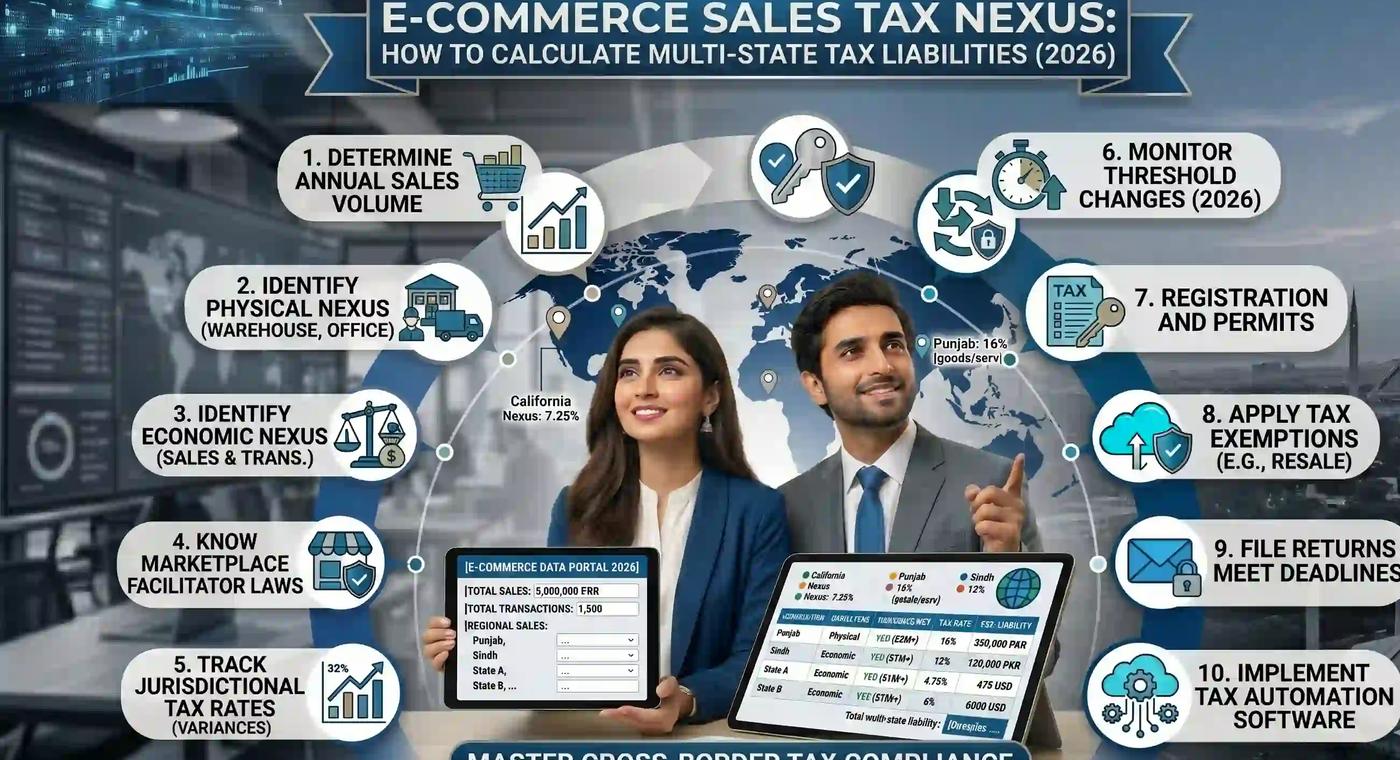
How to Calculate Multi-State Sales Tax Liability: A Step-by-Step Process
Step 1: Track Your Revenue by State
The foundation of accurate tax liability calculation is meticulous revenue tracking. Here's how to do it properly:
What to Track:
- Gross revenue (not profits) in each state where you make sales
- Transaction counts if your states use transaction-based nexus
- Date when you cross each state's nexus threshold
Tools to Consider:
- Accounting software like QuickBooks that categorizes sales by location
- Sales tax management software platforms designed for multi-state tracking
- Custom spreadsheets if you have low transaction volumes
The moment you understand how to calculate sales tax for online sales, you'll realize that precise record-keeping is non-negotiable.
Step 2: Determine Your Nexus Status in Each State
Once you've tracked your revenue, compare it against each state's economic nexus threshold:
- If your annual sales in California exceed $100,000, you have economic nexus there
- If your New York transactions exceed their threshold, nexus is triggered
- Track the specific month and year you cross these thresholds
This is where the difference between gross revenue calculation and net income becomes important. Remember: states care about gross sales, not profit margins.
Step 3: Register for Sales Tax in Triggered States
When does your business have sales tax nexus? The moment you exceed a state's threshold. At that point, you must:
- Register for a sales tax permit in that state (usually through their Department of Revenue)
- Understand the state's tax filing requirements
- Learn the state's specific tax registration by state procedures
For example, if you're selling in Texas and exceed their threshold in March, you should register by April at the latest. Delaying registration can result in penalties, interest, and back taxes.
If you're managing Pakistani business taxes and need to understand similar concepts, our guide on calculating vehicle tax and registration fees provides parallel insights into tax obligation timelines.
Step 4: Calculate and Collect the Correct Tax Amount
Once registered, you must understand sales tax requirements for that specific state:
- Look up the state's current sales tax rates on the state revenue department website
- Understand which products are taxable vs. non-taxable in that state
- Apply the correct rate to each transaction
This is where tools help significantly. A sales tax calculator can automate this process, ensuring accuracy across all your sales channels.
Step 5: File Returns and Remit Tax on Schedule
Each state has different tax filing requirements and schedules. Some require:
- Monthly filings (high-volume states)
- Quarterly filings (moderate-volume states)
- Annual filings (lower-volume states)
Create a tax filing deadlines calendar to ensure you never miss a deadline, as tax penalty costs can exceed the tax itself.
State-by-State Sales Tax Rate Comparison
Understanding Variation Across Major Markets
Different states have dramatically different approaches to sales tax. Here's a snapshot:
States with No Sales Tax:
- Alaska, Delaware, Montana, New Hampshire, Oregon (no state sales tax)
- These states offer tax advantages but may have other business taxes
High Sales Tax States:
- California: 7.25% (but local jurisdictions add up to 2.25% more)
- Tennessee: 9.55% (one of the highest rates)
- Louisiana: 7.0% baseline
- Arkansas: 6.5% baseline
Low Sales Tax States:
- Colorado: 4.63% baseline
- Georgia: 4.0% baseline
- Hawaii: 4.0% baseline
The difference in state sales tax rates means that a $1,000 sale generates $85 in tax liability in California but $0 in Montana. This is why sales tax rates comparison is essential for understanding your actual obligations.
The Role of Tax Compliance Software in Multi-State Management
Why Manual Calculation Isn't Sufficient Anymore
How much sales tax do I owe as an online seller? This question becomes impossible to answer accurately without proper systems. Here's why:
- Complexity: Over 13,000 different tax jurisdictions exist across the U.S.
- Rate Changes: States update rates regularly (sometimes multiple times per year)
- Taxability Rules: Products taxed in one state might be tax-exempt in another
- Threshold Tracking: Missing a $100 sale could mean the difference between compliance and non-compliance
Benefits of Automated Tax Solutions
Using sales tax management software or a sales tax calculator online offers:
- Accuracy: Eliminates human error in rate selection
- Efficiency: Automates tax calculation on every transaction
- Compliance: Maintains audit trails and documentation
- Reporting: Generates ready-to-file tax documents
- Updates: Automatically incorporates rate changes and rule updates
For U.S. sellers, tools like Avalara, TaxJar, and similar platforms integrate with your e-commerce system and calculate sales tax automatically. For Pakistani businesses managing similar complexities, our FBR tax calculator serves similar purposes.
Common Nexus Scenarios and How They Apply to Your Business
Scenario 1: The Amazon Seller with No Physical Presence
Situation: You sell products exclusively through Amazon with no physical location anywhere.
What Happens:
- Amazon handles tax collection in most states as a marketplace facilitator
- However, you still need to file a sales tax return in states where Amazon collects
- You should file informational returns showing your sales
Your Obligation: Monitor your annual sales to ensure you haven't exceeded any marketplace nexus thresholds that would require direct collection.
Scenario 2: The Multi-Channel Seller
Situation: You sell through Amazon, your own Shopify store, and a Facebook shop.
What Happens:
- Amazon may collect sales tax on Amazon sales
- You're responsible for your Shopify store sales
- You're responsible for Facebook marketplace sales
Your Obligation: Aggregate sales across all channels to determine multi-state nexus. A $60,000 Amazon threshold plus $50,000 Shopify sales equals $110,000, potentially exceeding economic nexus in your state.
Scenario 3: The Dropshipper
Situation: You dropship products from suppliers without holding inventory.
What Happens:
- Do dropshippers need to collect sales tax? Yes, in states where they have nexus
- Your nexus location is typically where you're located, plus any state where your order volume triggers thresholds
- Your suppliers don't collect tax on your wholesale purchases
Your Obligation: Track your sales by destination state and collect tax accordingly.
Avoiding Common Sales Tax Compliance Mistakes
Mistake #1: Ignoring Economic Nexus Until Too Late
Many businesses don't realize they've triggered economic nexus until they're audited. By then, they owe back taxes, interest, and penalties.
Better Approach: Monitor your sales actively. Use a spreadsheet or accounting software that tracks revenue by state monthly.
Mistake #2: Assuming Marketplace Sales Don't Require Filing
Even when a marketplace collects sales tax, you might need to file informational returns showing your sales. Some states audit sellers to ensure sales match marketplace data.
Better Approach: File returns in all states where you have significant sales, even if the marketplace collected the tax.
Mistake #3: Using Incorrect Tax Rates
Tax rates change, and local jurisdictions have different rates. Using yesterday's rate can result in underpayment.
Better Approach: Use automated sales tax calculator tools or verify rates quarterly on official state websites.
Mistake #4: Collecting Tax But Not Filing Returns
Some sellers collect tax from customers but forget to file returns and remit it to states.
Better Approach: Create a filing calendar with all deadlines highlighted. Remit tax by the deadline or face penalties.
Nexus Rules for Affiliate and Click-Through Sales
Understanding Different Types of Nexus
Affiliate Nexus: Some states established rules allowing them to tax sales made through affiliate marketing relationships. If you have affiliates in a state, you might have nexus there.
Click-Through Nexus: Several states created laws establishing nexus when online retailers have a "click-through" relationship with in-state residents (e.g., affiliate websites).
Remote Seller Requirements: These vary by state but generally apply when you meet economic thresholds, have nexus, or meet specific definitions.
Managing Vehicle Registration Taxes and Related Obligations
Understanding Vehicle Token Tax and Registration Costs
While our primary focus is sales tax, many business owners also deal with vehicle registration fees and vehicle token tax. These are related compliance areas worth understanding.
What is vehicle token tax? In some jurisdictions, it's a small annual fee (sometimes called a token tax) included in vehicle registration. In others, it's a separate calculation based on vehicle value or age.
For detailed guidance, our article on vehicle registration token taxes in Punjab explains similar concepts in a different context.
State Vehicle Registration Fee Variations:
- California: $287-$403 based on vehicle value
- Texas: $90 (among the lowest)
- Wyoming: $85 (lowest in the nation)
- Tennessee: ~$227
- New York: $93-$256 based on value
If your business uses vehicles, understanding registration renewal costs and DMV fees by state helps with tax planning.
Frequently Asked Questions About Sales Tax Nexus
What is economic nexus?
Economic nexus is a tax connection created when a business exceeds sales thresholds or transaction volumes in a state, triggering sales tax collection obligations regardless of physical presence. Most states adopted economic nexus rules after the 2018 South Dakota v. Wayfair Supreme Court decision.
How do I calculate my sales tax liability across multiple states?
How to calculate multi-state sales tax liability involves: (1) tracking revenue by state, (2) comparing against each state's threshold, (3) registering in triggered states, (4) applying correct rates, and (5) filing timely returns. Use accounting software or a business tax calculator to automate this process.
When do I need to collect sales tax?
When do I need to collect sales tax? Once you exceed a state's economic nexus threshold (usually $100,000 in annual sales), you must collect and remit sales tax. The obligation typically starts in the month you cross the threshold.
Do I need to collect sales tax if I sell through a marketplace?
Marketplace facilitators typically collect sales tax, but you should still verify your obligations by state. Some states require seller filings even when the marketplace collects. Use our sales tax calculator to determine your specific situation.
What is the difference between sales tax and use tax?
Sales tax vs use tax: Sales tax is collected at the point of sale by the seller. Use tax is a complementary tax that buyers owe when they purchase tax-free items. As a seller, you primarily deal with sales tax; buyers may owe use tax on untaxed purchases.
How often do I need to file sales tax returns?
Tax filing requirements vary by state and sales volume. High-volume states typically require monthly filings; moderate volume requires quarterly; low volume might allow annual filings. Check your state's Department of Revenue website for specific schedules.
What states have no sales tax?
Five states have no state-level sales tax: Alaska, Delaware, Montana, New Hampshire, and Oregon. However, some of these states have other business taxes, and local jurisdictions may have sales taxes.
What happens if I don't collect sales tax when I should?
Failing to collect and remit sales tax when you have nexus can result in:
- Back taxes (the uncollected tax)
- Interest charges (compounding over time)
- Penalties (often 10-25% of owed tax)
- Potential business license suspension
- Collection actions
How can I avoid sales tax penalties?
Avoid penalties by: (1) monitoring your sales actively, (2) registering promptly when thresholds are triggered, (3) collecting the correct amounts, (4) filing on time, and (5) using professional tax software.
Do I need to file sales tax if I'm below the threshold?
Generally, no—but check your state's rules. Some states allow voluntary registration for sellers below thresholds. If you register, you must then comply with all filing requirements.
Tools and Resources to Simplify Multi-State Tax Compliance
Free and Paid Solutions
Free Tools:
- Your state's Department of Revenue website (official rates and rules)
- Our sales tax calculator at taxcalculators.tools
- Google Sheets templates for basic tracking
Paid Solutions:
- Avalara TaxCompliance (integrates with accounting software)
- TaxJar (automated, multi-channel support)
- Quadient (enterprise-level solutions)
- Your accountant or bookkeeper
Professional Support:
- Certified Public Accountants (CPAs) with e-commerce expertise
- Tax attorneys for complex situations
- Business consultants specializing in sales tax
Using these resources helps ensure sales tax compliance and protects your business from costly audits.
Planning for Tax Season and Future Compliance
Building Tax Compliance Into Your Business Model
Rather than treating sales tax as an afterthought, integrate it into your business operations:
- Track from Day One: Implement sales tracking systems immediately, even if you're below thresholds
- Review Quarterly: Monitor your sales progress toward thresholds each quarter
- Plan Ahead: When approaching a threshold, research that state's requirements in advance
- Budget Accordingly: Set aside funds for tax liability; don't spend customer tax money
- Document Everything: Keep records of all sales, registrations, and filings for at least 7 years
Staying Updated on Tax Law Changes
State tax laws change frequently. Subscribe to:
- Your state's Department of Revenue updates
- Industry newsletters focused on e-commerce tax
- Our business tax calculator blog for updates on tax rules
Conclusion: Taking Control of Your Sales Tax Obligations
E-commerce sales tax nexus might seem complicated, but breaking it down into manageable steps makes it entirely manageable. Whether you're running a small side business or a full-scale e-commerce operation, understanding economic nexus, calculating your multi-state sales tax liability, and maintaining compliance protects your business legally and financially.
The key steps are simple:
- Track your revenue by state
- Compare against economic thresholds
- Register in triggered states
- Collect the correct tax amounts
- File timely returns
- Use professional tools and resources
Don't let sales tax compliance become a source of stress. Start using our free business tax calculator today to understand your current obligations. It takes just minutes to get clear answers about whether you need to collect sales tax and how much you might owe.
Ready to simplify your tax obligations? Visit our US sales tax calculator to get started. If you're managing international tax situations, our comprehensive tax resources cover multiple scenarios.
For Pakistani business owners dealing with similar complexities, explore our guides on FBR property tax rates and other local tax obligations.
Remember: staying compliant isn't about avoiding taxes—it's about understanding your obligations clearly and managing them professionally. Your customers, your business, and regulators will appreciate the professionalism.
Have questions about your specific situation? Use our interactive calculators, explore our comprehensive guides, or reach out to a tax professional. Your business success depends on getting the foundations right.
Important disclaimer
This article is for educational planning only. It does not provide professional tax, legal, accounting, payroll, customs, or financial advice. Tax rules can change and final results may depend on your personal facts. Always verify important tax decisions with official sources or a qualified professional.
About the author
This article was written by the Tax Calculators Team, the group behind TaxCalculators.tools. Learn more about our team and editorial process.
Last reviewed: June 21, 2026