If you own a vehicle in Pakistan — or you are thinking about buying one — there are two things you absolutely cannot ignore: vehicle verification and token tax. These are not just bureaucratic formalities. They protect your money, establish your legal ownership, and keep you out of serious trouble with the law.
But here is the thing most people miss: the rules are completely different depending on where you live. The token tax in Punjab is calculated differently than in Sindh. The verification portal in Islamabad works differently from the one in Karachi. The penalties, payment methods, and even the platforms vary province by province.
This guide breaks everything down — clearly, honestly, and completely — so whether you are in Lahore, Karachi, Rawalpindi, or anywhere else in Pakistan, you know exactly where you stand.
What Is Vehicle Verification in Pakistan?
Vehicle verification in Pakistan is the official process of checking whether a motor vehicle is properly registered, legally owned, and free of outstanding dues, theft records, or transfer disputes.
The system that powers this is called MTMIS — Motor Transport Management Information System. It is an online platform maintained by the Excise and Taxation Department in each province. MTMIS is not one national system. Punjab has its own. Sindh has its own. Islamabad (ICT) has its own.
Think of MTMIS as a vehicle's government-maintained identity card. Every registered car, motorcycle, truck, or bus has a record in the system. With just a registration number, you can instantly find out:
- Owner name and father's name
- Vehicle make, model, color, and year
- Engine number and chassis number
- Token tax status (paid or unpaid)
- Smart card and biometric verification status
- Any outstanding dues or legal flags
Before Pakistan launched these online portals, you had to physically visit the excise office, wait in long queues, and still risk getting incomplete information. Now, the online vehicle verification system puts all of this in your hands within seconds.
"The MTMIS online system has made it easier to verify vehicles by giving owners a safe and easy-to-reach online platform available at all times." — Excise & Taxation Department, Pakistan
For a full breakdown of how excise departments operate across Pakistan, read our detailed guide on Excise and Taxation Pakistan.
What Is Token Tax in Pakistan?
Token tax in Pakistan is an annual fee imposed by the provincial excise and taxation departments on every registered motor vehicle. It is essentially your vehicle's road use certification — proof that your vehicle is legally permitted to operate on public roads for that financial year.
Without a paid token tax, your vehicle registration is considered non-compliant. Traffic police can fine you. Your registration can be flagged. In Islamabad, the Excise and Taxation Department has warned that registrations can even be canceled, with penalties reaching 200% of the due amount.
The important thing to understand is this: token tax is not uniform across Pakistan. Punjab calculates it one way. Sindh calculates it another way. Islamabad follows yet another structure. And if you are an FBR-registered filer versus a non-filer, your rate changes significantly in most provinces.
MTMIS Punjab: How Online Vehicle Verification Works in Punjab
Punjab has the most advanced and widely used vehicle verification system in the country. It is operated by the Punjab Excise and Taxation Department through the MTMIS portal at mtmis.excise.punjab.gov.pk.
How to Verify a Vehicle Online in Punjab
- Go to mtmis.excise.punjab.gov.pk
- Enter your vehicle registration number (for example: LEA-1234)
- Optionally enter CNIC or chassis number for cross-verification
- Click Search — results appear instantly
The system shows owner details, registration history, engine and chassis numbers, token tax payment status, and smart card status. This is invaluable when buying a used car. A fraudulent seller cannot hide behind paperwork when the entire record is publicly accessible online.
If you do not have internet access, Punjab also provides SMS verification. Send your vehicle registration number to 8785 and receive the vehicle details directly on your mobile.
Token Tax Rates in Punjab 2025
Punjab made a major policy shift in recent years. Token tax is no longer based on engine capacity (cc). It is now calculated on the vehicle's invoice value (purchase price):
- Invoice value between PKR 1,000,000 and PKR 2,000,000 → 0.2% of invoice value annually
- Invoice value exceeding PKR 2,000,000 → 0.3% of invoice value annually
- Lifetime token tax for vehicles under 1,000cc → PKR 20,000 (increased from PKR 15,000)
This value-based approach means a newer, more expensive car now carries a higher token tax burden, which is a significant factor to consider when purchasing a vehicle.
Pro tip: If you pay your full annual token tax on or before August 31st, you receive a 10% rebate on the total amount due.
Filers vs. Non-Filers: FBR-registered tax filers pay significantly lower token tax rates than non-filers. If you are not currently registered with FBR, this alone is a strong financial reason to file. The difference can be substantial over several years of vehicle ownership.
How to Pay Token Tax Online in Punjab
Punjab has made token tax payment completely digital through the ePay Punjab platform:
- Download the ePay Punjab app (Google Play Store or Apple App Store)
- Register with your CNIC and mobile number
- Select Excise and Taxation Department → Token Tax
- Enter your registration number
- View your due amount and generate a 17-digit PSID number
- Pay via mobile banking, JazzCash, Easypaisa, ATM, or bank counter using the PSID
A 10% discount was also available on token tax payments via the ePay Punjab app through September 2025. Payment is instantly reflected in the excise database.
For a complete guide on Punjab vehicle registration fees and token tax calculations, visit Punjab Vehicle Verification and Token Tax.
MTMIS Sindh: Vehicle Verification and Token Tax in Sindh
Sindh operates its vehicle verification system through the Excise, Taxation and Narcotics Control Department of Sindh at excise.gos.pk. The system covers Karachi, Hyderabad, and all other districts across the province.
How to Verify a Vehicle Online in Sindh
- Visit excise.gos.pk
- Enter the vehicle registration number
- Hit search to retrieve owner details, registration status, and token tax history
For SMS verification in Sindh, send your registration number to 8147.
Sindh also implemented biometric verification for vehicle transfers in three phases — starting with new registrations, then used vehicle purchases, and finally all transfers regardless of status. This makes fraudulent ownership transfers significantly harder.
Token Tax Rates in Sindh 2025
Sindh's token tax structure under the Sindh Motor Vehicles Taxation Act, 1958 follows a more traditional format:
- Motorcycles and scooters: PKR 80 annually (consistent regardless of vehicle age)
- Cars and jeeps: Rates vary based on vehicle age and engine capacity, with vehicles under 1,000cc between 3–5 years old starting at approximately PKR 15,000
Sindh's rate structure is more complex than Punjab's and requires direct calculation through the Excise Sindh token tax calculator on excise.gos.pk.
How to Pay Token Tax Online in Sindh
- Visit excise.gos.pk and navigate to Online Tax Payment
- Enter your vehicle details to generate a PSID number
- Pay via JazzCash, Easypaisa, mobile banking, ATM, or bank counter
- Confirmation SMS is sent upon successful payment
The smart vehicle registration card (smart card) fee in Sindh is PKR 750, applicable for both new registrations and replacement of old registration booklets.
Late Payment Penalties in Sindh: Sindh has one of the strictest penalty structures in Pakistan:
- Delay up to 30 days: PKR 10,000 fine
- Delay beyond 6 months: up to PKR 200,000 fine
Do not test these deadlines. The fines can easily exceed your annual tax amount many times over.
For a dedicated guide on Sindh excise services, visit Sindh Vehicle Verification and Token Tax.
MTMIS Islamabad: Vehicle Verification and Token Tax in ICT
Islamabad Capital Territory (ICT) operates a highly structured vehicle verification and tax system through the Islamabad Excise and Taxation Department at islamabadexcise.gov.pk.
As a federal capital territory, Islamabad's excise department operates under the Deputy Commissioner who is also designated as Director General Excise and Taxation. The Chief Commissioner exercises the powers of Secretary Excise.
How to Verify a Vehicle Online in Islamabad
- Go to islamabadexcise.gov.pk or use the MTMIS Islamabad portal
- Enter registration number, CNIC, or chassis number
- Instantly view complete vehicle details
MTMIS Islamabad shows: owner name, father's/husband's name, registered city, registration number, engine number, chassis number, make and model, color, year of manufacture, registration date, purchase price, token tax status, last payment date, and any outstanding dues.
For Islamabad SMS verification, send your registration number to 8521.
Islamabad is also notable for requiring biometric verification (fingerprints of both buyer and seller) for any vehicle transfer or purchase — making it the most fraud-resistant transfer system in the country.
Token Tax in Islamabad 2025
Islamabad follows the same rate structure as Punjab since it operates under federal territory regulations aligned with Punjab's framework. The invoice value-based calculation applies here as well.
Important warning: The Islamabad Excise Department has specifically warned that vehicle registrations can be canceled and a 200% penalty imposed on defaulters. This is far more severe than the 5%–10% penalties seen elsewhere.
How to Pay Token Tax Online in Islamabad
- Visit islamabadexcise.gov.pk
- Generate your PSID for the vehicle
- Pay via JazzCash, Easypaisa, internet banking, ATM, or mobile app
- Download or save the digital token tax receipt
For a complete step-by-step guide on Islamabad excise services and online verification, visit our dedicated article: Excise and Taxation Islamabad Online Verification and Tax Payment.
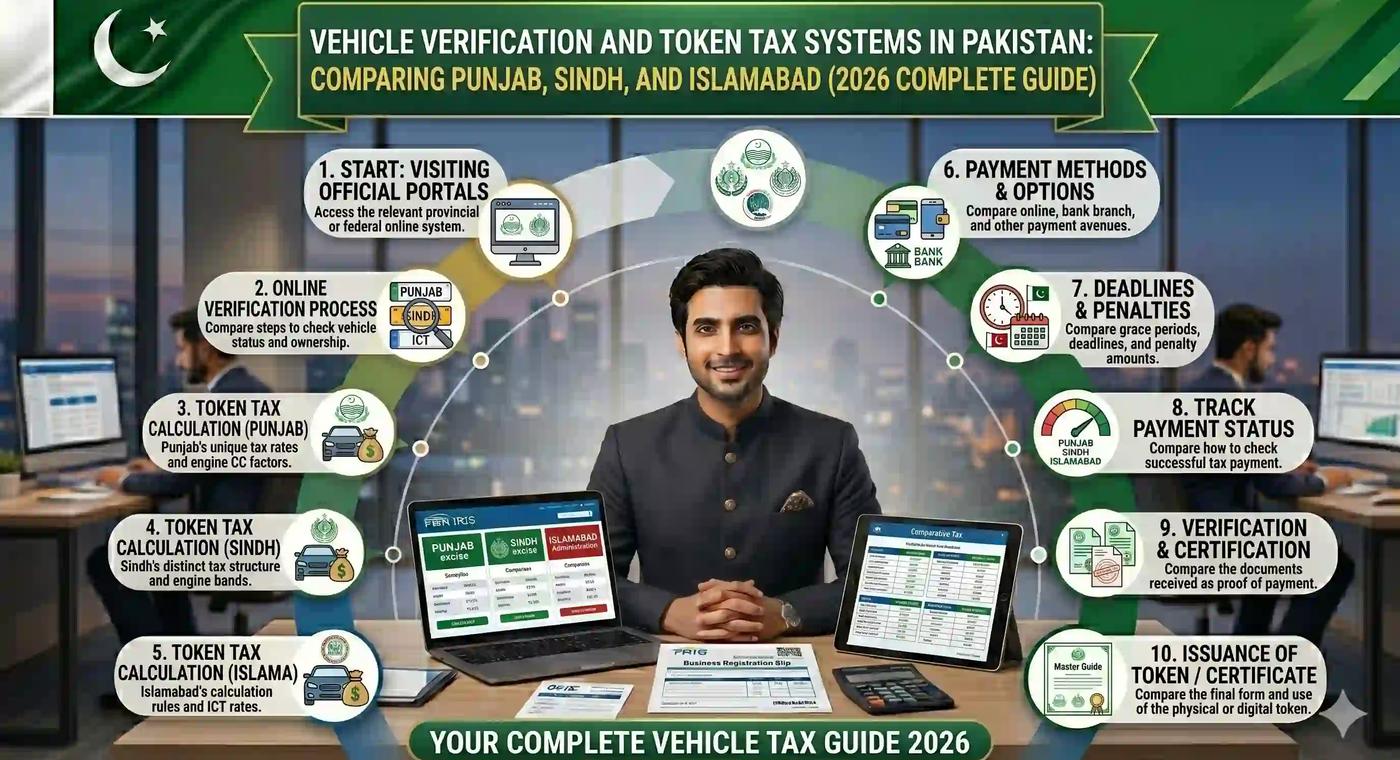
Punjab vs. Sindh vs. Islamabad: Side-by-Side Token Tax Comparison
Understanding the difference between token tax in Punjab, Sindh, and Islamabad helps you plan better, especially if you are relocating or purchasing a vehicle registered in another province.
Verification Portal:
- Punjab → mtmis.excise.punjab.gov.pk
- Sindh → excise.gos.pk
- Islamabad → islamabadexcise.gov.pk
SMS Verification Code:
- Punjab → 8785
- Sindh → 8147
- Islamabad → 8521
Token Tax Calculation Basis:
- Punjab → Invoice value of vehicle
- Sindh → Engine capacity + vehicle age
- Islamabad → Invoice value (aligned with Punjab)
Biometric Verification for Transfer:
- Punjab → Required in several districts
- Sindh → Mandatory (phased rollout)
- Islamabad → Mandatory for all transfers
Maximum Late Payment Penalty:
- Punjab → 10% after 30 days
- Sindh → Up to PKR 200,000 after 6 months
- Islamabad → Up to 200% of total due
Online Payment Platform:
- Punjab → ePay Punjab app
- Sindh → excise.gos.pk online payment
- Islamabad → islamabadexcise.gov.pk portal
Smart Card Fee:
- Punjab → Standard fee applies
- Sindh → PKR 750
- Islamabad → Standard fee applies
What Is a PSID Number and Why Does It Matter?
PSID stands for Payment Slip ID. It is a unique 6 to 17-digit number generated when you calculate your vehicle tax online through any provincial excise portal.
Think of the PSID as a temporary checkout code for your tax payment. Once generated, you can use it to pay your token tax through:
- Mobile banking apps (any bank)
- JazzCash wallet
- Easypaisa wallet
- ATM (using bill payment option)
- Bank branch counter
The PSID expires after a certain period, so generate it when you are ready to pay. After successful payment, you receive a confirmation SMS and can download your official token tax receipt (challan) for your records.
How to Check If a Car Is Stolen in Pakistan
One of the most powerful uses of MTMIS is verifying that a vehicle is not stolen before you buy it. In Pakistan, thousands of vehicles are stolen annually, and stolen cars are often sold through fraudulent transactions.
When you run a vehicle verification check on MTMIS, look for:
- "No record found" — The vehicle may not be registered, or it could have altered plates
- Ownership mismatch — The seller's name does not match the registered owner
- Outstanding token tax — Suggests the real owner may have abandoned or lost the vehicle
- Suspicious registration date — Very recent registration on an older vehicle can signal tampering
Always verify the chassis number (stamped physically on the car frame) against what MTMIS shows. If they do not match, walk away from the deal immediately.
"The online verification system provides instant access to a vehicle's authenticity, eliminating the need for time-consuming office visits." — MTMIS.com.pk
Vehicle Ownership Transfer in Pakistan: Province-by-Province Guide
Transferring vehicle ownership in Pakistan requires different steps depending on your province.
In Punjab: The transfer can be initiated online through the ePay Punjab platform. Biometric verification is required in multiple districts. The ownership transfer fee varies by vehicle type and age.
In Sindh: Biometric verification became mandatory in a phased rollout — first for new registrations, then for used vehicle purchases, and finally for all transfers. Both buyer and seller must provide fingerprints at an authorized center.
In Islamabad: Biometric verification is mandatory for all vehicle transfers. The ETO (Excise and Taxation Office) in Islamabad requires both parties to appear in person for biometric confirmation.
A 10% reduction in transfer costs per year from the date of first registration is offered in Punjab — meaning older vehicles attract lower transfer fees.
For a detailed breakdown of vehicle registration fees including transfer costs, visit Calculate Vehicle Tax and Registration Fee in Pakistan.
FBR Filer vs. Non-Filer: How It Affects Your Vehicle Tax
Under Section 231B of the Income Tax Ordinance 2001, withholding tax is collected at the time of new vehicle registration. This tax has different rates for filers (people registered on the FBR Active Taxpayer List) versus non-filers.
The filer vs. non-filer gap in vehicle taxation is one of the most practical reasons to keep your FBR returns current. Non-filers pay significantly higher withholding tax on vehicle registration, and in some provinces, higher annual token tax rates as well.
If you are unsure about your tax filing status or want to calculate your obligations accurately, explore our Pakistan Salary Tax Calculator 2026 Guide and Pakistan Salary Tax Slabs Breakdown for comprehensive guidance.
You can verify your filer status directly on the FBR Active Taxpayer List — Pakistan's official tax authority portal.
What Happens If You Do Not Pay Token Tax?
This is where many vehicle owners make an expensive mistake. Token tax is not optional, and the consequences of non-payment escalate quickly:
Punjab and Islamabad (General):
- 5% penalty if paid within 30 days after deadline
- 10% penalty if more than 30 days late
Islamabad (Severe Case):
- Vehicle registration may be canceled
- 200% penalty imposed on defaulters
Sindh (Progressive Fines):
- PKR 10,000 for delays beyond 30 days
- Up to PKR 200,000 for delays beyond 6 months
Beyond fines, an unpaid token tax flags your vehicle in the MTMIS system. This means anyone running a verification check on your car will see the outstanding dues — which directly reduces your vehicle's resale value and creates friction during any ownership transfer.
The smartest move is to pay before August 31st in most provinces to claim the early payment rebate and avoid all penalties entirely.
Property Tax and Other Excise Duties in Pakistan
The Excise and Taxation Departments across Pakistan do not only handle vehicle taxes. They also collect:
- Urban Immovable Property Tax — on residential and commercial properties
- Professional Tax — a flat PKR 200 on all vehicle types
- Entertainment Duty — on cinemas, theatres, and events
- Education Cess — particularly in ICT
For property tax information specific to Pakistan including DC rate valuations, visit our guide on FBR Property Tax and DC Rates Pakistan 2026.
Practical Tips for Vehicle Owners Across Pakistan
Whether you are in Lahore, Karachi, Rawalpindi, Islamabad, Faisalabad, or Multan, these best practices will protect you:
Before buying a used vehicle: Always run a verification check on MTMIS before paying any money. Match the chassis number physically to what the system shows. Confirm the seller's CNIC matches the registered owner's name.
For annual token tax: Set a reminder for July 1st each year (start of the financial year). Pay before August 31st to claim the 10% rebate. Never wait until the last month — payment systems can be slow at deadline time.
For vehicle transfers: Initiate the transfer within the legally required period after purchase. Delays in transfer result in additional fees and complications that can take months to resolve.
For FBR compliance: Register with FBR if you are not already a filer. The savings on vehicle tax alone over a few years can more than compensate for the effort of annual filing.
For online payment convenience: Keep JazzCash or Easypaisa linked to your CNIC. All provincial excise departments now accept digital payments, meaning you never have to visit an office for routine tax matters.
Use our free tool to calculate your vehicle taxes accurately before making any payment decisions: Advanced Free Tax Calculators at TaxCalculators.tools.
Frequently Asked Questions (FAQ)
What is MTMIS in Pakistan? MTMIS stands for Motor Transport Management Information System. It is an online vehicle verification platform managed by provincial Excise and Taxation Departments. It allows anyone to check vehicle ownership, registration status, token tax payment history, engine number, chassis number, and smart card status using just a vehicle registration number.
What is token tax in Pakistan? Token tax is an annual fee that vehicle owners must pay to their provincial excise department to legally operate their vehicle on public roads. The amount varies by province, vehicle type, engine capacity or invoice value, and whether the owner is an FBR filer or non-filer.
How do I verify my vehicle online in Punjab? Go to mtmis.excise.punjab.gov.pk, enter your vehicle registration number, and view the complete registration and tax details instantly. Alternatively, send your registration number via SMS to 8785.
How is token tax calculated in Punjab in 2025? Punjab now calculates token tax based on the vehicle's invoice value. Vehicles between PKR 1 million and PKR 2 million pay 0.2% annually. Vehicles above PKR 2 million pay 0.3% annually. Vehicles under 1,000cc pay a lifetime tax of PKR 20,000.
What is the penalty for late token tax payment in Pakistan? In Punjab and Islamabad, penalties range from 5% (within 30 days) to 10% (beyond 30 days). In Sindh, fines start at PKR 10,000 and can reach PKR 200,000 for delays beyond six months. Islamabad can impose a 200% penalty and cancel registrations for persistent defaulters.
Can I verify a stolen vehicle through MTMIS? Yes. MTMIS shows ownership records, and any mismatch between the seller's identity and the registered owner, or a "no record found" result, is a red flag. Always verify chassis numbers physically against what MTMIS shows before purchasing any used vehicle.
What is a PSID number for vehicle tax payment? PSID (Payment Slip ID) is a unique reference number generated when you calculate your vehicle tax online. It is used to complete payment through JazzCash, Easypaisa, mobile banking, ATM, or bank counter. It acts as your transaction identifier in the excise system.
How do I pay token tax online in Sindh? Visit excise.gos.pk, navigate to Online Tax Payment, enter your vehicle details to generate a PSID, and pay through JazzCash, Easypaisa, or mobile banking. Confirmation is sent via SMS.
Is token tax different for filers and non-filers? Yes. FBR-registered filers pay lower token tax and withholding tax rates compared to non-filers. Filing your income tax return annually with FBR can result in meaningful savings on vehicle registration and token tax costs.
What information does MTMIS Islamabad show? MTMIS Islamabad shows owner name, father's name, registered city, registration number, engine number, chassis number, vehicle make and model, color, year of manufacture, registration date, purchase price, token tax payment status, last payment date, and any outstanding dues.
Conclusion: Know Your Province, Know Your Rights
Pakistan's vehicle verification and token tax system has come a long way. From manual ledgers at dusty excise offices to real-time online portals, biometric transfers, and instant digital payments — the transformation is real and ongoing.
But the system remains fragmented by province. Punjab, Sindh, and Islamabad each have their own rules, their own rates, their own portals, and their own penalty structures. What is standard in Lahore may be entirely different in Karachi or Rawalpindi.
The smartest thing you can do as a vehicle owner in Pakistan is this: know which provincial system applies to you, stay current on your token tax, and always verify any vehicle before buying it. The tools exist. The portals are live. There is no excuse for being caught off guard.
Use our advanced free tax calculators to calculate your exact vehicle tax, registration fees, and annual token tax obligations before making any financial decisions — Try TaxCalculators.tools Now.
For everything related to salary tax, property tax, excise verification, and vehicle registration fees in Pakistan, explore our complete resource library at TaxCalculators.tools Blog.
For official verification and payment, always use the authorized portals: mtmis.excise.punjab.gov.pk for Punjab, excise.gos.pk for Sindh, and islamabadexcise.gov.pk for Islamabad. For FBR filer status and income tax, visit fbr.gov.pk.
Important disclaimer
This article is for educational planning only. It does not provide professional tax, legal, accounting, payroll, customs, or financial advice. Tax rules can change and final results may depend on your personal facts. Always verify important tax decisions with official sources or a qualified professional.
About the author
This article was written by the Tax Calculators Team, the group behind TaxCalculators.tools. Learn more about our team and editorial process.
Last reviewed: June 25, 2026