If you own a vehicle in Islamabad, you no longer need to take half a day off work, battle traffic, and stand in long queues at the Excise and Taxation Department Islamabad office. The entire process — from vehicle verification to token tax payment — can now be completed in under 15 minutes from your phone or laptop. This complete, step-by-step guide covers everything vehicle owners and buyers in Islamabad Capital Territory (ICT) need to know about the ICT Excise online services, the MTMIS Islamabad portal, token tax rates, payment methods, ownership transfers, and much more.
What Is the Excise and Taxation Department Islamabad?
The Excise and Taxation Department Islamabad, officially operating under the ICT Administration, is the government authority responsible for managing all vehicle-related services and tax collection in Islamabad Capital Territory (ICT). It is commonly referred to as ICT Excise or Islamabad Excise, and its official digital portal is islamabadexcise.gov.pk.
The department functions under the Deputy Commissioner of Islamabad, who also holds the designation of Director General Excise and Taxation. The powers of the Secretary Excise are exercised by the Chief Commissioner, making this a centrally administered government body under the federal capital's authority — unlike provincial excise departments in Punjab, Sindh, or KPK.
Core Responsibilities of ICT Excise and Taxation
The Islamabad Excise Department services cover a wide range of tax and regulatory functions for both vehicle owners and property holders:
- Motor Vehicle Registration — new vehicle registration, duplicate registration books, and registration certificates
- Annual Token Tax Collection — the yearly road tax based on engine capacity and filer/non-filer status
- Vehicle Ownership Transfer — legal transfer of registered vehicles between buyer and seller
- Online Vehicle Verification — real-time checking of registration status, chassis number, and ownership details via MTMIS Islamabad
- Smart Card Issuance and Status Check — issuance of biometric-linked smart vehicle cards
- Route Permits — for commercial vehicles operating within ICT
- Urban Immovable Property Tax — assessment and collection of property tax in Islamabad
- Professional Tax — collected from businesses and professionals within ICT jurisdiction
- Education Cess — levied under the Workers' Children Ordinance 1972 on companies with 10 or more employees
- Entertainment Duty, Bed Tax, and Tobacco Vend Fees — collected on hotels, entertainment venues, and licensed tobacco vendors
For a broader national overview of how excise departments function across Pakistan, read our guide on Excise and Taxation in Pakistan: A Complete Overview.
What Is MTMIS Islamabad? (Motor Transport Management Information System)
MTMIS Islamabad stands for Motor Transport Management Information System — the digital backbone of the Excise and Taxation Islamabad online portal. Developed and maintained by the Excise Taxation and Narcotics Department of ICT, MTMIS is the system through which citizens verify vehicles, pay taxes, and transfer ownership online.
Before MTMIS was introduced, vehicle verification in Islamabad required a physical visit to the excise office, manual document processing, and the risk of forged paper certificates. Today, the system holds records of every registered vehicle in ICT — including cars, motorcycles, commercial vehicles, buses, and tractors — and makes that data publicly available online in seconds.
What Information Does MTMIS Islamabad Show?
When you enter a vehicle's registration number into the MTMIS Islamabad system, it displays:
- Registered owner's full name and father's/husband's name
- Vehicle registration number and registration city
- Engine number and chassis number
- Make, model, and color of the vehicle
- Year of manufacture and purchase date
- Registration date and current registration status
- Token tax payment status (paid/pending)
- Last payment date and any outstanding tax dues
- Purchase price and vehicle category
This level of data transparency is exactly why MTMIS has become the first stop for anyone buying a used car in Islamabad. You can verify every claim the seller makes — and cross-check the chassis number against physical markings on the car itself.
Quick SMS Tip: You can also verify vehicle details via SMS by typing the chassis number and sending it to 8521. You'll get instant registration and ownership details on your mobile screen.
How to Verify Vehicle Registration Online in Islamabad (Step-by-Step)
Islamabad vehicle verification online is one of the most frequently searched services on the ICT Excise portal. Here's the complete process:
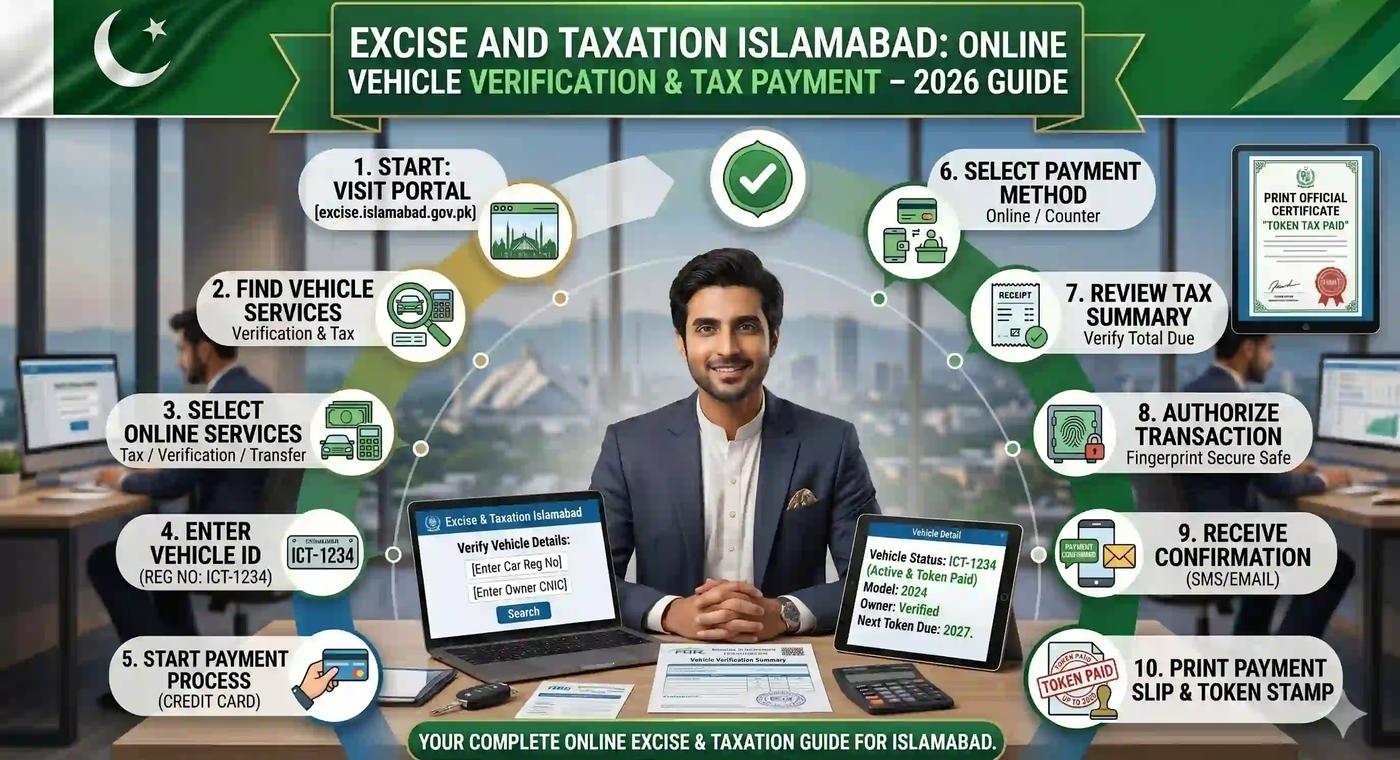
Step 1: Visit the Official Portal Go to https://islamabadexcise.gov.pk — the official website of the Excise and Taxation Department Islamabad. Always use the official government website to protect your personal information and ensure you're viewing accurate, government-verified data.
Step 2: Navigate to Vehicle Verification On the homepage, look for "Online Services" in the navigation menu. Click on "Vehicle Verification" or the MTMIS Islamabad option. You can also download the official Islamabad Excise mobile app (available on both Android and iOS via the City Islamabad App or the MTMIS app) to complete verification from your phone.
Step 3: Enter Vehicle Details Input your vehicle's registration number in the correct format (for example: ABC-123 or ISD-1234). Some verification requests also require the chassis number as a secondary confirmation step.
Step 4: CNIC Verification (Where Required) For added security on certain services, you may need to enter the registered owner's CNIC number. This CNIC verification for vehicles ensures only authorized users can access complete owner information.
Step 5: Review the Verification Results The system displays all vehicle information within seconds — owner name, registration status, tax dues, chassis and engine numbers, and more. Take a screenshot or print the page for your records.
Step 6: Check for Discrepancies If any details don't match what the seller or documents show, do not proceed with the transaction. Contact the Excise and Taxation office Islamabad G-6 for assistance, or visit the Islamabad Excise office at Sector H-9, near the HEC Building.
How to Pay Token Tax Online in Islamabad (Complete Step-by-Step Guide)
Token tax is an annual motor vehicle tax that all vehicle owners registered in Islamabad Capital Territory must pay to the Excise and Taxation Department. It is calculated based on your vehicle's engine capacity (CC) and whether you are an active FBR tax filer or a non-filer. Every tax year runs from 1 July to 30 June.
One important incentive to pay early: if you pay your full annual token tax on or before 31 August, you receive a 10% early payment rebate, which directly reduces your dues.
Here is the complete step-by-step process to pay token tax online in Islamabad:
Step 1: Log In to the ICT Excise Payment Portal Visit islamabadexcise.gov.pk and log in to your account, or register if you're accessing the portal for the first time. You'll need your CNIC and a mobile number for verification.
Step 2: Enter Your Vehicle Registration Number Input your vehicle's registration number. The system will automatically retrieve your vehicle's profile and calculate the outstanding token tax amount based on your engine capacity and filer status.
Step 3: Review the Tax Amount The portal displays the exact token tax due, any late payment surcharges, and the total payable amount. This is automatically calculated — you don't need to manually figure out which bracket applies to your vehicle.
Step 4: Generate a Payment Challan / PSID The system generates a token tax challan or a PSID (Payment Slip ID) — a unique reference number for your payment transaction. Note this number carefully; you'll need it to complete the payment.
Step 5: Choose Your Payment Method Islamabad offers multiple digital payment options for motor vehicle tax:
- Internet Banking — through any major bank's online portal
- Mobile Banking Apps — including JazzCash token tax payment and Easypaisa token tax Islamabad
- Debit/Credit Card — through the excise payment portal
- ATM — enter your PSID at any bank ATM and select the tax payment option
- Bank Counter (OTC) — take your challan to any authorized bank branch
Step 6: Save Your Payment Receipt Once payment is confirmed, the ICT Excise system automatically updates your vehicle record. Download and save your digital receipt. You can also access payment history anytime by logging into the portal and visiting "My Vehicles" or "Payment History."
Want to estimate your token tax before visiting the portal? Use our free Vehicle Token Tax Calculator to instantly calculate your dues based on engine size and filer status — no registration needed.
Token Tax Rates in Islamabad (2025–2026)
Islamabad follows the Federal Withholding Tax schedule under Section 231B of the Income Tax Ordinance 2001 — which means the rates here are set federally, not provincially, unlike Punjab or Sindh.
A critical point that many vehicle owners miss: filers pay significantly less than non-filers. If you're not on the FBR's Active Taxpayer List (ATL), you may be paying double the token tax you should be.
Here are the key rate highlights for Islamabad:
- Cars up to 850cc — PKR 10,000 (filer) / PKR 20,000 (non-filer)
- Cars 1000cc–1299cc — Rates in the mid-tier bracket for filers and non-filers
- Cars 1300cc–1499cc — PKR 2,500 (filer) / PKR 5,000 (non-filer)
- Cars 1800cc and above — Significantly higher rates apply
- Vehicles 10 years or older — Generally exempt from withholding tax under current federal rules
Important Update for July 2026: The Finance Bill 2026-27, approved by the National Assembly Standing Committee on Finance in June 2026, proposes replacing Islamabad's current flat engine-capacity-based token tax structure with an invoice-value-based system. If passed in its final form, the new rates will take effect from 1 July 2026. Always verify the latest rates on islamabadexcise.gov.pk or through our Vehicle Token Tax Calculator.
For a detailed breakdown of how to calculate vehicle registration fees and token tax from scratch, see our guide: How to Calculate Vehicle Tax and Registration Fees in Pakistan.
How to Transfer Vehicle Ownership in Islamabad
Vehicle ownership transfer in Islamabad has been substantially digitized, but it still requires both parties to be physically present at a NADRA-designated biometric verification center. Here is the process:
Step 1: Clear All Dues First Before any transfer can be processed, all outstanding token tax and dues on the vehicle must be cleared. The MTMIS Islamabad system will block the transfer if any pending payments exist. The seller can obtain a clearance certificate through the online portal as proof that the vehicle is tax-free.
Step 2: Gather Required Documents Both buyer and seller need:
- Original Registration Book (or smart card)
- CNICs of both buyer and seller
- Sale agreement or token receipt
- Valid token tax payment receipt
- Engine number and chassis number matching physical markings
Step 3: Visit a NADRA Biometric Center The Islamabad excise biometric verification process requires both parties to visit a NADRA-designated center for fingerprint verification. This step was introduced to eliminate fake transfers and protect both buyers and sellers.
Step 4: Online Transfer Completion After biometric verification, the ownership transfer is completed in the MTMIS system. The new owner's CNIC and details are updated in the national excise database Pakistan. Both buyer and seller receive an SMS notification from the MTMIS system confirming the successful transfer.
Step 5: Smart Card Issuance After transfer, the new owner can apply for an updated smart vehicle card through the Islamabad Excise portal. You can check your smart card status Islamabad by navigating to "Online Services" and selecting the smart card status option on the official website.
How to Check Smart Card Status in Islamabad
Smart cards are the modern replacement for the old paper-based vehicle registration books. To check the status of your smart card application:
- Visit islamabadexcise.gov.pk
- Go to Online Services → Select Smart Card Status (it appears as the 5th option in the dropdown menu)
- Enter your vehicle Registration Number and Application ID
- Click "Check" — the system will display one of the following:
- Application is under process
- Card is printed and ready for collection
- Dispatched to your registered address
What Taxes Does the Excise Department Islamabad Collect?
Beyond vehicle-related taxes, the ICT Excise and Taxation Department collects several other levies from businesses and property owners within Islamabad. Here's the full picture:
Urban Immovable Property Tax (Islamabad): Levied on commercial and residential properties within ICT. Property owners can check assessments and pay Islamabad property tax online through the official ICT Administration portal at ictadministration.gov.pk. For more on property tax calculations across Pakistan, visit our Property Tax Calculator for Pakistan and read our detailed article on FBR Property Tax and DC Rates in Pakistan 2026.
Professional Tax: Collected from individuals and firms engaged in professions within ICT, based on annual income brackets.
Education Cess: Levied under the Workers' Children Ordinance 1972 on companies or firms within ICT jurisdiction that have 10 or more employees. 98% of collected funds go toward the education of DC office staff's children.
Bed Tax: Applied to hotels within ICT that have more than 20 lodging units, under the Finance Act 1965. Hotels with liquor sale licenses are placed in Category I; others fall in Category II.
Entertainment Duty: Collected from entertainment venues and event organizers within Islamabad.
Tobacco Vend Fee: Collected from licensed tobacco vendors operating within ICT.
Motor Dealer Tax: Levied on registered motor vehicle dealers operating in Islamabad.
How to Verify a Used Car Before Buying in Islamabad
Buying a second-hand vehicle is one of the biggest financial decisions most Pakistanis make outside of property. The good news is that the MTMIS Islamabad system makes it nearly impossible for fraudulent sellers to deceive an informed buyer. Here's the safest verification checklist:
- Run an Online Verification First — Visit islamabadexcise.gov.pk and enter the registration number. Confirm the owner's name matches the seller's CNIC.
- Cross-Check Chassis and Engine Numbers — Compare the numbers shown in MTMIS with the physical markings on the vehicle. Any mismatch is a major red flag.
- Check Token Tax Status — Confirm that all token tax dues are cleared. Unpaid token tax becomes the new owner's liability after transfer.
- Request a Clearance Certificate — Ask the seller to generate and share the MTMIS clearance certificate before you pay any amount.
- Verify No Stolen Vehicle Flag — If the MTMIS system shows no record or marks the vehicle as suspicious, do not proceed under any circumstances.
- Check Ownership Transfer History — The system shows how many times a vehicle has been transferred. Frequent transfers on a relatively new car can indicate problems.
For a similar guide on Punjab, read our article on Punjab Vehicle Verification and Token Tax and for Sindh, see Sindh Vehicle Verification and Token Tax Guide.
How to Register a New Vehicle in Islamabad
Registering a new car in Islamabad through the Motor Registration Authority (MRA) under ICT Excise requires the following:
Documents Required for New Vehicle Registration:
- Original invoice from the authorized dealer
- CNIC of the owner
- Insurance certificate
- Customs duty payment receipt (for imported vehicles)
- Engine number and chassis number verification
Process:
- Visit the ICT Excise office or submit documents via the online portal
- Pay the registration fee (calculated as a percentage of the vehicle's invoice value — generally 1% to 5% depending on engine size)
- Pay the withholding tax (Section 231B) based on filer/non-filer status and engine capacity
- Receive a temporary registration certificate
- Apply for a smart card after registration is confirmed in the MTMIS system
New vehicles must be registered within 30 days of purchase. Failing to do so results in escalating penalties — starting from PKR 10,000 for 31–60 days late, rising substantially for longer delays.
Use our Vehicle Token Tax Calculator to estimate both registration fee and token tax before visiting the excise office, so you arrive prepared with the right amount.
Islamabad vs. Rawalpindi: Understanding the Difference
A common point of confusion for residents living near the twin-city boundary: vehicle registration in Rawalpindi falls under Punjab Excise and Taxation, while vehicles registered in Islamabad fall under ICT Excise. The two systems are separate.
- Rawalpindi vehicles are managed through the Punjab MTMIS system at mtmis.excise.punjab.gov.pk
- Islamabad vehicles are managed through islamabadexcise.gov.pk
- Token tax rates, registration fees, and payment processes differ between ICT and Punjab
If you're in Rawalpindi and looking to verify or pay your vehicle tax, refer to our complete guide: Punjab Vehicle Verification and Token Tax.
Islamabad Excise Department: Office Details and Contact Information
Official Website: islamabadexcise.gov.pk ICT Administration Portal: ictadministration.gov.pk Main Office Address: Sector G-6/1-2, Islamabad (Primary office — Excise and Taxation office Islamabad G-6) Vehicle Verification Discrepancy Office: Sector H-9, near HEC Building, Islamabad City Islamabad App: Available on Google Play Store and Apple App Store for mobile registration and token tax payments PAK ID App: Required for biometric verification procedures linked to ownership transfer SMS Verification: Type chassis number → Send to 8521
Office Working Hours: The Islamabad excise office generally operates Monday to Saturday during standard government working hours. Always check islamabadexcise.gov.pk for current Islamabad excise department timings, as they may vary during public holidays and Ramadan.
The Digital Pakistan Advantage: Why the Online Portal Matters
The shift to online services through the ICT Excise portal is not just a convenience upgrade — it represents Pakistan's commitment to the Digital Pakistan Initiative and Vision 2025 goals for e-governance. The results are measurable: over 60% of Islamabad vehicle owners now use the online excise portal, which has reduced office congestion by nearly 40% and cut average processing times by up to 70%.
For vehicle owners, this digital shift means:
- Time saved — What took half a day now takes 10–15 minutes
- 24/7 access — Pay your token tax at midnight if that's what works for you
- Automatic reminders — The portal sends SMS alerts before token tax due dates
- Instant receipts — Digital records that never get lost or damaged
- Fraud prevention — No more forged verification certificates
Pakistan's online government services ecosystem is expanding rapidly. To understand how income tax obligations interact with your vehicle ownership and other taxes, use our Pakistan Income Tax Calculator and read the full Pakistan Salary Tax Calculator Guide for 2026.
Frequently Asked Questions (FAQ)
What is token tax in Islamabad?
Token tax in Islamabad is an annual motor vehicle tax collected by the Excise and Taxation Department ICT under Section 231B of the Income Tax Ordinance 2001. It must be paid every year between July 1 and June 30 to legally operate your vehicle on public roads. The amount depends on your vehicle's engine capacity and whether you are an FBR active tax filer or a non-filer.
How much is token tax for a 1000cc car in Islamabad?
Islamabad follows a federal withholding tax schedule. For cars up to 850cc, filers pay PKR 10,000 and non-filers pay PKR 20,000 annually. For 1300cc–1499cc vehicles, filers pay around PKR 2,500 and non-filers pay around PKR 5,000. Always verify the current rates on islamabadexcise.gov.pk or use our Vehicle Token Tax Calculator for an instant estimate.
What is the official website of Excise and Taxation Islamabad?
The official website is islamabadexcise.gov.pk. The ICT Administration also maintains a portal at ictadministration.gov.pk. These are the only government-verified sources for vehicle verification, token tax payment, and excise services in Islamabad.
What happens if I don't pay token tax in Islamabad?
Unpaid token tax results in penalties and can block your ability to transfer vehicle ownership. Traffic police can stop and fine any vehicle not displaying a valid token. Outstanding dues appear in the MTMIS Islamabad database and must be cleared before the vehicle can legally be sold or transferred to a new owner.
Can I pay Islamabad excise token tax via mobile banking?
Yes. You can pay token tax online in Islamabad through JazzCash, Easypaisa, internet banking, ATMs, or debit/credit card via the official ICT Excise payment portal. The system generates a PSID number that you use to complete payment through any of these channels — no bank visit required.
What is the last date to pay token tax in Islamabad?
The token tax year runs from 1 July to 30 June. If you pay on or before 31 August, you receive a 10% early payment rebate. After that, late payment surcharges begin to apply. Always check the current year's due dates on the official Islamabad excise portal.
How to check vehicle owner by registration number in Islamabad?
Visit islamabadexcise.gov.pk, go to the Vehicle Verification section, and enter the registration number. The system displays the registered owner's name, CNIC-linked details, and vehicle information. Alternatively, send the chassis number via SMS to 8521 for instant results.
Is MTMIS Islamabad the same as Punjab Excise MTMIS?
No. MTMIS Islamabad is managed by the ICT Excise and Taxation Department under federal authority and uses the portal at islamabadexcise.gov.pk. Punjab's MTMIS is a separate provincial system accessible at mtmis.excise.punjab.gov.pk. Both are called MTMIS but are independent systems with different registries and processes.
Is property tax paid to the Excise Department Islamabad?
Yes. Urban Immovable Property Tax (UIPT) in Islamabad is assessed and collected by the Excise and Taxation Department ICT. Property owners can check their assessments and pay online through the ICT Administration portal. For property tax rate guidance, use our Property Tax Calculator.
Conclusion: Make Smart, Informed Decisions With the Right Tools
The Excise and Taxation Department Islamabad has genuinely transformed how citizens manage vehicle registration, token tax, and property tax obligations. The MTMIS Islamabad online verification system, the ICT Excise payment portal, and mobile-first tools like the City Islamabad App and PAK ID App have made compliance faster, safer, and more accessible than ever before.
Whether you're a first-time buyer verifying a used car, a vehicle owner trying to pay token tax before the deadline, or someone navigating an ownership transfer — the entire process is now in your hands, literally.
The one additional tool that can save you time and money before you even open the excise portal is an accurate tax calculator. Know your dues before you go.
Use the free Vehicle Token Tax Calculator at Tax Calculators to instantly estimate your annual token tax in Islamabad, Punjab, Sindh, or KPK — based on your engine size and FBR filer status.
Explore our full suite of free Pakistani tax tools at taxcalculators.tools/tools/pk — including the FBR Tax Calculator, Salary Tax Calculator, Income Tax Calculator, and Property Tax Calculator. Stay compliant, save time, and avoid unnecessary fines.
For official information, always refer to islamabadexcise.gov.pk and ictadministration.gov.pk. For the latest salary tax slabs and breakdowns, read our Pakistan Salary Tax Slabs Breakdown.
Important disclaimer
This article is for educational planning only. It does not provide professional tax, legal, accounting, payroll, customs, or financial advice. Tax rules can change and final results may depend on your personal facts. Always verify important tax decisions with official sources or a qualified professional.
About the author
This article was written by the Tax Calculators Team, the group behind TaxCalculators.tools. Learn more about our team and editorial process.
Last reviewed: June 24, 2026