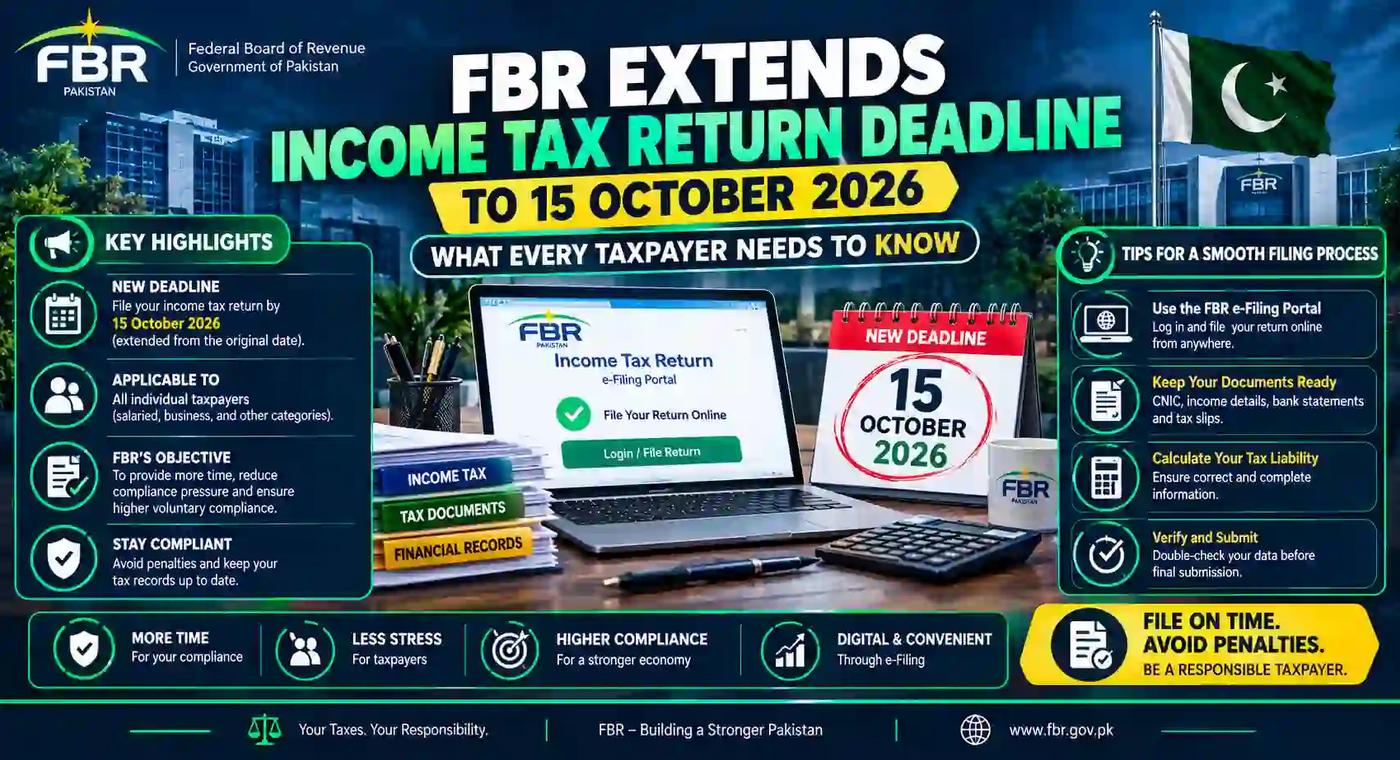
The Federal Board of Revenue has given taxpayers 15 extra days. On the night of 30 September 2026, the FBR announced that the income tax return deadline for Tax Year 2026 moves from 30 September to 15 October 2026.
If you were rushing to file, you can breathe for now. But two weeks go quickly, and the cost of missing this date is much higher than it was a year ago.
This guide explains who the extension covers, why the FBR granted it, what happens if you miss it, and how to file step by step on IRIS. It also answers the questions people search for most, from "is the date really extended?" to "can I still file after 15 October?"
Yes, the FBR extended the income tax return deadline for Tax Year 2026 to 15 October 2026. The extension applies to persons who had to file by 30 September 2026, including salaried individuals, sole proprietors and AOPs. Late filers pay a Section 182A surcharge of Rs 25,000 (individuals) to return to the Active Taxpayer List.
What Did the FBR Announce? The Official Extension Explained
The FBR issued a notification on 30 September 2026, just hours before the original deadline expired. According to Business Recorder's report on the notification, the Board used its powers under Section 214A of the Income Tax Ordinance, 2001. It extended the filing date for Tax Year 2026 to 15 October 2026 for persons required to file by 30 September.
The reason given was requests from trade bodies and tax bar associations.
Here is the sequence of events:
- 29–30 September: The FBR said no extension was under consideration and called a circulating extension circular fake.
- 30 September, late evening: The FBR issued the official notification.
- Result: The new last date is 15 October 2026.
That reversal confuses many people, so one rule is worth remembering: trust only the official notification. Fake circulars spread fast in the last days of September. Always check the FBR official website or the IRIS portal before acting on a forwarded image.
For a plain-English overview of how return dates work, see our guide on the income tax return deadline in Pakistan.
Why Did the FBR Extend the Deadline?
Three pressures came together.
1. Portal problems.
Tax professionals reported slowdowns and errors on IRIS in the final weeks. When thousands of people file in the last 48 hours, the system struggles.
2. Requests from business groups.
Trade bodies, including the Federation of Pakistan Chambers of Commerce and Industry (FPCCI), and tax bar associations asked for more time. Some asked for a month or longer.
3. A big filing season.
Reports put returns filed well past 5 million, including more than a million new filers, according to ProPakistani's coverage. More first-time filers means more questions, more document gathering and more last-minute stress.
Extensions are not new. The FBR extended the deadline for Tax Year 2024 to 31 October 2024. For Tax Year 2025 it first moved the date to 15 October 2025, then pushed it again to 31 October 2025.
Important: Do not assume a second extension this year. In 2026 the FBR denied an extension one day and granted it the next. Planning around "maybe it will move again" is a gamble, and the penalties are real.
If you searched "fbr extends deadline 2022" and landed on old results, ignore them. They refer to a different tax year. This article covers Tax Year 2026, meaning income earned between 1 July 2025 and 30 June 2026.
Who Does the 15 October Extension Apply To?
The notification covers persons who were required to file by 30 September 2026. In practice, that means:
- Salaried individuals
- Sole proprietors (a proprietorship firm files under the owner's individual return)
- Business individuals, traders and freelancers
- Associations of Persons (AOPs)
- Companies with a special tax year that fell due on 30 September
What about regular companies?
Companies with a 30 June year-end normally file by 31 December 2026. This extension is not aimed at them. If you run a company, confirm your due date with your accountant.
Does the extension apply to proprietorship firms?
Yes. A proprietorship is not a separate legal entity for income tax. The owner files as an individual, so the 15 October date applies. Our guide on how to file an income tax return online in Pakistan in 2026 walks through the business-individual route as well.
Who Must File an Income Tax Return in Pakistan?
Many people believe they need to file only if they owe tax. That is not how the law works. Section 114 of the Income Tax Ordinance, 2001 requires several groups to file even if their tax is zero.
You generally need to file if:
- Your taxable income exceeds the basic exemption limit (Rs 600,000 for salaried individuals under the current slabs).
- You are a business owner, trader or self-employed professional.
- You are a freelancer or digital content creator earning income in Pakistan.
- You own certain property, vehicles or commercial and industrial utility connections that the law lists.
- You are a company, AOP or registered person.
- You want to be on the Active Taxpayer List to enjoy lower withholding rates.
The last point matters most to ordinary people. Even if you are below the taxable limit, filing a nil return keeps you on the ATL. That alone can save you real money on banking, property and vehicle transactions.
Not sure where you stand? Our guides on how to become a tax filer in Pakistan and the Income Tax Ordinance 2001 explained cover the rules in simple language.
A note for freelancers and overseas Pakistanis
Freelancers often assume foreign-currency income is "invisible". It is not. If your income is received in Pakistan, it needs to be declared. Read our FBR tax planning guide for freelancers for deductions and planning tips.
Overseas Pakistanis and expats with income in two countries should also read Pakistan vs US tax system for expats.
What Happens If You Miss the 15 October Deadline?
This is the part where the extension helps you most, because the cost of being late is no longer small.
1. You fall off the Active Taxpayer List
The Active Taxpayer List (ATL) decides whether you are treated as a filer for withholding purposes. If you file after the due date, you do not return to the ATL automatically. You must pay a surcharge under Section 182A.
Under the Finance Act 2026, that surcharge has risen sharply:
- Individuals: Rs 25,000 (previously Rs 1,000)
- AOPs: Rs 50,000 (previously Rs 10,000)
- Companies: Rs 100,000 (previously Rs 20,000)
For many salaried people, that amount can exceed their entire tax bill for the year. This is why filing before 15 October matters.
2. You may face a Section 182 penalty
Late filing can also attract a separate penalty under Section 182. This is different from the ATL surcharge. Paying one does not cancel the other. The amount depends on your category and the tax payable, so check your exact figure with a tax professional before paying.
3. You pay more tax on everyday transactions
Non-filers and late filers face higher withholding rates on many transactions. These typically include:
- Bank cash withdrawals and certain banking transactions
- Property purchases and sales
- Vehicle registration and transfer
- Utility bills and some other services
Rates change with each Finance Act, so we do not quote a fixed table here. For current rates, read our guides on filer vs non-filer tax rates in Pakistan, bank transaction withholding tax and withholding tax on property transactions.
4. You raise your audit and notice risk
The FBR is linking data from banks, property registries, vehicle registration and investment institutions. Mismatches between what you earn and what you declare are easier to spot than ever. If you receive a notice, our FBR notice and ATL correction service can help you respond correctly.
Tax professionals also warn that "late filer" treatment can still apply to some property provisions even after you pay the surcharge. The safest route is simple: file before the deadline.
Does Filing After 15 October Make You a Non-Filer?
Not exactly, and this is a common source of confusion.
The FBR will still accept your return after the due date. But you will not appear on the ATL until you pay the Section 182A surcharge. In daily life, you are treated like a non-filer for withholding purposes until your name returns to the list.
Here is a simple example.
Example: Ayesha is a salaried employee in Lahore. She files on 14 October. She stays on the ATL and pays no surcharge. Her colleague Bilal files on 20 October. He must pay the Rs 25,000 surcharge to get back on the ATL, and he may also face a Section 182 penalty. Same income, same documents, very different cost.
If you are unsure of your current status, use our ATL status check guide or the ATL filer status check and fix service.
Step-by-Step: How to File Your Income Tax Return on IRIS Before 15 October
You do not need to be a tax expert. You do need the right documents and a calm, early start. Aim to file at least a few days before the deadline, not on the last evening when the portal is slowest.
Step 1: Gather your documents
Collect these before you log in:
- CNIC and registered mobile number
- Salary certificate or payslips from your employer
- Bank statements (1 July 2025 to 30 June 2026)
- Withholding tax certificates (electricity, telephone, bank profit and others)
- Property, vehicle and investment records
- Details of loans, gifts and foreign remittances
- Last year's return and wealth statement for comparison
Step 2: Log in to IRIS
Go to the FBR IRIS portal and log in with your credentials. Having trouble with access? Our FBR IRIS login guide covers password resets and common errors. For a broader walkthrough, see the FBR IRIS portal guide for 2026-2027.
If you do not yet have an NTN, you can register first. Learn more about NTN registration or verify an NTN.
Step 3: Open the Tax Year 2026 return
Choose the income tax return for Tax Year 2026. Make sure you select the correct year, since wrong-year filing is a frequent and costly mistake.
Step 4: Enter your income and deductions
Fill in each section carefully:
- Salary income and tax already deducted
- Business or freelance income and expenses
- Other income such as rent, profit on debt and dividends
- Tax credits, deductions and exemptions you qualify for
Not sure how much tax you will owe? Run the numbers first with our free Salary Tax Calculator or Income Tax Calculator. They use current slabs, which you can check against our FBR tax slabs 2026-2027 update.
Step 5: Complete the wealth statement
The wealth statement lists your assets and liabilities. It must reconcile: opening wealth plus income, minus expenses, should equal closing wealth. Gaps are the number one trigger for FBR queries.
Step 6: Review, verify and submit
Check every figure twice. Then complete verification and submit. Download and save your return acknowledgment. It is your proof of filing.
Step 7: Confirm your ATL status
After filing, check that your name appears on the Active Taxpayer List. Updates are not always instant, so check again after a few days.
Pro tip: Do not leave the wealth statement for the final hour. It is the most time-consuming part and where most errors happen.
Common Mistakes to Avoid During the Extension
A longer deadline does not make filing easier. It just changes where people slip.
- Waiting for another extension. Last-minute extensions can happen, but they are never guaranteed.
- Filing the wrong tax year. Confirm you are on Tax Year 2026.
- Ignoring small incomes. Rent, profit on savings and freelance income all count.
- Mismatched wealth statements. Your opening balance must match last year's closing balance.
- Forgetting withholding certificates. Missing credits mean you may overpay.
- Treating "nil return" as optional. A nil return keeps you on the ATL.
- Trusting forwarded circulars. Confirm every notice on official channels.
Several of these relate to advance tax and quarterly payments. If you earn business or rental income, try our Advance Tax Calculator and read the rental income tax guide.
Can You Ask for a Personal Extension Under Section 119?
Yes, in some cases. If you cannot file by the deadline for a genuine reason, the law allows you to request more time from the relevant Commissioner Inland Revenue under Section 119.
Keep these points in mind:
- The request must be made before the deadline passes.
- You need a clear, honest reason, such as illness or missing records.
- Approval is not automatic.
- It is not a substitute for filing on time.
If your situation is complicated, speak to a professional early. Our income tax return filing service can help you prepare and file correctly.
Where to Get Help: Islamabad, Karachi, Lahore, Multan and Beyond
Tax questions are local. Offices, consultants and documents differ by city, and many people prefer to speak to someone nearby.
Islamabad: The FBR head office is on Constitution Avenue, and the Regional Tax Office handles many local cases. Taxpayers in sectors such as F-8, G-9, I-8 and Blue Area often need help with NTN registration and return filing. See our Islamabad tax services.
Karachi: Karachi has a large concentration of businesses, traders and salaried professionals across Saddar, Clifton, Gulshan and DHA. Many need help with business returns and ATL corrections. See our Karachi tax services.
Lahore: From Gulberg to Johar Town, Model Town and DHA, Lahore has a busy mix of salaried filers, freelancers and small businesses. See our Lahore tax services.
Multan, Rawalpindi, Faisalabad, Peshawar and other cities: Taxpayers in Multan, Faisalabad, Rawalpindi, Peshawar, Quetta, Sialkot, Gujranwala, Hyderabad, Bahawalpur and beyond can file online from anywhere. You do not need to visit an FBR office to submit a return. Our team can support you remotely through the contact page.
How Does This Extension Affect Your Tax Planning?
Smart taxpayers use extra time well, not as an excuse to delay.
Use the extra days to:
- Reconcile your bank statements with your declared income
- Collect missing withholding certificates
- Check your deductions and credits
- Review your property and vehicle declarations
- Compare your estimate with a calculator, such as the FBR Tax Calculator
- Plan ahead for next year's advance tax
If you want to lower your bill legally, read our guides on how to reduce salary tax legally in Pakistan and top tax saving tips from the FBR.
Also keep the upcoming dates handy. Our FBR tax deadlines calendar lists the main compliance dates so nothing sneaks up on you.
Why Choose Tax Calculators?
Taxes feel stressful because the rules change often and the language is dense. Why choose Tax Calculators? Because we focus on clear answers and free tools:
- Plain language. No jargon walls.
- Current rules. Our guides track the latest FBR updates.
- Free calculators. Estimate before you file.
- Transparent methods. Read our online tax calculator accuracy methodology.
- Real support. From NTN to ATL corrections, we help with the whole process.
You can explore advanced free tax calculators for Pakistan, or browse our full list of the best free tax calculators in 2026.
Conclusion: Use These 15 Days Wisely
The FBR's extension to 15 October 2026 is real, official and helpful. But it is also a short window with a higher penalty waiting on the other side.
Here is your simple plan:
- Gather your documents this week.
- Estimate your tax with a free calculator.
- Prepare your wealth statement early.
- File well before 15 October.
- Confirm your ATL status afterward.
You do not have to do this alone. Start with our free Salary Tax Calculator and use the advanced free calculators offered by Tax Calculators to see your numbers before you file. If you would rather hand it over, our income tax return filing service is ready to help, or you can contact us with any question.
File early, file correctly, and keep your name on the Active Taxpayer List.
Frequently asked questions
Has the FBR extended the income tax return deadline to 15 October 2026?
Yes. The FBR announced on 30 September 2026 that the Tax Year 2026 filing date moves from 30 September to 15 October 2026, under Section 214A of the Income Tax Ordinance, 2001.
Who can use the 15 October extension?
It covers persons who were required to file by 30 September 2026, including salaried individuals, sole proprietors, business individuals and AOPs. Companies with a 30 June year-end normally file by 31 December.
Is the income tax return date for a proprietorship firm also extended?
Yes. A proprietorship files through the owner's individual return, so the same 15 October deadline applies.
What happens if I miss 15 October?
You can still file, but you will not return to the Active Taxpayer List until you pay the Section 182A surcharge. For individuals it is Rs 25,000. You may also face a separate Section 182 penalty.
Will I become a non-filer if I file after the deadline?
The FBR accepts late returns. But until you pay the surcharge and re-enter the ATL, you are treated as a non-filer for many withholding purposes.
Will the FBR extend the deadline again?
Nobody can say for sure. The FBR has extended deadlines in past years, but it also denied an extension just a day before granting this one. Plan to file before 15 October.
What documents do I need to file?
Your CNIC, salary certificate, bank statements, withholding tax certificates, and property, vehicle and investment records. Keep last year's wealth statement handy.
How do I check whether I am on the ATL?
Check the Active Taxpayer List on the FBR's official channels, or read our ATL status check guide.
Can I file my return from my mobile phone?
Yes, if your device can access the IRIS portal and you can complete verification. A laptop is easier for the wealth statement.
Do I need to file a return if my income is below the taxable limit?
You may not owe tax, but you may still need to file, and a nil return helps you stay on the ATL.
Important disclaimer
This article is for educational planning only. It does not provide professional tax, legal, accounting, payroll, customs, or financial advice. Tax rules can change and final results may depend on your personal facts. Always verify important tax decisions with official sources or a qualified professional.