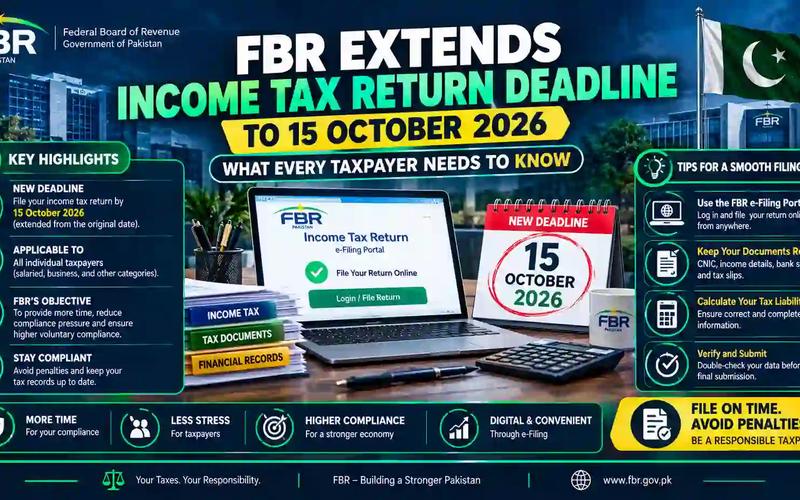
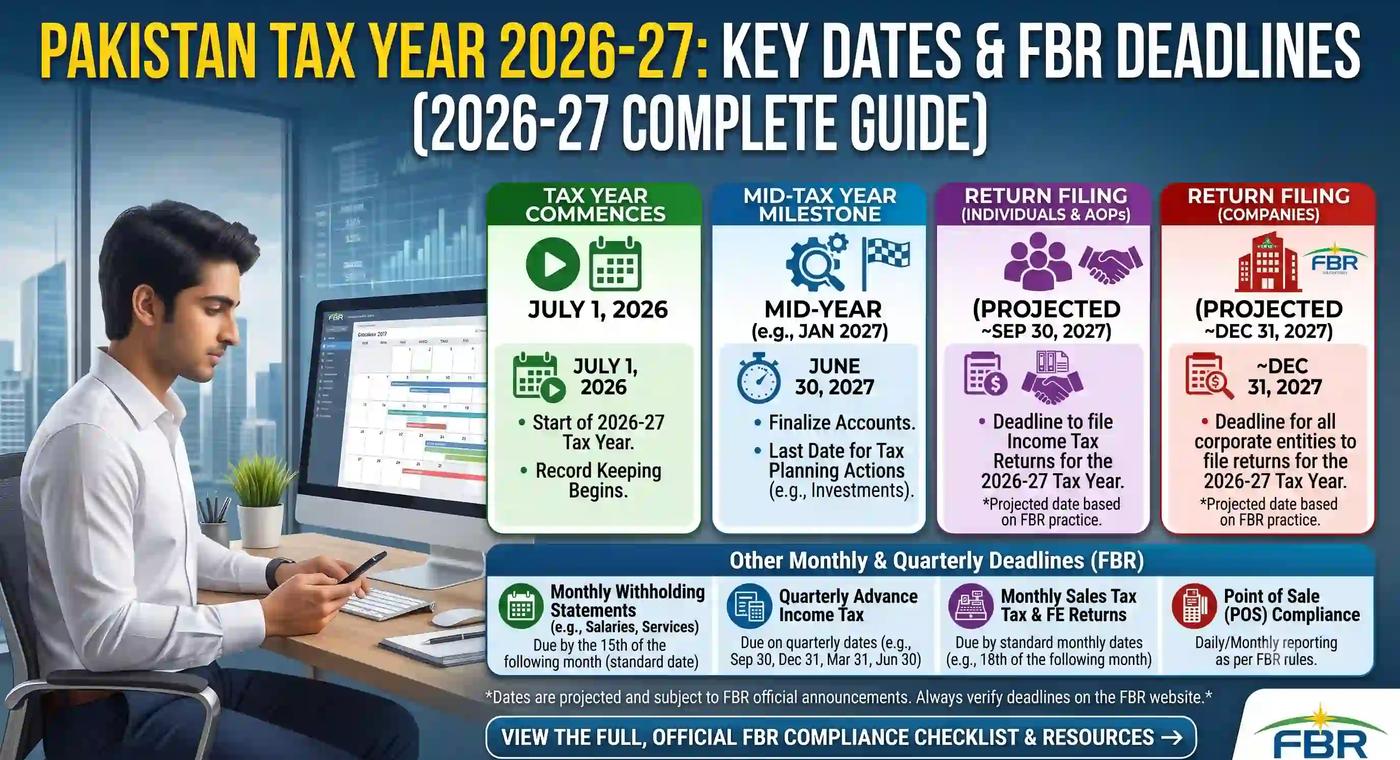
If you earn a salary, run a business, or own property in Pakistan, one thing can save you thousands of rupees every single year: knowing your tax dates before the Federal Board of Revenue (FBR) has to remind you. Pakistan's tax year 2026-27 — officially Tax Year 2027 in FBR's numbering — runs from July 1, 2026 to June 30, 2027, and it comes with a full calendar of deadlines: annual return filing, monthly sales tax statements, withholding tax submissions, and advance tax installments. Miss even one, and you could face daily penalties, lose your Active Taxpayer List (ATL) status, or pay double withholding tax on your own bank transactions.
This guide breaks down every key date for Tax Year 2026-27, explains the updated income tax slabs, and shows you exactly how to stay compliant — without needing to hire a tax lawyer just to understand your calendar.
What Is Pakistan's Tax Year 2026-27?
FBR doesn't use the calendar year for tax purposes. Instead, Pakistan follows a July-to-June fiscal tax year. So when people say "tax year 2026-27," they mean the income period from July 1, 2026 to June 30, 2027 — which FBR formally labels Tax Year 2027.
This naming convention trips up a lot of taxpayers, so here's the simple rule:
- Tax Year 2026 = income earned between July 1, 2025 and June 30, 2026 (return due by September 30, 2026)
- Tax Year 2027 (commonly called "tax year 2026-27") = income earned between July 1, 2026 and June 30, 2027 (return due by September 30, 2027)
If you're reading this in mid-to-late 2026, you actually have two overlapping obligations: filing your Tax Year 2026 return (due very soon) and starting fresh withholding/compliance tracking for the new Tax Year 2027 that just began. Getting this distinction right is the first step to never missing a deadline again.
Why These Dates Matter for Every Pakistani Taxpayer
Tax dates aren't just bureaucratic formalities — they directly affect your money.
- Active Taxpayer List (ATL) status: File on time and you stay on the ATL, which means lower withholding tax rates on banking transactions, vehicle registration, and property deals.
- Non-filer penalties: Miss the deadline, and you're immediately dropped from ATL, facing higher withholding rates on almost every financial transaction until you catch up.
- Daily penalties: Under Section 182 of the Income Tax Ordinance 2001, late filing triggers a minimum penalty structure that keeps accumulating the longer you wait.
- Business continuity: For companies and AOPs, missing sales tax or withholding tax deadlines can trigger FBR notices, audits, and default surcharge under Section 205.
In short, understanding the FBR tax calendar 2026-27 isn't optional — it's the cheapest form of tax planning available to you.
FBR Tax Calendar 2026-27: Complete List of Key Dates
Here's the full breakdown of what's due, and when, throughout Tax Year 2026-27.
1. Annual Income Tax Return Deadlines
| Annual Income Tax Return Deadlines | ||
|---|---|---|
| Taxpayer Category | Period Covered | Filing Deadline |
| Salaried individuals & AOPs (Tax Year 2026) | July 1, 2025 – June 30, 2026 | September 30, 2026 |
| Companies with June year-end (Tax Year 2026) | July 1, 2025 – June 30, 2026 | December 31, 2026 |
| Salaried individuals & AOPs (Tax Year 2027 / 2026-27) | July 1, 2026 – June 30, 2027 | September 30, 2027 |
| Companies (Tax Year 2027 / 2026-27) | July 1, 2026 – June 30, 2027 | December 31, 2027 |
FBR has, in past years, granted short extensions through official SRO notifications — but you should never plan around an extension. Treat September 30 as a hard line.
2. Monthly Sales Tax Return Deadlines
Any business registered under the Sales Tax Act 1990 with a valid STRN must file monthly. The rule is simple: the return for any given month is due by the 15th of the following month. So your July 2026 sales tax return is due August 15, 2026, your August return is due September 15, 2026, and so on through the entire tax year 2026-27. If the 15th falls on a weekend or public holiday, the deadline typically shifts to the next working day, but always confirm this against FBR's official announcements before assuming.
3. Withholding Tax (WHT) Statement Deadlines
If you're a withholding agent — an employer, a company deducting tax at source, or any entity required to withhold under the Income Tax Ordinance — your monthly WHT statement is also due by the 15th of the following month. Late filing carries a minimum penalty, and repeated non-compliance increases your audit risk significantly.
4. Advance Tax Installments
Companies and certain individuals with business income are required to pay advance tax in quarterly installments throughout Tax Year 2026-27, generally due by the 25th of September, December, March, and June. This is separate from your annual return and is calculated against estimated income for the year.
5. Wealth Statement Filing
Individual taxpayers filing an income tax return must also submit a wealth statement (and wealth reconciliation) alongside their return — same deadline as your annual return, September 30.
6. SECP & Provincial Filings
If you run a registered company, don't forget SECP's separate annual filing obligations, and if your business operates in the services sector, check provincial sales tax deadlines (Punjab, Sindh, KPK, Balochistan each run their own portals with similar monthly cycles).
For a running, always-updated version of this calendar, our FBR IRIS portal guide for 2026-2027 tracks every change as FBR issues new notifications.
Income Tax Slabs for Tax Year 2026-27: What Changed
Under the Finance Act 2026, the salaried income tax slab structure was revised, with four brackets seeing rate cuts and one new bracket introduced at the top end. Based on the officially notified rates effective July 1, 2026, the salaried slab structure for Tax Year 2026-27 looks like this:
- Up to Rs. 600,000/year — 0% (tax-free)
- Rs. 600,000 – 1,200,000 — 1%
- Rs. 1,200,000 – 2,200,000 — 11%
- Rs. 2,200,000 – 3,200,000 — 20% (reduced from 23%)
- Rs. 3,200,000 – 4,100,000 — 25% (reduced from 30%)
- Rs. 4,100,000 – 5,600,000 — 29% (reduced from 35%)
- Rs. 5,600,000 – 7,000,000 — 32% (new bracket)
- Above Rs. 7,000,000 — 35%
This is a genuinely bigger relief package than previous years for the Rs. 2.2 million to Rs. 5.6 million income bracket — the heart of Pakistan's salaried middle class. Non-salaried individuals and business income earners fall under a separate, generally higher slab table, so don't assume the same numbers apply if you're self-employed or run a proprietorship.
Because Finance Act notifications can carry fine print — surcharges, rebates, Section 60 Zakat credits, or pension-contribution deductions — don't calculate your final liability by hand. Run your numbers through our Pakistan income tax calculator or our dedicated salary tax calculator to get an accurate, up-to-date figure in seconds. You can also read the full breakdown in our FBR tax slabs 2026-2027 updates article.
Why Filer Status Matters More Than Ever in 2026-27
Becoming a "filer" — someone whose name appears on FBR's Active Taxpayer List — isn't just about avoiding penalties. It's a financial strategy.
Filers enjoy:
- Significantly lower withholding tax on bank profit, cash withdrawals, and property transactions
- Reduced advance tax on vehicle registration and token tax
- Easier access to loans, visas, and government tenders
- No 236C/236K-style surcharge exposure on property deals
Non-filers face:
- Double (or higher) withholding tax rates across nearly every financial transaction
- Restrictions on purchasing property above certain thresholds
- A higher likelihood of receiving FBR scrutiny notices
If you're still unsure whether it's worth the paperwork, the math almost always favors becoming a filer — especially if you own property, a vehicle, or move significant money through your bank account. Check your current status anytime through our guide on checking your FBR Active Taxpayer List status.
How to Become a Filer in Pakistan: Step-by-Step
- Get your NTN: Register for a National Tax Number through the FBR IRIS portal using your CNIC — this is free and typically instant for individuals.
- Create your IRIS profile: Log in at iris.fbr.gov.pk, complete your registration form (Form 181), and verify your mobile number and email.
- Gather your documents: Salary certificate, bank statements, property documents, and any investment records for the relevant tax year.
- File your return: Navigate to Declaration → Income Tax Return → select the correct Tax Year, complete the income and wealth statement sections, and submit.
- Pay any tax due: Generate a Computerized Payment Receipt (CPR) and pay through your bank or a designated payment channel.
- Confirm ATL status: It typically updates within a day or two of a successful, on-time filing.
For a more detailed walkthrough with screenshots and common troubleshooting tips, see our full how to become a tax filer in Pakistan guide, plus our FBR IRIS login guide if you're logging in for the first time.
What Happens If You Miss a Deadline?
Missing a tax deadline in Pakistan isn't catastrophic if you act quickly — but the costs add up fast the longer you wait.
- Late annual return: Penalty under Section 182 accrues per day/month of delay, with a minimum charge even if no tax is owed. Section 205 default surcharge applies if tax was also outstanding.
- Loss of ATL status: You're removed from the list until you file and, in many cases, pay an additional ATL surcharge to be reinstated.
- Late monthly WHT/sales tax statements: Minimum penalties apply per month, and repeated delays raise audit risk substantially.
- Non-filer for multiple years: FBR can issue formal notices, and penalties under Section 114A can reach significant amounts for taxpayers who ignore filing obligations entirely.
Real-world example: A private limited company with a December year-end return due December 31, 2026, but filed in mid-January 2027 faces a per-day penalty accumulation from the missed date — a bill that easily runs into six figures (PKR) for even a few months of delay. The lesson is consistent across every taxpayer category: file on time, even if your figures aren't perfect, and amend later if needed. A slightly imperfect on-time return is almost always cheaper than a perfect late one.
Special Cases: Overseas Pakistanis, Freelancers & Property Owners
Overseas Pakistanis: If you hold a Pakistani NTN or earn Pakistan-source income (rental income, dividends, capital gains on local assets), you're subject to the same September 30 deadline — even while living abroad. Filing can be done entirely online through IRIS.
Freelancers and gig workers: Foreign remittances and freelance export income often qualify for reduced tax rates, but only if properly declared and, in many cases, registered with the relevant IT/export body. Don't assume foreign income is automatically tax-free just because it's earned outside Pakistan.
Property owners and sellers: Withholding tax on property transactions (commonly referenced under Sections 236C and 236K) differs sharply between filers and non-filers — sometimes by several percentage points on the transaction value. If you're planning a property sale or purchase during Tax Year 2026-27, check current rates before signing anything using our guide on withholding tax on property transactions in Pakistan.
Why Use a Tax Calculator Instead of Manual Math?
Tax slabs change almost every year with the Finance Act, exemptions and credits vary by individual circumstance, and even a small miscalculation can mean underpaying (triggering a notice) or overpaying (losing money unnecessarily). A dedicated calculator applies the correct, current-year FBR slab automatically, accounts for filer vs. non-filer status, and gives you an instant, accurate number — no spreadsheet required.
Our free tools are built specifically for Tax Year 2026-27 compliance:
- Income Tax Calculator — full annual liability estimate
- Salary Tax Calculator — monthly payslip-level breakdown
- FBR Tax Calculator — general-purpose FBR-aligned calculations
- Withholding Tax Calculator — for agents and businesses
- Advance Tax Calculator — quarterly installment planning
You can also read our step-by-step Pakistan income tax calculator 2026-2027 guide or explore legal ways to reduce your salary tax in Pakistan through allowable deductions and credits.
Building Good Habits for the Rest of Tax Year 2026-27
Compliance doesn't have to feel like a scramble every September. A few habits make the entire year easier:
- Set calendar reminders for the 15th of every month if you file sales tax or WHT statements.
- Track income and expenses monthly, not annually — reconstructing a year of transactions in August is where most errors happen.
- Reconcile your wealth statement quarterly if your assets or income sources are complex (property, investments, multiple bank accounts).
- Check your ATL status periodically, especially after filing, to confirm FBR has processed your return correctly.
- Review Finance Act updates each June, since new slabs and rules typically take effect from July 1 — right at the start of the new tax year.
Frequently Asked Questions
What is the last date to file an income tax return in Pakistan for Tax Year 2026? The deadline is September 30, 2026 for salaried individuals and Associations of Persons (AOPs). Companies with a June 30 year-end have until December 31, 2026, unless FBR issues an official extension.
What is Pakistan's Tax Year 2026-27? Tax Year 2026-27 (FBR's Tax Year 2027) covers income earned between July 1, 2026 and June 30, 2027. The corresponding annual return is due by September 30, 2027 for individuals and AOPs.
What happens if I don't file my tax return in Pakistan? You face daily/monthly penalties under Section 182, potential default surcharge under Section 205, removal from the Active Taxpayer List, and significantly higher withholding tax on banking, property, and vehicle transactions until you file.
How can I become a filer in Pakistan? Register for an NTN via the FBR IRIS portal using your CNIC, complete your taxpayer profile, then file your income tax return for the relevant tax year through IRIS. Your name is added to the ATL shortly after a successful, verified filing.
What are the income tax slabs for salaried individuals in 2025-2026 and 2026-27? For Tax Year 2026 (2025-26), the previous slab structure applied with a top rate of 35% starting near Rs. 4.1 million. Under the Finance Act 2026, Tax Year 2026-27 introduces reduced rates for middle brackets (20%, 25%, 29%) and a new 32% bracket between Rs. 5.6 million and Rs. 7 million, with 35% applying above Rs. 7 million.
Do overseas Pakistanis need to file a return by the same deadline? Yes. If you hold a Pakistani NTN or have Pakistan-source income, the same September 30 deadline applies, and filing can be completed entirely online via IRIS from anywhere in the world.
What is the deadline for monthly sales tax and withholding tax statements? Both are due by the 15th of the month following the transaction period — for example, your June 2026-27 filings are due by the 15th of the following month.
Conclusion: Don't Let a Date Cost You Money
Pakistan's tax year 2026-27 comes with a full, predictable calendar — annual returns due September 30 and December 31, monthly filings due the 15th, and quarterly advance tax installments throughout the year. None of these dates are a surprise if you plan ahead, and none of the penalties are unavoidable if you file on time.
The fastest way to stay ahead of every deadline is to know exactly what you owe before FBR tells you. Use our free Pakistan Income Tax Calculator today to check your Tax Year 2026-27 liability in under a minute, explore our full suite of tax calculators for Pakistan, and bookmark this page so you never miss a key FBR date again.
For official confirmation of any date or rate mentioned in this article, always cross-check against the Federal Board of Revenue's official website, since FBR occasionally issues SRO notifications that adjust deadlines or slab rates after publication.
Important disclaimer
This article is for educational planning only. It does not provide professional tax, legal, accounting, payroll, customs, or financial advice. Tax rules can change and final results may depend on your personal facts. Always verify important tax decisions with official sources or a qualified professional.
About the author
This article was written by the Tax Calculators Team, the group behind TaxCalculators.tools. Learn more about our team and editorial process.
Last reviewed: July 19, 2026