If you're planning to buy or sell property in Pakistan in 2026, one number will affect your transaction more than almost anything else: your withholding tax. Whether you're a first-time buyer in Islamabad, a seller in DHA Lahore, or an overseas Pakistani sending funds through a Roshan Digital Account, the Federal Board of Revenue (FBR) will collect advance tax the moment your property changes hands.
This guide breaks down everything you need to know about withholding tax on property transactions in Pakistan for 2026 — the rates under Section 236C and 236K, the difference between filer and non-filer costs, how FBR valuation compares to DC rates, and what's changing under the Finance Act 2026. By the end, you'll know exactly how much tax to expect and how to avoid overpaying.
What Is Withholding Tax on Property in Pakistan?
Withholding tax (also called advance tax) on property is a tax collected at the source — at the time of registration or transfer — rather than at the end of the tax year. Instead of waiting for you to declare your income, the registrar, housing authority, or transfer office deducts a fixed percentage of the property's value and deposits it directly with FBR under the Income Tax Ordinance, 2001.
This system applies specifically to immovable property (plots, houses, apartments, shops, commercial buildings, and agricultural land converted for commercial use) and is governed by two key sections:
- Section 236K — Advance tax on the purchase of property, paid by the buyer.
- Section 236C — Advance tax on the sale of property, paid by the seller.
Both are collected as a percentage of the property's FBR valuation or the DC (District Collector) rate, whichever is higher — not necessarily the price you actually paid or received.
Why This Matters More in 2026
Property taxation in Pakistan has changed significantly this year. The government revised valuation tables for multiple cities, adjusted rates under the Finance Act 2026, and is actively discussing further relief in the Budget 2026-27. If you don't track these updates, you risk either overpaying at registration or facing an unexpected FBR notice later.
For filers, staying on the Active Taxpayers List (ATL) can mean paying less than half of what a non-filer pays on the same transaction. For overseas Pakistanis, understanding these rules before wiring money through a Roshan Digital Account can prevent costly surprises at the registration desk.
Section 236C vs Section 236K: What's the Difference?
| Section 236C vs Section 236K: What's the Difference? | ||
|---|---|---|
| Feature | Section 236K (Buyer) | Section 236C (Seller) |
| Who pays | Purchaser of property | Seller/transferor of property |
| When collected | At time of registration/transfer | At time of sale/transfer |
| Based on | Higher of FBR value or DC value | Higher of FBR value or DC value |
| Adjustable? | Yes, against annual tax liability for filers | Yes, against annual tax liability for filers |
| Non-filer treatment | Roughly double the filer rate | Roughly double the filer rate |
In simple terms: 236K taxes you when you buy, and 236C taxes you when you sell. Both are advance payments against your eventual income tax liability — not a separate, permanent tax — provided you are an active filer.
Latest FBR Withholding Tax Rates on Property (2026-27)
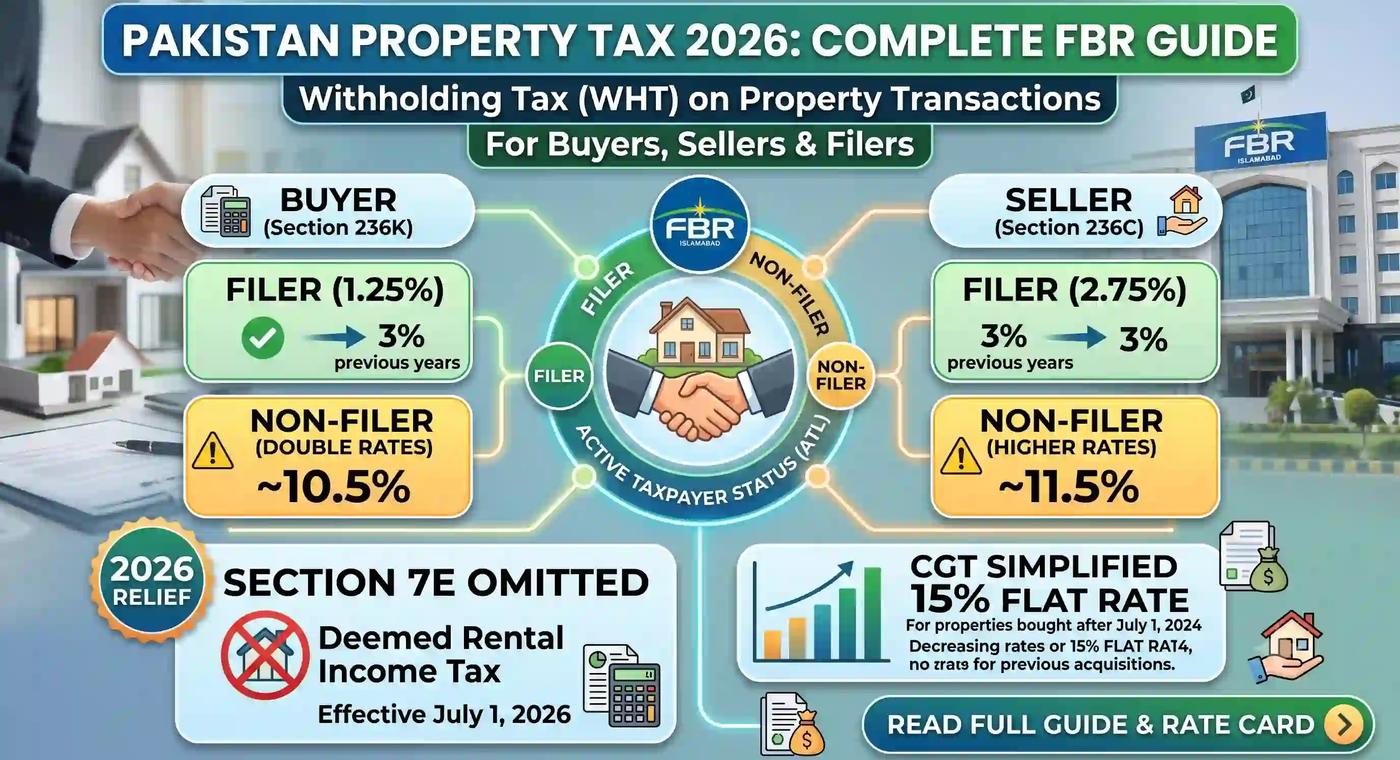
Following the Finance Act 2026, rates for Tax Year 2027 (July 2026 – June 2027) have been revised. Based on official notifications and rate cards published by FBR, the general structure looks like this:
| Latest FBR Withholding Tax Rates on Property (2026-27) | ||
|---|---|---|
| Taxpayer Status | Section 236K (Buyer) | Section 236C (Seller) |
| Filer | Reduced rate, generally around 1.25% | Around 2.75% |
| Late Filer | Higher than filer rate, below non-filer rate | Moderately higher |
| Non-Filer | Roughly double the filer rate | Roughly double the filer rate |
Important: These figures are based on the most recent FBR notifications and industry rate cards available as of mid-2026, but property tax rates in Pakistan have seen multiple revisions this year through separate SROs. Always confirm the exact current percentage on the official FBR Withholding Tax Rate Card or through our Withholding Tax Calculator before finalizing any transaction, since the applicable rate depends on your filer status, the notification in effect on your transfer date, and your property's location.
FBR Valuation vs DC Rate: Which One Applies?
This is where most buyers get confused — and where most overpayment happens.
- FBR Valuation Rate: An official value set by FBR for tax purposes, often lower than actual market price but higher than DC rate in many urban areas.
- DC (District Collector) Rate: A provincial valuation used for stamp duty and registration, historically lower than market value.
The rule that matters: Whichever value is higher — FBR or DC — is used to calculate your withholding tax. If FBR valuation rates get revised downward (as happened in Islamabad and parts of Lahore in 2026), your withholding tax bill shrinks automatically, even if the market price you paid stays the same.
For a full area-wise breakdown, see our detailed guide on FBR Property Tax & DC Rates in Pakistan 2026.
How to Calculate Advance Tax on Property Purchase or Sale
Here's a simple, practical example to show how the math works:
Scenario: You're an active filer buying a plot with an FBR valuation of PKR 10,000,000.
- Confirm your filer status is active on ATL.
- Check the current 236K rate for filers (roughly 1.25% as of Tax Year 2027).
- Multiply: PKR 10,000,000 × 1.25% = PKR 125,000 advance tax.
- If you were a non-filer, the same transaction could cost roughly double — around PKR 250,000 or more.
This tax is not necessarily lost money. For filers, it is adjustable against your annual income tax return. For non-filers, it is treated as a final, non-adjustable cost until you become an active filer.
You can run your own numbers instantly using our free Property Tax Calculator or the more detailed Advance Tax Calculator — both updated for 2026-27 rates.
Filer vs Non-Filer: The Real Cost Difference
The single biggest factor in your property tax bill isn't the property's value — it's your tax filer status.
- Filer: Listed on FBR's Active Taxpayers List, files annual returns on time, pays the lowest advance tax rate, and can adjust the tax paid against final liability.
- Late Filer: Filed late or missed the September 30 deadline; pays a rate between the filer and non-filer bracket, sometimes with added penalties.
- Non-Filer: Not on the ATL; pays roughly double the filer rate on both 236C and 236K, and the tax is non-adjustable and effectively punitive.
If you're not sure of your status, check it before you sign any transfer documents. Our guide on How to Become a Tax Filer in Pakistan walks through the registration process step by step, and you can verify your current ATL status directly on FBR's official portal.
Overseas Pakistanis: Do You Get Any Exemption?
Overseas Pakistanis remain among the most active buyers in cities like Islamabad and Lahore, and there are real advantages available to them in 2026:
- Overseas Pakistanis who qualify as non-resident filers can often access relief similar to resident filers on certain property transactions, provided they route funds through official banking channels such as a Roshan Digital Account.
- Recent reductions in FBR valuation rates in Islamabad (10–35% lower in several sectors) have made transactions more affordable for overseas buyers specifically, since advance tax is calculated on the lower revised value.
- Overseas Pakistanis should still confirm their NTN registration and filer status through IRIS, FBR's online tax portal, before any transfer — non-filers, resident or overseas, pay the higher rate regardless of nationality status.
For a step-by-step walkthrough of the portal itself, see our FBR IRIS Portal Guide 2026-27.
Are Inherited or Gifted Properties Exempt?
Generally, transfers through inheritance or as a gift to immediate family members (spouse, parents, children) are treated differently from a normal sale-purchase transaction and are typically exempt from Sections 236C and 236K. However:
- This exemption usually applies only to direct blood relations or spouses, not to extended family or unrelated parties.
- Provincial transfer fees, mutation charges, and registration costs may still apply even when the federal withholding tax is exempt.
- Always get written confirmation from your local registrar or an FBR representative before assuming an exemption applies to your specific case, since documentation requirements vary by province and by the relationship between transferor and transferee.
How to Pay Withholding Tax on Property (Step-by-Step)
- Confirm your filer status on the Active Taxpayers List via IRIS or FBR's ATL search tool.
- Verify the applicable value — check both the FBR valuation table and your province's DC rate for the exact location.
- Calculate the tax using the current 236C or 236K rate for your status.
- Pay through the registrar or transfer authority, who deducts and deposits the tax with FBR via the official Payment Slip ID (PSID) system.
- Request a withholding tax certificate from the collecting authority — you'll need this when filing your annual return to claim adjustment (if you're a filer).
- File your income tax return on time to ensure the advance tax collected is properly credited against your final liability.
Excise and Taxation departments in each province (Punjab, Sindh, KPK) also handle related provincial charges such as stamp duty and registration fees, so it's worth checking your relevant provincial Excise and Taxation office alongside FBR for a complete cost picture.
Location-Specific Property Tax Notes for 2026
Property tax outcomes vary significantly by city because FBR valuation tables are notified separately for each region.
Islamabad: FBR reduced valuation rates by 10–35% across multiple sectors in 2026, directly lowering withholding tax for buyers and sellers in urban ICT areas (rural ICT areas remain excluded).
Lahore / DHA Lahore: Updated valuation tables were issued for several DHA phases and Nishtar Town sectors in 2026, with an estimated valuation reduction of nearly 40% in some zones — a major relief for buyers and sellers in one of Pakistan's most active property markets.
Karachi, Rawalpindi, Faisalabad, Multan, Peshawar, Quetta: Valuation and DC rate updates in these cities tend to follow separately, so always check the specific notification for your city and sector rather than assuming a nationwide rate applies uniformly.
If FBR's valuation conflicts with the provincial DC rate for a specific plot, remember: the higher of the two values is used for tax calculation.
Budget 2026-27: What Might Change Next?
Industry reports suggest the government is considering further real estate tax relief in the upcoming budget cycle, with proposals reportedly including:
- Further reduction in the 236K buyer rate for filers.
- Further reduction in the 236C seller rate for filers.
- A review of capital gains tax and holding-period rules.
- Measures aimed at attracting overseas Pakistani investment into housing and construction.
- Better alignment between FBR valuation and provincial DC rate systems to reduce confusion.
These remain proposed changes until passed through the Finance Bill and formally notified by FBR — so don't finalize a transaction assuming a lower rate that hasn't been officially confirmed yet.
Common Mistakes Buyers and Sellers Make
- Assuming the sale-agreement price is what tax is calculated on, when FBR or DC value may be higher.
- Not checking filer status before signing token/advance payment agreements.
- Ignoring provincial stamp duty and registration charges as separate from federal withholding tax.
- Forgetting to request a withholding tax certificate, which delays adjustment during annual return filing.
- Overseas buyers relying on outdated valuation tables instead of checking the latest 2026 notification for their specific sector.
Frequently Asked Questions
What is withholding tax on property in Pakistan? It's an advance income tax collected at the time a property is bought or sold, deducted by the registrar or transfer authority and deposited directly with FBR, based on the property's FBR or DC value.
Who pays 236C and who pays 236K? The seller pays advance tax under Section 236C. The buyer pays advance tax under Section 236K. Both are collected at the point of transfer, not later.
Is withholding tax on property refundable for filers? Yes. For active filers, the amount collected under 236C and 236K is adjustable against your total annual income tax liability when you file your return. If your actual tax liability is lower, you may receive a refund.
What happens if a non-filer buys or sells property in Pakistan? Non-filers pay roughly double the withholding tax rate applied to filers, and this amount is generally treated as final and non-adjustable, making non-filer status significantly more expensive on every transaction.
Does withholding tax apply to inherited or gifted property? Transfers to immediate family members through inheritance or gift are typically exempt from Sections 236C and 236K, though provincial transfer and registration fees may still apply. Always confirm with your local registrar for your specific case.
How often are FBR property valuation rates updated? FBR revises valuation tables periodically through official SRO notifications, sometimes multiple times a year for high-activity cities like Islamabad, Lahore, and Karachi. It's important to check the notification date closest to your transaction date rather than relying on older figures.
Final Thoughts
Withholding tax on property transactions in Pakistan isn't just a line item at the registrar's office — it's one of the biggest cost factors in any real estate deal in 2026. Understanding the difference between Section 236C and 236K, keeping your filer status active, and checking the correct FBR or DC valuation for your area can save you hundreds of thousands of rupees.
Before you sign anything, calculate your exact liability using our free Withholding Tax Calculator or Property Tax Calculator, and always cross-check the current rates against the official FBR Withholding Tax Rate Card before finalizing your transaction.
Note: Withholding tax rates on property have changed multiple times in 2026 through separate FBR notifications, and further relief is under discussion for Budget 2026-27. This article reflects the most recent publicly available information as of July 2026 — always verify current rates directly with FBR or a qualified tax advisor before completing a property transaction, since I can't guarantee every rate cited here remains unchanged at the moment you read this.
Important disclaimer
This article is for educational planning only. It does not provide professional tax, legal, accounting, payroll, customs, or financial advice. Tax rules can change and final results may depend on your personal facts. Always verify important tax decisions with official sources or a qualified professional.
About the author
This article was written by the Tax Calculators Team, the group behind TaxCalculators.tools. Learn more about our team and editorial process.
Last reviewed: July 14, 2026