
If you've ever looked at your payslip and wondered why a chunk of your salary disappears before it even reaches your bank account, the answer lies in one document: the Income Tax Ordinance 2001. This single law shapes how every rupee of taxable income in Pakistan — from a shopkeeper's daily sales to a multinational's annual profit — gets taxed.
For most people, "Pakistan tax law" sounds intimidating. Sections, schedules, SROs, Finance Acts — it's a lot. But once you understand the logic behind the Income Tax Ordinance 2001, the whole system starts to make sense. This guide breaks it down in plain language: what it is, how it works, what changed under the Finance Act 2026, and exactly what you need to do to stay compliant with the Federal Board of Revenue (FBR).
What Is the Income Tax Ordinance 2001?
The Income Tax Ordinance 2001 is Pakistan's primary piece of legislation governing direct taxation. It replaced the older Income Tax Ordinance of 1979 and came into force on 1 July 2002, promulgated as Ordinance XLIX of 2001. It is the legal foundation that tells the Federal Board of Revenue who must pay tax, on what income, at what rate, and by what deadline.
In simple terms, the Ordinance answers four questions for every taxpayer in Pakistan:
- Who is liable to pay income tax (individuals, associations of persons, companies)
- What counts as taxable income (salary, business income, property income, capital gains)
- How much tax is owed (based on tax slabs, rates, and credits)
- When and how it must be paid and reported (tax year, return filing, withholding)
Unlike the Sales Tax Act 1990, which taxes consumption and transactions, the Income Tax Ordinance 2001 is a direct tax law — it taxes income itself, deducted straight from the source in many cases through withholding tax.
Why the Income Tax Ordinance 2001 Matters
Pakistan's taxation system relies heavily on this Ordinance because income tax is one of the largest contributors to the country's tax-to-GDP ratio. Every Finance Act passed by Parliament each year amends this Ordinance rather than replacing it, which is why you'll often see references like "Income Tax Ordinance 2001 amended up to 2026."
It matters to you personally because it determines:
- Whether your salary is taxed and how much
- Whether you're classified as a filer or non-filer — and the financial consequences of that status
- What deductions and tax credits you can legally claim
- The penalties you face for late or incorrect filing
If you want to see exactly how these rules translate into rupees, our income tax calculator for Pakistan applies the current FBR slabs automatically, so you don't have to do the math by hand.
Structure of the Income Tax Ordinance 2001
The Ordinance is organized into 13 chapters, over 240 sections, and seven schedules. Understanding this structure helps you find what you're looking for instead of getting lost in legal language.
Key Components
- Charging sections — establish that tax is levied on taxable income (Section 4)
- Heads of income — salary, business, property, capital gains, and "income from other sources"
- Withholding provisions — sections like 149, 153, and 236 that require tax to be deducted at source
- Filing and compliance sections — Section 114 (return filing), Section 116 (wealth statement)
- Penalty and prosecution sections — Sections 182 and 191 dealing with non-compliance
- Schedules — the First Schedule contains tax rates; the Second Schedule lists exemptions
This layered structure is exactly why the Ordinance can be updated yearly through a Finance Act without rewriting the entire law — only the relevant sections or schedule entries are amended.
Key Sections of the Income Tax Ordinance 2001 Explained
Section 4 – Charge of Tax
This is the foundation section. It establishes that income tax is charged on every person's taxable income for a tax year at the rates specified in the First Schedule.
Section 149 – Salary
Section 149 governs how employers deduct income tax from employee salaries every month. This is the section responsible for the tax already withheld from your payslip — your employer calculates it based on your annual estimated salary and deducts a proportional amount monthly.
Section 153 – Payments for Goods, Services and Contracts
This section requires withholding tax on payments made to suppliers, service providers, and contractors — a major compliance area for businesses.
Section 236 (and its sub-sections, like 236C and 236K)
These cover withholding tax on specific transactions such as property sales (236C) and property purchases (236K) — relevant to anyone buying or selling real estate in Pakistan.
Section 114 – Return of Income
Section 114 lists who is legally required to file an income tax return, including salaried individuals above the taxable threshold, business owners, and property owners meeting specific criteria.
Section 116 – Wealth Statement
Alongside the return, many taxpayers must also submit a wealth statement disclosing assets, liabilities, and personal expenses for the year.
Tax Year vs Financial Year in Pakistan
Under the Ordinance, the standard "tax year" runs from 1 July to 30 June, and is referred to by the year in which it ends. For example, income earned between 1 July 2025 and 30 June 2026 falls under Tax Year 2026. Some businesses use a "special tax year" with FBR approval if their accounting period differs.
Income Tax Slabs Under the Income Tax Ordinance 2001 (2026–27)
Tax rates are not fixed in the Ordinance's original text — they're revised annually through the Finance Act and listed in the First Schedule. Following the Finance Act 2026, the salaried individual tax slabs effective from 1 July 2026 look like this:
| Income Tax Ordinance 2001: income tax slabs | |
|---|---|
| Annual Taxable Income | Tax Rate |
| Up to Rs. 600,000 | 0% |
| Rs. 600,001 – Rs. 1,200,000 | 1% of amount exceeding Rs. 600,000 |
| Rs. 1,200,001 – Rs. 2,200,000 | Rs. 6,000 + 11% of amount exceeding Rs. 1,200,000 |
| Rs. 2,200,001 – Rs. 3,200,000 | Rs. 116,000 + 20% of amount exceeding Rs. 2,200,000 |
| Rs. 3,200,001 – Rs. 4,100,000 | Rs. 316,000 + 25% of amount exceeding Rs. 3,200,000 |
| Rs. 4,100,001 – Rs. 5,600,000 | Rs. 541,000 + 29% of amount exceeding Rs. 4,100,000 |
| Rs. 5,600,001 – Rs. 7,000,000 | Rs. 976,000 + 32% of amount exceeding Rs. 5,600,000 |
| Above Rs. 7,000,000 | Rs. 1,424,000 + 35% of amount exceeding Rs. 7,000,000 |
The Finance Act 2026 raised the threshold for the top 35% tax rate from Rs. 4.1 million to Rs. 7 million, giving genuine relief to middle-income earners. The maximum rate for salaried individuals stays at 35%, while non-salaried individuals continue to face a top rate of 45%. The tax-free threshold of Rs. 600,000 has not changed.
Rather than manually working through these brackets, you can plug your salary into our salary tax calculator or the general FBR tax calculator for an instant, accurate breakdown. For a deeper dive into how these brackets were calculated, see our full FBR tax slabs 2026–27 update guide and our salary tax slabs breakdown.
Filer vs Non-Filer: Why It Matters Under the Ordinance
The Ordinance draws a sharp distinction between a filer (someone whose name appears on the FBR's Active Taxpayer List, or ATL) and a non-filer. This status affects far more than just your annual return — it changes the withholding tax rate applied to almost every major transaction you make: buying property, purchasing a vehicle, banking transactions, and even mobile phone usage in some categories.
Non-filers typically pay withholding tax at rates that can be double or more compared to filers. This is a deliberate design in the Ordinance meant to encourage tax registration. You can check your current status anytime using our guide on the FBR Active Taxpayer List (ATL) status check, and if you're not yet registered, our step-by-step guide on how to become a tax filer in Pakistan walks you through NTN registration and IRIS enrollment.
How to File an Income Tax Return Under the Ordinance
Filing isn't optional for anyone who meets the criteria under Section 114. Here's the general process:
- Register for an NTN through the FBR IRIS portal using your CNIC.
- Log in to IRIS and select the correct tax year.
- Declare your income under the relevant head — salary, business, property, or other sources.
- Claim eligible deductions and tax credits, such as charitable donations or pension contributions.
- Submit your wealth statement if required under Section 116.
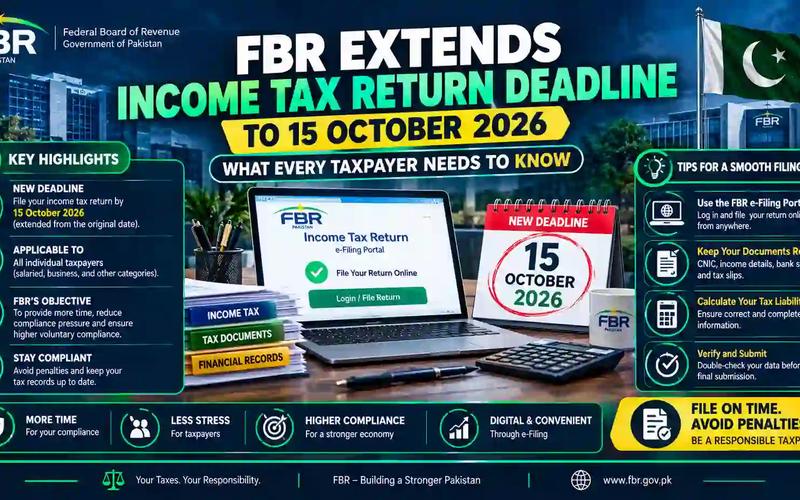
- Verify and submit before the deadline — typically 30 September for salaried individuals, though FBR frequently extends this date.
If you're new to the portal, our detailed FBR IRIS portal guide and FBR IRIS login guide walk through the entire process screen by screen. And to keep track of due dates, bookmark our income tax return deadline Pakistan tracker.
Withholding Tax and Advance Tax Under the Ordinance
Two mechanisms make Pakistan's income tax system function on a "pay-as-you-earn" basis:
- Withholding tax — deducted at the source of payment (salary, contracts, property transactions, banking) under sections like 149, 153, and 236.
- Advance tax — quarterly installments paid by businesses and certain individuals in anticipation of their year-end liability, under Section 147.
Property transactions are a particularly common area of confusion. If you're buying or selling real estate, our guide on withholding tax on property transactions in Pakistan explains exactly what you'll pay and when, and our withholding tax calculator gives you an instant estimate. For quarterly business obligations, the advance tax calculator simplifies the process considerably.
Tax Exemptions and Deductions Under the Income Tax Ordinance 2001
The Second Schedule of the Ordinance lists income and entities exempt from tax, along with reduced-rate categories. Common exemptions and deductions include:
- Certain agricultural income (a provincial rather than federal tax subject)
- Donations to approved charitable institutions (tax credit under Section 61)
- Contributions to approved pension funds
- Certain allowances and benefits for specific employee categories
- Export-related and special economic zone incentives for businesses
Salaried individuals looking to legally reduce their liability should read our practical guide on how to reduce salary tax legally in Pakistan — it covers every legitimate deduction available under the current law.
Corporate Tax and Business Compliance
For companies, the Ordinance applies a flat corporate tax rate (generally 29% for most companies, with banking companies taxed differently), alongside minimum tax provisions and — until recently — a super tax on high earners. The Finance Act 2026 abolished the super tax under Section 4C for persons with income not exceeding Rs. 500 million, excluding banks, oil and gas exploration companies, and fertilizer sellers, marking a significant relief measure for mid-sized businesses.
Freelancers and small business owners fall under the same Ordinance but often qualify for the presumptive tax regime or reduced rates depending on their sector. Business owners can benchmark their liability with our business tax calculator framework or the Pakistan-specific tools listed above.
Capital Gains Tax and Property Transactions
Property sellers are subject to capital gains tax under the Ordinance, with rates depending on the holding period of the property. Longer holding periods generally reduce the effective tax rate. If you're planning to sell property, our guide on capital gains tax on property sale in Pakistan explains the current holding-period rules and rates in detail.
Penalties Under the Income Tax Ordinance 2001
Non-compliance carries real financial consequences under Section 182 and related provisions:
- Late filing penalty — a percentage of tax payable or a fixed minimum amount, whichever is higher, for each day of delay
- Non-filing penalty — higher fixed penalties for individuals who fail to file altogether despite being liable
- Concealment penalties — for underreporting income or assets, which can include penalties up to the amount of tax evaded, along with possible prosecution in serious cases
- ATL removal — being dropped from the Active Taxpayer List, resulting in significantly higher withholding tax rates on transactions
Staying on the ATL isn't just about avoiding embarrassment — it's a direct financial decision that affects every major transaction you make throughout the year.
Recent Amendments: What Changed Under the Finance Act 2026
Every year's Finance Act reshapes parts of the Ordinance, and 2026 brought some of the most significant relief measures in years:
- The 35% top tax slab threshold moved from Rs. 4.1 million to Rs. 7 million annually
- The 9% surcharge on individuals earning above Rs. 10 million annually was fully abolished
- Middle brackets saw real rate cuts, easing the burden on salaried professionals
- Super tax was scrapped for most businesses earning under Rs. 500 million
These changes reflect Pakistan's ongoing effort — partly shaped by its IMF program commitments — to balance relief for salaried, fully-documented taxpayers against the need to expand the tax base into under-taxed sectors like retail and agriculture.
Income Tax Ordinance 2001 vs Earlier Tax Laws
Before 2001, Pakistan operated under the Income Tax Ordinance 1979, which itself replaced the Income Tax Act 1922 (a law that also forms the historical basis of India's income tax system). The 2001 Ordinance modernized the framework by:
- Introducing clearer definitions of "resident" and "non-resident" taxpayers
- Establishing structured withholding tax provisions across dozens of transaction types
- Creating a more formal self-assessment and audit system
- Aligning more closely with international tax treaty standards for double taxation relief
A Practical Example
Consider Ahmed, a salaried marketing manager in Lahore earning Rs. 3,600,000 annually. Under the 2026–27 slabs, his tax falls in the Rs. 3,200,001–4,100,000 bracket: Rs. 316,000 plus 25% of the amount over Rs. 3,200,000 — meaning Rs. 316,000 + Rs. 100,000 = Rs. 416,000 for the year, deducted proportionally each month by his employer under Section 149. If Ahmed also earns rental income from a property, that income is taxed separately under the "income from property" head, and he must declare it in his annual return under Section 114.
The Future of Pakistan's Tax System
Digital transformation is reshaping how the Ordinance is enforced. FBR's IRIS system, real-time integration with banks for withholding data, and increased use of data analytics to detect non-filers all point toward a more automated, harder-to-avoid compliance environment. As the tax base widens into retail, agriculture, and the digital economy, expect more frequent amendments — making it worth checking updates every budget cycle rather than assuming last year's rules still apply.
Frequently Asked Questions
What is the Income Tax Ordinance 2001? It is Pakistan's principal federal law governing income tax, in force since 1 July 2002, setting out who pays tax, on what income, and at what rate, administered by the FBR.
When was the Income Tax Ordinance 2001 enacted? It was promulgated as Ordinance XLIX of 2001 and became effective from the tax year starting 1 July 2002, replacing the Income Tax Ordinance 1979.
What are the current tax slabs under the Income Tax Ordinance 2001? For tax year 2026–27, income up to Rs. 600,000 is tax-free, with progressive rates rising to 35% for income above Rs. 7 million, following relief measures introduced in the Finance Act 2026.
What is the difference between a filer and a non-filer? A filer is listed on the FBR's Active Taxpayer List after submitting their return; a non-filer isn't, and pays significantly higher withholding tax on transactions like property and vehicle purchases.
What is the penalty for not filing a tax return in Pakistan? Penalties include a percentage of tax payable per day of delay (subject to a minimum), removal from the ATL, and in serious cases, prosecution for concealment or non-compliance.
What is Section 149 of the Income Tax Ordinance 2001? Section 149 governs the withholding of income tax by employers from employee salaries on a monthly basis, based on estimated annual income.
Conclusion
The Income Tax Ordinance 2001 might read like dense legal text, but at its core, it's simply the rulebook for how Pakistan taxes income — from your monthly salary to a company's annual profit. Understanding the key sections, current slabs, and your filer status puts you in control instead of leaving you guessing at tax time.
You don't need to calculate any of this manually. Use our free income tax calculator for Pakistan to see exactly what you owe under the current Finance Act 2026 rates, or explore our full suite of Pakistan tax calculators covering salary, withholding, advance tax, and property tax — built to keep you compliant and confident every tax year.
For the official, authoritative text of the Income Tax Ordinance 2001 and current SROs, always cross-check with the Federal Board of Revenue.
Important disclaimer
This article is for educational planning only. It does not provide professional tax, legal, accounting, payroll, customs, or financial advice. Tax rules can change and final results may depend on your personal facts. Always verify important tax decisions with official sources or a qualified professional.
About the author
This article was written by the Tax Calculators Team, the group behind TaxCalculators.tools. Learn more about our team and editorial process.
Last reviewed: July 21, 2026