If you're a Pakistani living in the United States, a US citizen working in Pakistan, or simply someone juggling finances across both countries, taxes are probably one of the most confusing parts of your life right now. Two very different systems, two different tax years, two different sets of rules — and somehow you're expected to stay compliant with both.
Here's the good news: once you understand the core differences between the Pakistan tax system and the US tax system, the confusion clears up fast. This guide breaks down everything from FBR vs IRS to double taxation, tax treaties, filing deadlines, and the exact steps expats need to take to stay penalty-free on both sides of the world.
Understanding the Two Tax Systems at a Glance
Before diving into the details, it helps to see the big picture. Pakistan and the US approach taxation from two completely different philosophies.
Pakistan largely follows a territorial-leaning system with residency-based rules, administered by the Federal Board of Revenue (FBR). The US, on the other hand, is one of the only countries in the world that taxes based on citizenship, not just residency — meaning even if you haven't set foot in America in years, the Internal Revenue Service (IRS) may still expect a tax return from you.
That single difference — worldwide income taxation in the US versus a more residency-focused approach in Pakistan — is the root of almost every headache expats deal with.
FBR vs IRS: Who Collects What
| FBR vs IRS: Who Collects What | ||
|---|---|---|
| Feature | Pakistan (FBR) | United States (IRS) |
| Tax year | July 1 – June 30 | January 1 – December 31 |
| Tax ID | National Tax Number (NTN) | Social Security Number (SSN) / EIN |
| Filing basis | Residency-based | Citizenship + residency-based |
| Filing deadline | September 30 (typically) | April 15 |
| Non-filer penalty system | Filer vs non-filer tax rates | Late-filing & late-payment penalties |
The FBR oversees income tax, sales tax, and federal excise duty in Pakistan, while the IRS administers federal income tax, payroll tax, and reporting requirements for US citizens and residents. If you want to check current thresholds or file directly, you can use our Pakistan income tax calculator or the US federal income tax calculator to see exactly where you stand under each system.
Worldwide Income vs Territorial Taxation: The Core Difference
This is the single most important concept for any expat to understand.
The US taxes worldwide income. If you're a US citizen or green card holder, the IRS expects you to report income earned anywhere in the world — Pakistan included — regardless of where you actually live. This is why so many overseas Americans are surprised to learn they still owe US filing obligations even decades after leaving the country.
Pakistan taxes based primarily on residency status. If you're a resident of Pakistan (generally spending 183+ days in the country during a tax year), your worldwide income is taxable there too. Non-residents are typically taxed only on Pakistan-sourced income.
So here's the scenario that trips people up: a Pakistani-American who lives in Karachi but holds a US passport can, in theory, owe tax obligations to both countries on the same income. That's where double taxation risk comes in — and where relief mechanisms like the Foreign Earned Income Exclusion and Foreign Tax Credit become essential.
Income Tax Slabs: Pakistan vs USA
Pakistan uses a progressive slab system that's recalculated almost every fiscal year through the Finance Act, with separate slabs for salaried and non-salaried individuals. The US also uses a progressive tax bracket structure, but with seven federal brackets ranging from 10% to 37%, plus separate state income taxes in most states.
A few practical differences worth noting:
- Pakistan's slabs shift often, so checking the latest FBR tax slabs 2026-2027 update before filing is smart practice.
- The US adjusts tax brackets annually for inflation — you can review the federal tax brackets and slabs explained for 2026 for the current numbers.
- Pakistan doesn't have a state-level income tax layer the way most of the US does, which simplifies compliance somewhat for Pakistani residents.
If you want a side-by-side estimate, running your numbers through the salary tax calculator for Pakistan alongside the paycheck tax calculator for the US gives you a real, dollar-and-rupee comparison rather than a theoretical one.
Filer vs Non-Filer: A System Unique to Pakistan
One thing that genuinely confuses US-based expats is Pakistan's filer vs non-filer system. Unlike the US, where everyone above the filing threshold simply files or faces penalties, Pakistan applies different — often significantly higher — withholding tax rates to non-filers on things like:
- Bank transactions
- Vehicle registration
- Property purchases
- Dividend income
Becoming an Active Taxpayer (filer) isn't just about compliance — it directly reduces the withholding tax you pay on everyday transactions. Overseas Pakistanis can register for an NTN and get on the Active Taxpayer List (ATL) even while living abroad. Our guide on how to become a tax filer in Pakistan walks through the exact steps, and you can check your ATL status directly once registered.
The US has no equivalent "filer status" concept — but it does have its own version of financial consequences for non-compliance, which we'll cover next.
What Happens If You Don't File US Taxes as an Expat
This is where things get serious for American citizens and green card holders abroad. The IRS doesn't simply stop caring because you moved overseas. Non-filing can lead to:
- Failure-to-file and failure-to-pay penalties (which compound over time)
- Loss of eligibility for certain tax credits
- Complications when renewing a passport
- In severe, prolonged cases, referral for collection action
If you've fallen behind on US filings while living in Pakistan, the IRS offers the Streamlined Filing Compliance Procedures — a program designed specifically for expats who unintentionally fell out of compliance, allowing them to catch up without the harshest penalties. According to the IRS's official guidance for international taxpayers, this remains one of the most commonly used relief paths for overseas Americans.
Avoiding Double Taxation: FEIE, FTC, and the US-Pakistan Tax Treaty
Here's where expats can breathe a little easier. Both the US tax code and international agreements provide real mechanisms to avoid being taxed twice on the same income.
Foreign Earned Income Exclusion (FEIE)
US citizens living and working abroad can exclude a set amount of foreign-earned income from US taxation each year, provided they meet either the Physical Presence Test or the Bona Fide Residence Test. This is claimed using Form 2555.
Foreign Tax Credit (FTC)
Instead of (or alongside) the FEIE, expats can claim a dollar-for-dollar credit for income taxes already paid to Pakistan, reducing US tax liability on the same income. This is often more advantageous for higher earners.
The US-Pakistan Tax Treaty
Pakistan and the United States do have a bilateral tax treaty in place, primarily designed to prevent double taxation on specific categories of income and to establish which country has primary taxing rights in different scenarios. It's not a blanket exemption — but it does provide clarity on issues like teaching income, pensions, and certain business profits. If you're structuring cross-border income, it's worth reviewing the treaty text directly through the IRS tax treaty documents page rather than relying on secondhand summaries.
FATCA and FBAR: Reporting Requirements Pakistani Expats Often Miss
If you're a US citizen or green card holder with financial accounts in Pakistan, two reporting requirements apply regardless of whether you owe any tax:
FBAR (Foreign Bank Account Report): Required if the aggregate value of your foreign financial accounts exceeds $10,000 at any point during the year. This is filed separately from your tax return, directly with FinCEN.
FATCA (Foreign Account Tax Compliance Act): Requires reporting foreign financial assets above certain thresholds on Form 8938, filed with your regular tax return.
Many overseas Pakistanis with property, savings accounts, or investments back home are unaware these apply — and penalties for non-compliance can be steep even when no additional tax is actually owed. If you also hold shares in Pakistani mutual funds or similar pooled investments, Form 8621 (PFIC) reporting may apply as well, which is a commonly overlooked filing obligation.
Property, Capital Gains, and Wealth Reporting
Property taxation is another area where the two systems diverge sharply.
In Pakistan, property transactions trigger withholding tax obligations at the time of purchase or sale, along with capital gains tax that varies based on the holding period. You can review current rates in our guide on capital gains tax on property sale in Pakistan and withholding tax on property transactions.
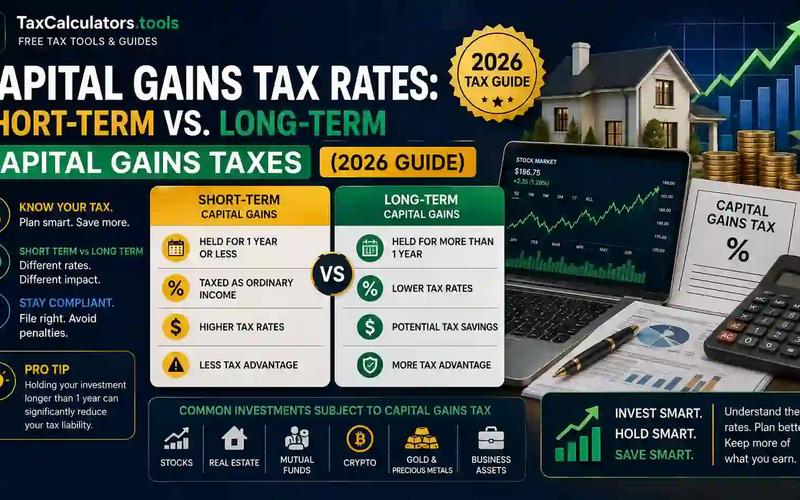
In the US, capital gains tax depends on how long an asset was held — short-term gains are taxed as ordinary income, while long-term gains (assets held over a year) benefit from lower preferential rates. You can estimate this using the US capital gains tax calculator.
There's also a reporting nuance here: if a US person owns property in Pakistan, that property itself generally isn't taxed by the IRS, but any rental income or gains from selling it must be reported on the US return — even if Pakistani tax was already paid on it, with a Foreign Tax Credit typically available to offset the overlap.
Additionally, Pakistan doesn't currently impose a broad annual wealth tax, though wealth statements are required as part of the tax return filing process for resident individuals above certain thresholds. The US also has no federal wealth tax, though estate and gift tax rules apply above high exemption thresholds — a completely different mechanism from anything in Pakistan's system.
Sales Tax vs GST vs VAT: A Quick Clarification
This is a common point of confusion. Pakistan uses a General Sales Tax (GST) system on goods, with provincial sales taxes applying separately to services. The US has no federal sales tax at all — instead, individual states set their own sales tax rates, and several states (like Delaware and Oregon) charge none whatsoever.
If you're comparing consumption taxes across both countries, our breakdown of sales tax vs GST in Pakistan explains how the provincial and federal layers interact, which is structurally very different from the flat, state-administered US sales tax model.
Deductions: Standard vs Itemized (US) and Zakat/Allowances (Pakistan)
The US allows taxpayers to choose between a standard deduction (a flat amount) or itemized deductions (mortgage interest, medical expenses, charitable donations, etc.) — whichever reduces taxable income more. Our guide on standard vs itemized deductions breaks down how to decide which one benefits you.
Pakistan's system works differently — it allows specific deductions and tax credits, including a Zakat deduction for those who pay it under the Zakat and Ushr Ordinance, along with certain allowances for salaried individuals. There's no direct "standard deduction" equivalent, making Pakistan's deduction structure narrower but more targeted.
Renouncing US Citizenship and the Exit Tax
For long-term dual citizens who eventually decide the compliance burden isn't worth it, renouncing US citizenship is an option — but it comes with its own tax consequence: the exit tax. If your net worth or average tax liability exceeds certain IRS thresholds, you may be treated as having sold all your worldwide assets the day before expatriation, triggering a final tax bill. This is a significant, irreversible decision that typically requires professional tax and legal guidance before proceeding.
Self-Employment and Business Income Across Borders
Freelancers and business owners face an extra layer of complexity. In the US, self-employed individuals pay self-employment tax (covering Social Security and Medicare) in addition to regular income tax — you can estimate this with the self-employment tax calculator.
Pakistan doesn't have a direct equivalent to US self-employment tax, but business income is taxed under separate slabs from salaried income, and corporate tax rates apply to registered companies rather than sole proprietors. If you're running a business that touches both countries, understanding FBR's tax calculator tools alongside the US business tax calculator helps you plan quarterly estimated payments accurately on both sides.
Why Use Tax Calculators Instead of Guessing
Manually comparing two entirely different tax codes is where most expats make costly mistakes — missing a bracket, forgetting a deduction, or misjudging how much they'll actually owe after credits. This is exactly why using dedicated, up-to-date tax calculators makes such a difference. Instead of relying on outdated blog posts or rough mental math, you get real numbers based on current-year rates for both Pakistan and the US, side by side.
Whether you need to check your position under Pakistan's salary tax calculator 2026 guide or want to explore advanced free tax calculators for the US system, having accurate figures before you file — or before you talk to an accountant — puts you in control rather than guessing.
Frequently Asked Questions
Do Pakistani expats in the US have to pay taxes in Pakistan too? Generally, no — if you're a non-resident of Pakistan (spending fewer than 183 days there in a tax year), you're only taxed on Pakistan-sourced income, not your US earnings.
Do US citizens living in Pakistan need to file US taxes? Yes. US citizenship-based taxation means American citizens and green card holders must file a US tax return annually regardless of where they live, though exclusions and credits often reduce the actual tax owed to zero.
Is there a tax treaty between Pakistan and the United States? Yes, a bilateral tax treaty exists between the two countries, primarily addressing specific categories of income to help prevent double taxation, though it doesn't eliminate all US filing obligations for citizens.
What is the penalty for not filing US taxes as an expat? Penalties can include failure-to-file and failure-to-pay charges that compound over time, along with potential passport complications in extreme, prolonged non-compliance cases.
How do I become a tax filer in Pakistan as an overseas Pakistani? You'll need to register for an NTN through the FBR's IRIS portal and file an annual return to appear on the Active Taxpayer List, which reduces withholding tax rates on transactions back home.
Can I claim a foreign tax credit for taxes paid in Pakistan? Yes. US taxpayers can generally claim the Foreign Tax Credit for income taxes paid to Pakistan on the same income, helping avoid double taxation on that portion of earnings.
Final Thoughts
The Pakistan and US tax systems weren't built to talk to each other — one taxes citizenship, the other taxes residency, and the paperwork requirements on both sides can feel overwhelming if you're navigating them alone. But once you understand the mechanics — FBR vs IRS, filer status, FEIE, FTC, FATCA, and the treaty provisions — the path to staying compliant on both sides becomes a lot more manageable.
If you're currently trying to figure out exactly where you stand, don't leave it to guesswork. Use our advance free tax calculators to run real numbers for both Pakistan and the US side by side, and check out our full blog library for deeper guides on FBR filing, US federal brackets, property tax, and everything in between.
Important disclaimer
This article is for educational planning only. It does not provide professional tax, legal, accounting, payroll, customs, or financial advice. Tax rules can change and final results may depend on your personal facts. Always verify important tax decisions with official sources or a qualified professional.