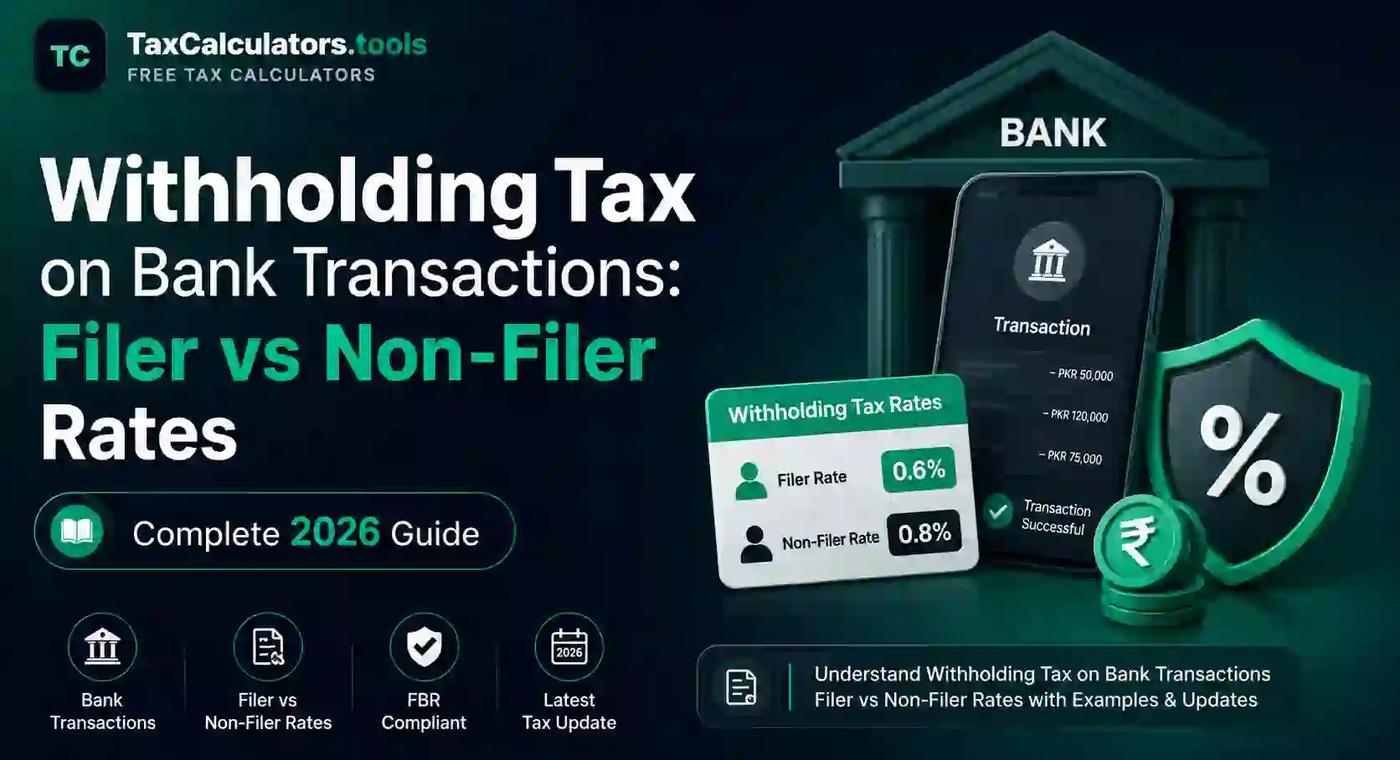
If you've ever looked at your bank statement and wondered why a chunk of money disappeared before it even reached your account, you've met withholding tax on bank transactions. It's one of the most common — and most misunderstood — parts of Pakistan's tax system. And the single biggest factor that decides how much you lose? Whether you're a filer or a non-filer with the Federal Board of Revenue (FBR).
In this guide, we'll break down exactly how withholding tax works on cash withdrawals, bank transfers, and other banking instruments, what separates a filer from a non-filer, and — most importantly — how much extra a non-filer actually pays compared to someone on the Active Taxpayer List. No jargon, no legal maze, just a clear, practical explanation you can actually use.
What Is Withholding Tax on Bank Transactions?
Withholding tax is an advance tax that your bank deducts automatically at the time of a transaction, before the money ever reaches you. Instead of waiting until the end of the tax year to collect what's owed, FBR asks banks to act as collection agents — deducting a small percentage on cash withdrawals, transfers, and certain other banking transactions, and depositing that amount directly with the government.
Think of it less like a separate tax and more like a prepayment. If you're an active filer, this amount is usually adjustable against your annual tax liability or refundable when you file your return. If you're a non-filer, it often becomes a final, non-adjustable cost — which is exactly why the gap between filer and non-filer rates matters so much.
This system is rooted in Pakistan's Income Tax Ordinance 2001, and it applies broadly across commercial banks, though the exact rate depends on the transaction type, the amount, and your filer status.
Why Filer vs Non-Filer Status Matters So Much
Here's the part most people miss: withholding tax on bank transactions isn't just a flat percentage — it's a two-tier system designed specifically to reward documented, tax-compliant individuals and penalize those who stay outside the tax net.
The logic is straightforward. FBR wants more people filing income tax returns and appearing on the Active Taxpayer List (ATL). To push that behavior, it applies noticeably higher withholding tax rates to non-filers on almost every major financial transaction — cash withdrawals, banking instruments, vehicle registration, property transfers, and more. A filer might pay a fraction of a percent on a cash withdrawal, while a non-filer on the exact same transaction pays a rate that can be two, three, or even several times higher.
Over a year, for someone who regularly withdraws cash or moves money between accounts for business, that difference adds up to a substantial amount of unrecoverable tax. This is the single biggest financial incentive FBR uses to convert non-filers into filers.
"The extra tax collected from non-filers is not a discount — it is deliberately structured to be more expensive than simply filing a tax return." — This is the core principle behind Pakistan's withholding tax policy on banking transactions.
Current Withholding Tax Rates: Filer vs Non-Filer
Rather than cramming numbers into a table, let's walk through this the way you'd actually experience it — transaction by transaction.
Cash withdrawals above the threshold. Under Section 231A of the Income Tax Ordinance, banks deduct withholding tax when a non-filer withdraws cash exceeding the specified threshold in a single day. Filers are largely exempt from this deduction on regular cash withdrawals, while non-filers face a deduction calculated as a percentage of the withdrawn amount. This is one of the most noticeable differences ordinary account holders feel, because it applies every single time they withdraw a large sum.
Banking transactions and instruments (Section 236P). This section covers non-cash banking transactions — things like demand drafts, pay orders, online transfers (RTGS, IBFT), and other instruments — for amounts exceeding the prescribed daily limit. Filers are generally exempt here as well. Non-filers, on the other hand, are charged advance tax on the transaction value, which is deducted automatically by the bank at the time of transfer.
Advance tax on other specified transactions. Beyond straightforward withdrawals and transfers, several other banking-adjacent transactions carry differentiated rates — from vehicle registration to certain utility payments processed through banks — where non-filers consistently pay a steeper rate than filers.
Because FBR periodically revises these percentages through the annual Finance Act, the exact numeric rate for the current tax year can shift. Rather than relying on a number that may already be outdated by the time you read this, always cross-check the live rate on FBR's official portal or run your numbers through a dedicated withholding tax calculator before making a large transaction — it takes the guesswork out completely and shows you the exact deduction for your filer status instantly.
For a broader look at how these rates evolved into the current structure, our detailed breakdown on filer vs non-filer tax rates in Pakistan walks through the historical context and recent Finance Act changes.
Who Counts as a Filer — and Who Doesn't
A filer is any individual or entity whose name appears on FBR's Active Taxpayer List at the time of the transaction. Being a filer isn't about income level or how much tax you owe — it's simply about whether you've filed your income tax return for the relevant tax year and FBR has processed and reflected that status.
A non-filer, by contrast, is anyone who hasn't filed a return, whose return wasn't filed on time, or whose name has been removed from the ATL for any compliance reason — even if they technically earn taxable income.
It's worth noting there's also a middle category many people don't know about: a late filer. If you file after the ATL deadline but before the next cycle, you may appear on a supplementary list, sometimes with a small surcharge, but still access filer-level rates on most transactions. This is often the fastest route back to lower withholding tax if you missed the original deadline.
You can verify your own status in under a minute using FBR's Active Taxpayer List check — either by CNIC (for individuals) or NTN (for businesses). Our guide on checking FBR Active Taxpayer List status walks through the exact steps, including the SMS-based verification method that doesn't even require logging into a portal.
How to Become a Filer and Start Saving on Withholding Tax
Becoming a filer is genuinely one of the highest-return actions a taxpayer in Pakistan can take, and the process is more accessible than most people assume.
Here's the general path:
- Register for an NTN (National Tax Number) if you don't already have one — this can be done online through FBR's registration portal using your CNIC.
- Create your IRIS account. IRIS is FBR's official e-filing system, and it's where all return filing, verification, and tax record management happens.
- Gather your income documents — salary certificates, bank statements, business income records, or any other proof of earnings for the relevant tax year.
- File your income tax return through IRIS, declaring your income, assets, and any tax already withheld or paid in advance.
- Wait for ATL update. Once your return is processed and accepted, FBR updates the Active Taxpayer List, and your filer status becomes active — typically reflected within a short window after submission.
Once you're on the ATL, the reduced withholding tax rates apply automatically to your bank transactions — you don't need to submit any separate exemption certificate for standard banking deductions.
If you want the full step-by-step walkthrough with screenshots and common troubleshooting tips, our dedicated guide on how to become a tax filer in Pakistan covers the entire registration and filing process in detail. And if you're logging in for the first time and unsure how IRIS works, the FBR IRIS portal guide is the most beginner-friendly resource we've put together.
FBR IRIS Login: A Quick Primer
Since IRIS is central to both filing your return and maintaining filer status, it's worth understanding how the login process works.
IRIS is accessible directly through FBR's official website at iris.fbr.gov.pk. First-time users register using their CNIC, mobile number, and email — FBR sends verification codes to both to confirm identity before granting portal access. Returning users log in with their registered CNIC or NTN as the username along with their chosen password.
Common login issues usually come down to three things: an expired password (IRIS enforces periodic resets), an unregistered or changed mobile number (SMS verification will fail), or browser compatibility (IRIS tends to run more smoothly on updated versions of Chrome or Firefox). Our FBR IRIS login guide covers password recovery and account recovery steps in detail if you get stuck.
Penalties and Extra Costs for Non-Filers Beyond Withholding Tax
Withholding tax on bank transactions is just one piece of a much larger cost structure that non-filers face. It's worth understanding the full picture, because the withholding tax difference alone often undersells how expensive non-filer status really is.
Non-filers typically face higher advance tax rates on vehicle registration and transfer, elevated withholding tax on property purchases and sales, higher rates on dividend income, and increased tax on prize bonds and winnings. In several cases, non-filers are also barred entirely from certain transactions — such as purchasing property above a specified value or registering high-value vehicles — regardless of how much extra tax they're willing to pay.
There's also a compounding effect that's easy to underestimate: withholding tax deducted from a non-filer is frequently treated as a final tax, meaning it isn't adjustable or refundable even if the person's actual tax liability for the year would have been lower. For a filer, the same deduction is usually adjustable against their annual return — so if too much was withheld, they get it back.
If you're curious how this same filer/non-filer gap plays out specifically in real estate transactions, we've covered that in depth in our piece on withholding tax on property transactions in Pakistan.
Real-World Example: The Cost Difference in Practice
Let's make this concrete with a simple scenario, without diving into constantly-changing exact percentages.
Imagine two people — Ahmed, a filer, and Bilal, a non-filer — both withdraw a large amount of cash from their bank on the same day for a business payment. Ahmed's withdrawal passes through with no withholding deduction, because he's an active filer. Bilal's identical withdrawal gets a noticeable percentage sliced off automatically, deducted before the cash is handed over.
Now scale that across a year. If Bilal regularly makes large cash withdrawals or bank transfers for business purposes — say, monthly supplier payments or payroll — that "invisible tax" adds up to a meaningful sum, all of it non-adjustable since Bilal never files a return to claim it back. Ahmed, meanwhile, keeps that money and only settles his actual tax liability once, at filing time, with the ability to claim any other withholding amounts as credit.
This is exactly why financial advisors, accountants, and even bank relationship managers in Pakistan routinely recommend filing a return — not out of civic duty alone, but because non-filer status is measurably, repeatedly more expensive.
Tools That Make This Easier: Tax Calculators
Manually tracking every withholding tax section, threshold, and rate update is genuinely difficult — even for people who work in finance. This is where a good tax calculator earns its keep.
A reliable income tax calculator lets you estimate your annual liability instantly based on your income bracket, so you know roughly where you stand before you even file. Pairing that with a dedicated withholding tax calculator means you can plug in a transaction amount and your filer status, and immediately see the deduction you'll face — before you walk into the bank, not after.
For businesses managing regular advance tax obligations, the advance tax calculator is particularly useful for forecasting cash flow around large transactions. And if you want a broader view of your overall tax position across salary, banking, and other income sources in one place, the FBR tax calculator consolidates several calculations into a single, free tool.
Explore our full suite of free tax calculators to check your numbers before your next major transaction — it takes less time than waiting in a bank queue.
How Often Do Withholding Tax Rates Change?
FBR typically revises withholding tax rates annually through the Finance Act, usually announced alongside the federal budget. However, rates can also be adjusted mid-year through Statutory Regulatory Orders (SROs) if the government decides on an interim policy change. This is why relying on a static number from an old article — or even last year's version of this one — can lead to inaccurate expectations.
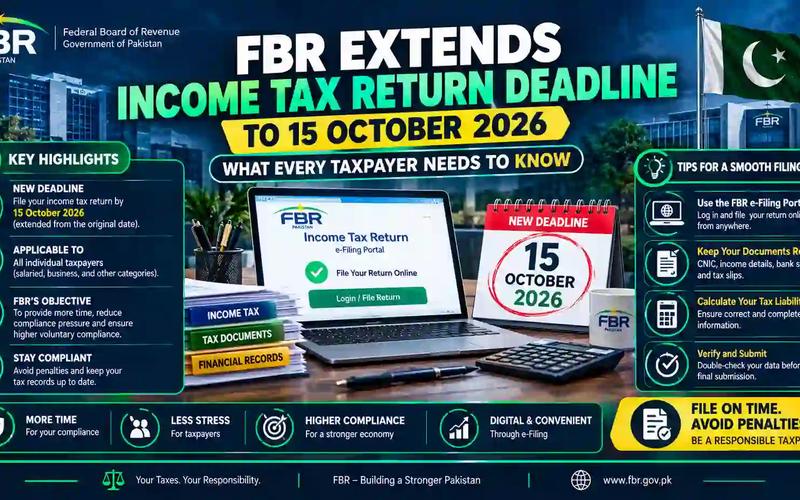
For the latest confirmed rate structure and slab updates, our regularly refreshed guide on FBR tax slabs and updates tracks these changes as they're officially notified. It's also worth bookmarking the FBR tax deadlines calendar so you never miss an ATL filing window and accidentally slip into non-filer status for a stretch of the year.
For the most authoritative, primary-source confirmation of any rate, FBR's own official website at fbr.gov.pk publishes notified SROs and circulars directly — always worth a quick cross-check before making a high-value transaction.
Practical Tips to Reduce Your Withholding Tax Burden
A few habits genuinely make a difference here:
- File before the ATL deadline every year, even if your income is modest — filer status is what unlocks the lower rate, not your income level.
- Check your ATL status before large transactions, since processing delays occasionally cause a recently-filed return to not yet reflect in the system.
- Split large cash needs across filer-status family members or business accounts where legally appropriate, rather than one large non-filer withdrawal.
- Keep your NTN and bank account details consistent, since mismatches between registered information and bank records can occasionally cause a filer to be incorrectly taxed at the non-filer rate.
- Use a calculator before, not after, the transaction — this is the simplest way to avoid an unpleasant surprise on your statement.
None of these require professional tax expertise — they're habits anyone can build once they understand how the filer/non-filer system actually rewards compliance.
Frequently Asked Questions
What is withholding tax on bank transactions? It's an advance tax that banks automatically deduct on specified cash withdrawals, transfers, and banking instruments, calculated as a percentage of the transaction and paid directly to FBR on your behalf.
Who is considered a filer in Pakistan? Anyone whose name appears on FBR's Active Taxpayer List at the time of the transaction, which requires having filed an income tax return for the applicable tax year.
What is the penalty for being a non-filer? Non-filers face significantly higher withholding tax rates on bank transactions, property, vehicles, and dividends, and in some cases are restricted from making certain high-value transactions altogether.
How can I check if I am a filer or non-filer? You can verify your status instantly through FBR's Active Taxpayer List check using your CNIC or NTN, either online through IRIS or via SMS verification.
Is withholding tax refundable? For filers, withholding tax is generally adjustable against annual tax liability and refundable if excess was deducted. For non-filers, it's often treated as a final tax and is typically not refundable.
Does withholding tax apply to online bank transfers? Yes — online transfers, RTGS, and other banking instruments above the specified threshold are covered under the same withholding tax framework as cash withdrawals, with the filer/non-filer distinction still applying.
Final Thoughts: Filing Isn't Just Compliance — It's Savings
The gap between filer and non-filer withholding tax rates isn't a technicality buried in tax law — it's one of the most direct, measurable financial incentives in Pakistan's entire tax system. Every large cash withdrawal, every bank transfer, every property or vehicle transaction quietly reflects whether you took the time to file a return or not.
The good news is that closing that gap is entirely within your control, and it doesn't require a tax consultant or weeks of paperwork. Register on IRIS, file your return, confirm your ATL status, and you immediately start keeping more of your own money on every transaction going forward.
Before your next bank withdrawal or transfer, take two minutes to run the numbers through our free withholding tax calculator — it's the fastest way to see exactly what filer status is worth to you, in real rupees, on your real transaction.
Important disclaimer
This article is for educational planning only. It does not provide professional tax, legal, accounting, payroll, customs, or financial advice. Tax rules can change and final results may depend on your personal facts. Always verify important tax decisions with official sources or a qualified professional.