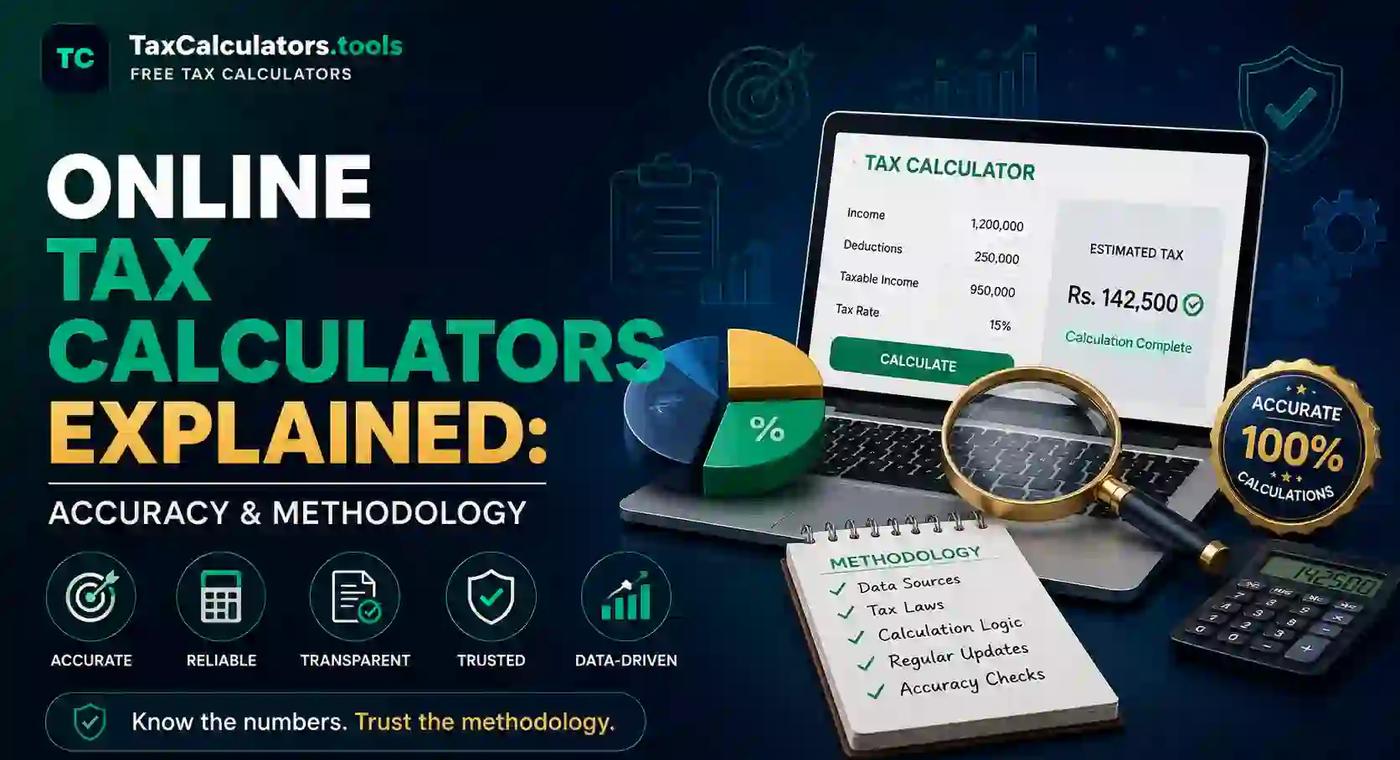
Filing taxes used to mean sitting down with a calculator, a stack of forms, and a strong cup of coffee. Today, most people just open an online tax calculator, punch in a few numbers, and get an estimate in seconds. But have you ever wondered what's actually happening behind that "Calculate" button?
This guide breaks down the real tax calculator methodology — how these tools pull data, apply tax rules, and generate results — and honestly answers the question everyone asks: how accurate are online tax calculators, really? Whether you're checking your federal tax calculator estimate in the US or using a salary tax calculator in Pakistan, you'll leave this article knowing exactly what's happening under the hood.
What Is an Online Tax Calculator?
An online tax calculator is a digital tool that estimates how much tax you owe (or how much refund you'll get) based on the financial information you enter — income, filing status, deductions, and location. Instead of manually applying tax bracket formulas, the tool does the math instantly using pre-programmed tax rules for a specific tax year.
Think of it as a simplified simulation of the actual tax filing process. A good digital tax calculator doesn't just multiply your income by a flat rate — it replicates the layered, rule-based logic that tax authorities like the IRS or FBR use.
Why Tax Calculators Matter (For Both the US and Pakistan)
Tax systems in both countries are progressive, meaning different portions of your income are taxed at different rates. Manually figuring this out is confusing and error-prone. That's where these tools add real value:
- Speed — get an estimate in under a minute instead of hours of manual math
- Planning — know your take-home pay before accepting a job offer or raise
- Compliance — avoid underpaying or overpaying estimated taxes
- Accessibility — no accounting background required
In the US, people use tools like a federal income tax calculator to plan around IRS brackets, while in Pakistan, users rely on an FBR income tax calculator to check monthly withholding under the latest FBR slabs. You can read more in our FBR Tax Calculator 2026 Guide.
The Methodology Behind Online Tax Calculators
Here's the actual step-by-step process most reliable tax calculators follow.
Step 1: Data Collection
The calculator first collects your inputs — this is the "garbage in, garbage out" stage. Common inputs include:
- Gross annual or monthly income
- Filing status (single, married, head of household)
- Location (state, province, or country — since state tax calculator and provincial rules differ)
- Additional income sources (freelance, rental, capital gains)
- Retirement contributions or pre-tax deductions
Step 2: Determining Taxable Income
Once your gross income is captured, the tool calculates your adjusted gross income (AGI) by subtracting eligible pre-tax deductions (retirement contributions, health savings accounts, etc.). This AGI, minus your standard or itemized deduction, becomes your taxable income calculation — the number that actually gets taxed, not your full salary.
Step 3: Applying Tax Brackets or Slabs
This is the heart of the tax calculation algorithm. Both the US and Pakistan use a progressive (tiered) system, meaning you don't pay one flat rate on your entire income. Instead, each "slice" of income is taxed at the rate for that bracket.
For example, in the US federal system, if you're in the 22% bracket, that doesn't mean 22% of your total income goes to tax — only the portion that falls into that bracket does. This is the difference between your marginal tax rate (the rate on your last dollar earned) and your effective tax rate (the average rate across your whole income). Our Federal Tax Brackets Explained 2026 guide covers this in more depth.
Pakistan's FBR system works similarly with salary tax slabs, which is why users searching "how is salary tax calculated in Pakistan" often get confused — the math isn't a flat percentage either. See our Pakistan Salary Tax Slabs Breakdown for slab-by-slab detail.
Step 4: Factoring in Deductions and Credits
A calculator's accuracy depends heavily on how well it handles deductions and credits:
- Standard deduction vs itemized deduction — most free calculators default to the standard deduction unless you specify itemizing
- Tax credits (child tax credit, education credits) — these reduce your tax bill dollar-for-dollar, unlike deductions which reduce taxable income
- Withholding tax estimate — factoring in what's already been deducted from your paycheck
If you're unsure which deduction method benefits you more, our Standard vs Itemized Deductions Guide walks through real comparisons.
Step 5: Calculating Final Liability or Refund
After applying brackets, deductions, and credits, the calculator arrives at your tax liability estimate. It then compares this against what's already been withheld (via your paycheck or advance tax payments) to show whether you owe more or are due a tax refund.
How Accurate Are Online Tax Calculators?
This is the single most-asked question, and the honest answer is: it depends on the quality of the tool and the quality of your inputs.
A well-built calculator that's updated for the current tax year and uses official IRS tax tables or FBR slabs can get remarkably close to your actual liability — often within a small margin of error. However, accuracy typically drops when:
- You have multiple income streams (freelance + salary + investments)
- You qualify for niche deductions or credits the calculator doesn't account for
- State or provincial rules aren't factored in alongside federal/national rules
- Tax laws changed recently and the tool hasn't been updated
For a general estimate, a tax refund estimator is usually accurate within 5–10% of your final number — close enough for planning, but not a replacement for official filing. According to the Internal Revenue Service (IRS), even their own official withholding estimator recommends users have their most recent pay stub and tax return on hand for the most accurate result — a good reminder that input quality drives output accuracy for any tool, official or third-party.
Why Do Tax Calculator Results Vary Between Tools?
If you've tried two different calculators and gotten two different numbers, you're not imagining it. Common reasons include:
- Different assumed filing statuses — one may default to "single," another to "married"
- Outdated tax tables — some tools lag behind current-year updates
- State/provincial handling — some calculators skip local taxes entirely
- Rounding methods — small differences in how brackets are applied
- Deduction assumptions — standard vs itemized defaults
This is exactly why choosing an updated, transparent tool matters more than picking the first result on Google.
Types of Online Tax Calculators
Not all tax calculators serve the same purpose. Here's a breakdown by use case:
- Income tax calculator — general annual tax liability estimate
- Paycheck calculator — take-home pay per pay period
- Payroll tax calculator — used by employers to calculate withholding
- Self-employment tax calculator — for freelancers and 1099 workers
- Capital gains tax calculation tools — for investment income
- Sales tax calculator — for purchases, not income
- Property tax calculator — annual property-based tax
You can explore country-specific versions directly:
- US: Federal Income Tax Calculator, Paycheck Tax Calculator, Self-Employment Tax Calculator
- Pakistan: Salary Tax Calculator, Income Tax Calculator, Withholding Tax Calculator
Online Tax Calculators: US vs Pakistan
| Online Tax Calculators: US vs Pakistan | ||
|---|---|---|
| Feature | US Tax Calculators | Pakistan Tax Calculators |
| Governing body | IRS | FBR (Federal Board of Revenue) |
| System type | Federal + state layered | Federal (with provincial variations for some taxes) |
| Common tools | Federal income tax calculator, state income tax calculator | Salary tax calculator, FBR tax calculator |
| Filing frequency | Annual (with quarterly estimated taxes for self-employed) | Annual, with monthly withholding on salary |
| Special cases | States like Texas have no state income tax | Non-filers face higher withholding rates |
If you're comparing systems directly — say, as an expat — our Pakistan vs US Tax System Guide breaks this down further.
How to Use an Online Tax Calculator Correctly
To get the most accurate estimate possible, follow these practical tips:
- Use your most recent pay stub or income statement — not a rough guess
- Select the correct filing status — this alone can shift your result significantly
- Include all income sources — freelance, rental, or investment income all matter
- Choose the right deduction method — check both standard and itemized if unsure
- Confirm the tax year — make sure the calculator reflects current rules, not last year's
- Re-run it after major life changes — marriage, new job, or a new dependent all affect your estimate
Tax Calculators vs Tax Software vs Accountants
It's worth understanding where a free calculator fits versus other options:
- Tax calculator vs tax software: A calculator gives you a quick estimate; tax software (like TurboTax-style platforms) actually files your return, stores documents, and walks through every line item.
- Tax calculator vs accountant: A calculator is instant and free but can't account for unusual situations (business structures, multi-state income, complex deductions) the way a licensed tax professional can.
- Manual calculation vs online calculator: Manual math is more error-prone and time-consuming, but it forces you to understand your numbers — a calculator trades that understanding for speed.
The smartest approach for most people: use a calculator for planning and budgeting throughout the year, then use software or a professional at actual filing time.
Real-World Example: Calculating Tax Step by Step
Let's say a US taxpayer earns $65,000 annually, files as single, and takes the standard deduction.
- Gross income: $65,000
- Standard deduction reduces taxable income
- Remaining taxable income is split across brackets — a portion taxed at 10%, the next portion at 12%, and so on up to their marginal rate
- The calculator sums the tax owed from each bracket segment
- It subtracts any tax already withheld from paychecks
- Result: either a balance due or a refund estimate
This layered math is exactly why two people earning the same salary but with different deductions or filing statuses can see very different final numbers — and why a calculator's real value is doing this bracket-by-bracket math instantly instead of manually.
The Future of Tax Calculators: AI and Real-Time Calculation
Tax calculators are evolving fast. The next generation of tools is moving toward:
- Real-time tax calculation that updates instantly as tax law changes are announced
- AI-assisted deduction detection — flagging credits or deductions users might miss
- Integrated document scanning — pulling numbers directly from pay stubs or tax forms
- Multi-country support — useful for remote workers and expats juggling two tax systems
As these tools mature, expect tighter integration with official data sources like the IRS and FBR, closing the accuracy gap even further.
FAQs
How does an online tax calculator work? It takes your income, filing status, and deductions, applies current tax brackets or slabs, and calculates your estimated tax liability or refund — all based on official tax rules for that year.
Are online tax calculators accurate? Yes, generally, if the tool is updated for the current tax year and you enter accurate, complete information. They're best used as estimates, not final figures.
Can a tax calculator replace a tax professional? No. Calculators are great for quick estimates and planning, but a licensed tax professional handles complex situations, filing, and legal compliance a calculator can't.
Why is my tax calculator estimate different from my actual refund? Differences usually come from missing income sources, incorrect filing status, outdated tax tables, or deductions and credits the calculator didn't account for.
How often are tax calculators updated for new tax laws? Reliable calculators update annually — and sometimes mid-year — whenever brackets, standard deductions, or credit amounts change.
Is it safe to enter personal financial data into a tax calculator? Reputable calculators don't require personally identifiable information like your name or Social Security/CNIC number — only income figures needed for the math. Always check a site's privacy policy before entering sensitive data.
Conclusion
Online tax calculators have turned a once-intimidating process into something anyone can do in minutes. Understanding the methodology — data input, taxable income calculation, bracket application, and deduction handling — helps you trust your results and know when it's time to bring in a professional instead.
Ready to see your own numbers? Explore our advanced free tax calculators for both the US and Pakistan, and check out our full library of tax planning guides to stay ahead of every tax season.
Important disclaimer
This article is for educational planning only. It does not provide professional tax, legal, accounting, payroll, customs, or financial advice. Tax rules can change and final results may depend on your personal facts. Always verify important tax decisions with official sources or a qualified professional.