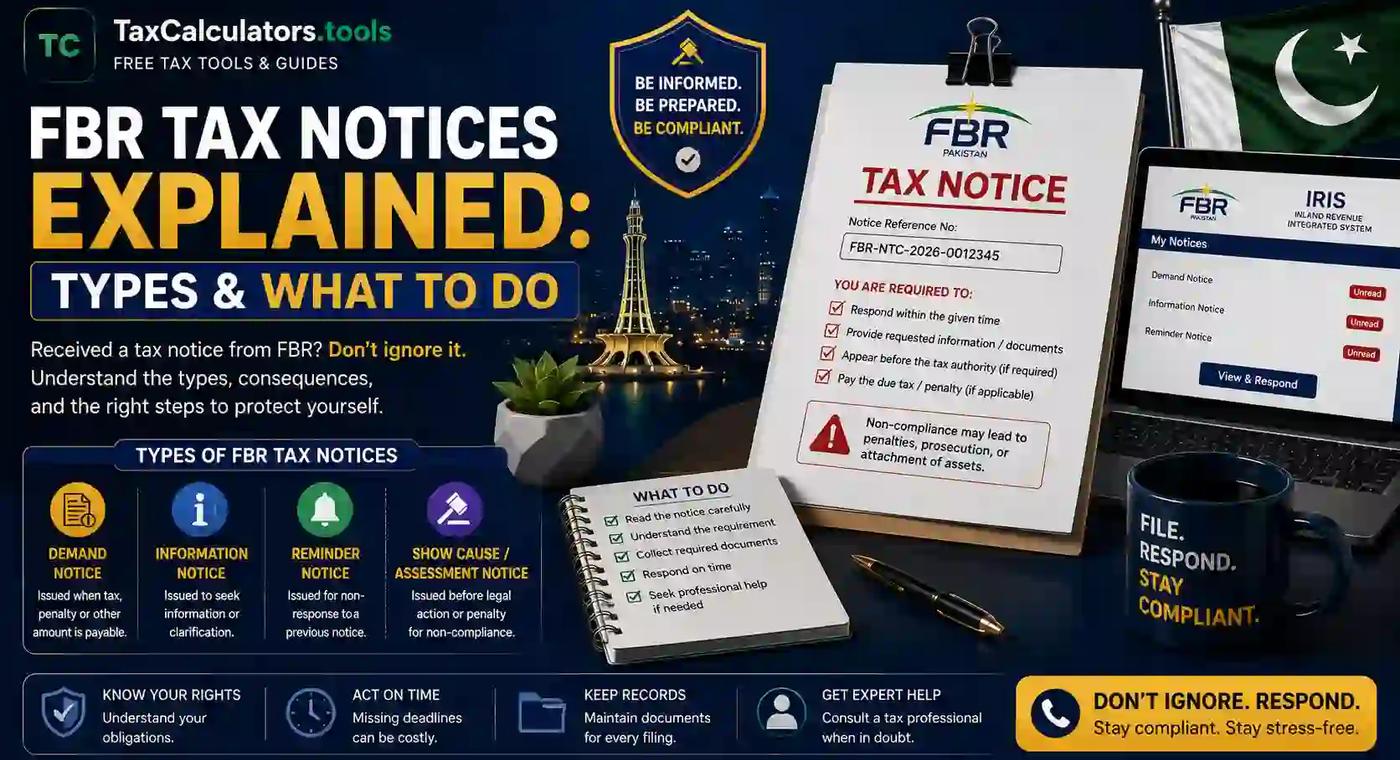
If an FBR notice has landed in your IRIS inbox or your inbox at home, the first feeling is usually panic. Don't let it be. Most FBR notices are routine — a missing return, a mismatched bank transaction, or a request for clarification — and they almost always have a fixed, manageable process to resolve them. This guide breaks down every major type of FBR notice, why you got one, and exactly what to do next, step by step.
An FBR notice is an official communication issued by the Federal Board of Revenue under the Income Tax Ordinance, 2001, asking a taxpayer to explain, correct, or submit information related to their tax affairs. It can relate to non-filing, an audit, undeclared income, or a mismatch between your declared income and your actual financial activity. Ignoring it rarely makes it go away — responding correctly usually does.
By the end of this article, you'll know how to identify which notice you've received, how to check it on IRIS, how to draft a proper reply, and when it's smarter to bring in a professional.
What Is an FBR Notice, Exactly?
An FBR notice is a legal document issued by the Federal Board of Revenue (or one of its Regional Tax Offices) that requires a taxpayer to take a specific action within a set deadline — usually between 7 and 30 days, depending on the section under which it's issued.
Notices are not random. FBR's system flags taxpayers based on data it already holds: bank transaction reports, property registration records, vehicle purchases, utility bills, withholding tax statements from employers, and cross-matching with the Active Taxpayer List (ATL). If something doesn't add up, IRIS generates a notice automatically or a tax officer issues one manually after review.
Getting a notice does not automatically mean you've done something wrong. It often just means FBR needs more information, a missing document, or a corrected filing.
Why Do People Receive FBR Notices?
There are a handful of recurring reasons behind most notices issued in Pakistan:
- You didn't file your income tax return for a tax year you were required to file
- Your bank reported cash withdrawals or transactions above the withholding tax threshold
- You bought property, a vehicle, or made a large purchase that doesn't match your declared income
- Your wealth statement doesn't reconcile year-over-year
- You were randomly selected for audit under the FBR's parametric selection system
- Your withholding tax deductions (salary, contracts, dividends) don't match what your employer or client reported
- You appear as a non-filer despite having taxable income, based on third-party data
If you're unsure whether you were even required to file, it helps to first check your filer status and correct your Active Taxpayer List entry before assuming the notice is an error.
Types of FBR Notices Explained
FBR notices are issued under specific sections of the Income Tax Ordinance, 2001, and each section serves a different purpose. Here's a breakdown of the ones you're most likely to encounter.
Notice Under Section 114 (Return Not Filed)
This is the most common notice for non-filers. It's issued when FBR's records show you had a filing obligation — based on your income, property ownership, vehicle registration, or utility connections — but you never submitted a return.
What to do: File the return for the relevant tax year through IRIS as soon as possible. Late filing after a Section 114 notice can still get you onto the ATL, though it may come with a surcharge. If you're not sure how the filing process works end-to-end, this walkthrough on how to become a tax filer in Pakistan covers it clearly.
Notice Under Section 114(4) (Specific Year Non-Filing)
A more targeted version of the above — FBR names the exact tax year(s) you missed. Respond by filing precisely those years' returns, not just the current one.
Notice Under Section 122 (Amendment of Assessment)
This one is more serious. It means FBR believes your previously filed return understated your income or overstated deductions, and the department intends to amend your assessment — which usually results in additional tax payable.
What to do: Don't ignore the timeline. You're entitled to respond with supporting documents (bank statements, invoices, expense records) explaining the figures you originally declared. If the amendment proceeds and you disagree, you have the right to file an appeal against the FBR order with the Commissioner Inland Revenue (Appeals).
Notice Under Section 176 (Information/Document Request)
A Section 176 notice is essentially a data request — FBR is asking you to provide specific documents, bank statements, contracts, or explanations. It's investigative, not necessarily punitive.
What to do: Provide exactly what's asked, nothing more, nothing less, and keep copies of everything submitted along with an acknowledgment.
Notice Under Section 177 (Tax Audit)
This notice initiates a full FBR audit. You'll be asked to produce books of accounts, bank records, invoices, and supporting evidence for a specific tax year. Audit selection can happen randomly through FBR's computer-ballot system or based on risk parameters (unusual income patterns, industry benchmarks, or previous discrepancies).
What to do: Organize your financial records early, respond to every audit query in writing, and strongly consider professional representation — audit notices are where errors in response can lead to real financial exposure.
Show Cause Notice
A show cause notice is issued when FBR intends to impose a penalty, and gives you a formal opportunity to explain why that penalty shouldn't apply — for example, for late filing, incomplete wealth statements, or failure to respond to an earlier notice.
What to do: Respond within the deadline with a clear, factual explanation. Silence is treated as an admission, which almost always leads to the penalty being finalized.
Wealth Statement Notice
Issued when your declared wealth statement doesn't reconcile with the previous year's figures, or when large asset additions (property, vehicles, investments) aren't reflected properly.
What to do: Recheck your wealth reconciliation statement, correct discrepancies, and refile if needed through IRIS.
Penalty Notice
This confirms a penalty has already been imposed — for late filing, non-filing, or incorrect information. It's typically the final stage after a show cause notice went unanswered or the explanation wasn't accepted.
What to do: You can pay the penalty or, if you believe it's unjustified, file an appeal within the allowed timeframe.
Withholding Tax Notice
Sent to employers, banks, or businesses acting as withholding agents when there's a shortfall or mismatch in the tax they were required to deduct and deposit on behalf of others.
What to do: Reconcile your withholding tax statements against actual deductions and file corrected statements where needed.
How to Check an FBR Notice Online Through IRIS
You don't need to wait for a printed letter — most notices appear directly in your IRIS account. Here's how to check:
- Go to the official IRIS portal at iris.fbr.gov.pk
- Log in using your registration number (CNIC for individuals) and password
- Navigate to the "Inbox" or "Notices" section under your dashboard
- Open the notice to view the section it's issued under, the deadline, and the specific query
- Download the notice as a PDF for your records before drafting a response
If you've forgotten your login credentials or your account shows an inactive status, resolving that is usually the first step — a good reference is this FBR IRIS portal guide, which walks through login recovery and registration issues.
How to Respond to an FBR Notice, Step by Step
Every notice response follows roughly the same structure, whether it's a simple non-filing notice or a full audit query.
Step 1: Read the notice carefully. Identify the exact section it's issued under, the tax year in question, and the deadline. This determines everything else.
Step 2: Gather your documents. Depending on the notice, you may need your CNIC, bank statements, salary certificates, property documents, previous tax returns, and wealth statements.
Step 3: Draft a written reply. Address the specific query raised — don't submit a generic response. Reference the notice number and section explicitly.
Step 4: Submit through IRIS. Most replies are uploaded directly to the portal against the notice reference number, along with supporting attachments.
Step 5: Keep proof of submission. Save the acknowledgment or tracking number IRIS generates after you submit.
Step 6: Follow up if there's no response. If FBR doesn't act within a reasonable time, you can follow up through the RTO (Regional Tax Office) or FBR helpline.
A properly documented, on-time reply resolves the vast majority of notices without escalation. Most problems arise not from the underlying tax issue but from missed deadlines or incomplete responses.
Documents You'll Typically Need
Depending on the notice type, keep these ready:
- CNIC and NTN details
- Salary certificate or business income records
- Bank statements for the relevant tax year
- Property purchase/sale documents, if applicable
- Vehicle registration documents, if applicable
- Previous years' tax returns and wealth statements
- Withholding tax certificates from employers or banks
If you're unsure whether your NTN is even active or correctly linked to your CNIC, it's worth doing an NTN verification check before you respond — a mismatched or inactive NTN can complicate an otherwise simple reply.
What Happens If You Ignore an FBR Notice?
Ignoring a notice doesn't make the issue disappear — it escalates it. Here's the typical progression:
- Best judgment assessment: FBR can assess your tax liability based on available data, often at a higher figure than reality, simply because you didn't provide your own explanation
- Penalties and surcharges: Late or non-response frequently triggers penalty notices
- Removal from or exclusion from the Active Taxpayer List, meaning higher withholding tax rates on banking transactions, property, and vehicle purchases
- Recovery proceedings, including bank account attachment in serious, prolonged non-compliance cases
In short: responding late is manageable. Not responding at all is what turns a routine notice into a real problem.
FBR Notices for Specific Situations
Notice for Bank Transactions
Banks report large cash withdrawals and transactions to FBR under withholding tax rules. If your transaction volume doesn't match your declared income, expect a notice asking you to explain the source of funds. Understanding how withholding tax applies to filers and non-filers on bank transactions helps you anticipate this before it happens.
Notice for Property Purchase
Property registration authorities share transaction data with FBR. A notice here usually asks you to prove the source of funds used for the purchase and confirm it was declared in your wealth statement. This guide on withholding tax on property transactions in Pakistan explains the tax mechanics involved.
Notice for Undeclared Income
This is more serious — it implies FBR has evidence of income that wasn't reported. Respond with full transparency and supporting documentation, and strongly consider consulting a tax professional before replying.
Filer vs Non-Filer: Why It Matters When You Get a Notice
Your filer status directly affects how a notice plays out. Filers — people on the Active Taxpayer List — generally face lower withholding tax rates and fewer automatic triggers for notices. Non-filers face higher withholding rates across banking, property, and vehicle transactions, which is often exactly what generates the notice in the first place.
If you're not sure where you stand, the difference is explained clearly in this comparison of filer vs non-filer tax rates in Pakistan. Becoming an active filer is often the single most effective way to reduce future notices.
Understanding the Legal Basis: Income Tax Ordinance, 2001
Every FBR notice traces back to a specific section of the Income Tax Ordinance, 2001 — the law that governs income tax in Pakistan. Knowing the ordinance isn't just legal trivia; it tells you your rights, your deadlines, and your appeal options. For a plain-language breakdown of how the ordinance works, see this explainer on the Income Tax Ordinance 2001 in Pakistan.
You can also always verify the exact wording of any section directly on FBR's own portal at fbr.gov.pk, which publishes the full ordinance and current SROs (Statutory Regulatory Orders).
When Should You Hire a Tax Consultant?
Not every notice needs a lawyer. A simple Section 114 non-filing notice can usually be resolved by filing the missing return yourself through IRIS. But consider professional help when:
- You've received a Section 122 amendment or Section 177 audit notice
- The amounts involved are significant
- You're unsure how to explain a discrepancy in your bank transactions or wealth statement
- You've already missed one deadline and received a follow-up penalty notice
- The notice involves a business, not just personal income
Whether you're in Islamabad, Lahore, or Karachi, working with someone who understands FBR's regional tax office procedures can save weeks of back-and-forth. If your notice relates specifically to an ATL correction or notice resolution, FBR notice and ATL correction support is a dedicated service worth exploring rather than navigating IRIS blind.
Staying Ahead of Future Notices
The best way to deal with FBR notices is to avoid triggering avoidable ones in the first place:
- File your return every year, even if your income is below the taxable threshold, if you're required to
- Keep your wealth statement updated and reconciled annually
- Check your Active Taxpayer List status periodically
- Mark your calendar with FBR's tax filing deadlines so you're never caught filing late
- Use a reliable FBR tax calculator before filing, to catch mismatches before FBR does
- If you run a business, make sure your company registration and tax registration details are consistent across all records
Frequently Asked Questions
What is an FBR notice? An FBR notice is an official communication from the Federal Board of Revenue asking a taxpayer to file a missing return, explain a discrepancy, submit documents, or respond to an audit query, issued under a specific section of the Income Tax Ordinance, 2001.
Why did I receive an FBR notice? Most notices are triggered by non-filing, a mismatch between your declared income and your actual transactions (bank, property, or vehicle purchases), or random/risk-based audit selection.
How do I check my FBR notice online? Log in to IRIS at iris.fbr.gov.pk using your CNIC and password, then check the notices or inbox section of your dashboard for pending communications.
What happens if I don't respond to an FBR notice? FBR can proceed with a best judgment assessment based on available data, impose penalties, and in prolonged non-compliance cases, initiate recovery proceedings — including affecting your Active Taxpayer List status.
How many days do I have to respond to an FBR notice? It varies by notice type, but most give between 7 and 30 days. The exact deadline is always stated on the notice itself, so check it first.
Can I dispute an FBR notice or the resulting assessment? Yes. You can respond with supporting evidence during the notice period, and if an assessment is finalized against you, you have the right to file an appeal with the Commissioner Inland Revenue (Appeals) within the prescribed timeframe.
Is an FBR notice the same as a penalty? No. A notice is a request or query; a penalty is only imposed after that process concludes — usually following a show cause notice — if your explanation isn't accepted.
Final Thoughts
FBR notices feel intimidating, but almost all of them follow a predictable, resolvable path: identify the section, gather your documents, respond within the deadline, and keep proof of everything you submit. The taxpayers who run into real trouble are typically the ones who ignore the notice entirely, not the ones who respond imperfectly.
If you're currently holding an FBR notice and aren't sure where to start, don't guess your way through IRIS. Use a free FBR tax calculator to check your numbers first, and if the notice is more serious — an audit, an amendment, or a penalty — get dedicated help through FBR notice and ATL correction support before your deadline passes.
Important disclaimer
This article is for educational planning only. It does not provide professional tax, legal, accounting, payroll, customs, or financial advice. Tax rules can change and final results may depend on your personal facts. Always verify important tax decisions with official sources or a qualified professional.
About the author
This article was written by the Tax Calculators Team, the group behind TaxCalculators.tools. Learn more about our team and editorial process.
Last reviewed: August 26, 2026