Every payday, thousands of salaried Pakistanis look at their payslip and ask the same question: why did my employer deduct this much tax, and how does that number connect to what I'll owe for the whole year? The confusion is real, and it's completely understandable. Pakistan's income tax system is built around annual income tax slabs, yet tax is deducted from your paycheck every single month. That gap between "annual" and "monthly" is where most of the confusion — and most of the calculation mistakes — happen.
This guide walks you through exactly how monthly and annual salary tax calculation work in Pakistan, using a real worked example with actual numbers. By the end, you'll understand the FBR income tax slabs for the current tax year, how your employer arrives at your monthly deduction, and how to check your own numbers using a reliable salary tax calculator Pakistan tool. Whether you're in Islamabad, Lahore, or Karachi, the math works the same way — only the local property or vehicle taxes differ by province.
Why Salary Tax Confuses So Many People in Pakistan
Here's the core issue: Pakistan's tax year runs from July to June, and the Federal Board of Revenue (FBR) publishes income tax slabs on an annual basis. But your salary isn't paid annually — it's paid monthly. So your employer, acting as your withholding agent under Section 149 of the Income Tax Ordinance 2001, has to reverse-engineer your annual tax liability every month and deduct a proportional slice of it.
This creates a few common pain points:
- People assume their monthly tax should simply be "yearly tax slab rate applied to monthly salary," which isn't how it works.
- Bonuses, increments, or a mid-year job change throw off the arithmetic completely.
- Many salaried individuals genuinely don't know whether Rs. 100,000 a month falls into a taxable bracket or not.
- Freelancers and non-salaried professionals often confuse their tax treatment with the salaried tax slabs, when the two are taxed very differently.
Understanding the mechanics behind both approaches — monthly and annual — removes almost all of this guesswork. Let's start with the foundation: the actual tax slabs.
FBR Income Tax Slabs for Salaried Persons — Tax Year 2025-26
Under the Finance Act 2025, the following income tax slabs Pakistan 2025-26 apply to salaried individuals (defined as anyone whose salary income makes up more than 75% of their total taxable income for the year):
Slab 1: Annual taxable income up to Rs. 600,000 — 0% tax (fully exempt)
Slab 2: Rs. 600,001 to Rs. 1,200,000 — 1% of the amount exceeding Rs. 600,000
Slab 3: Rs. 1,200,001 to Rs. 2,200,000 — Rs. 6,000 plus 11% of the amount exceeding Rs. 1,200,000
Slab 4: Rs. 2,200,001 to Rs. 3,200,000 — Rs. 116,000 plus 23% of the amount exceeding Rs. 2,200,000
Slab 5: Rs. 3,200,001 to Rs. 4,100,000 — Rs. 346,000 plus 30% of the amount exceeding Rs. 3,200,000
Slab 6: Above Rs. 4,100,000 — Rs. 616,000 plus 35% of the amount exceeding Rs. 4,100,000
Pakistan's income up to Rs. 600,000 per year (Rs. 50,000 per month) remains completely tax-free for salaried individuals under the current slab structure.
It's worth noting the government presented the Federal Budget 2026-27 on June 12, 2026, which restructures these slabs starting July 1, 2026 for Tax Year 2027 — including a higher threshold for the top 35% rate and the removal of the 9% surcharge that previously applied above Rs. 10 million annual income. If your calculation falls in Tax Year 2026-27, always cross-check the applicable slab with FBR's official notification before filing, since using the wrong year's rates is one of the most common — and costly — mistakes taxpayers make.
For a full breakdown of how these compare year over year, our guide on Pakistan's salary tax slabs walks through the historical changes in detail.
How Pakistan's Progressive Tax System Actually Works
Pakistan uses a progressive tax system, which is a concept people frequently misunderstand. A progressive system does not mean your entire income gets taxed at the rate of the bracket it falls into. Instead, each portion of your income is taxed only at the rate for that specific slab — similar to filling water into stacked buckets, where each bucket has to be full before the next one starts collecting.
For example, if your annual taxable salary is Rs. 1,800,000, you do not pay 11% tax on the whole amount. You pay:
- 0% on the first Rs. 600,000
- 1% on the next Rs. 600,000 (from Rs. 600,001 to Rs. 1,200,000)
- 11% only on the remaining Rs. 600,000 (from Rs. 1,200,001 to Rs. 1,800,000)
This is why the fixed amounts (like "Rs. 6,000 plus 11% of excess") appear in the FBR slab table — they represent the tax already accumulated from the lower brackets, so you don't have to recalculate every bracket manually each time. This structure is standard internationally too, and if you want a broader explanation of how progressive taxation works globally, Investopedia's overview of progressive tax systems is a solid, well-cited reference point.
Annual Salary Tax Calculation: A Worked Example
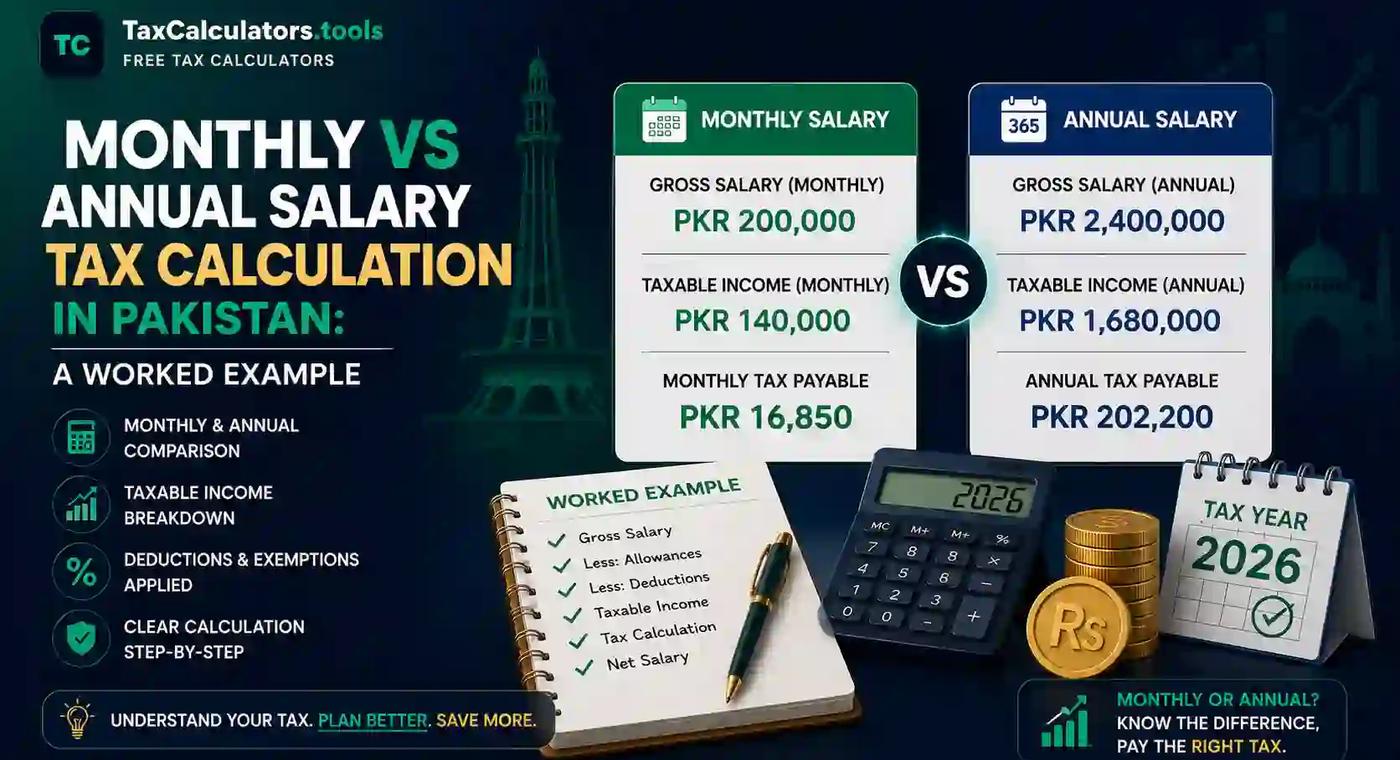
Let's use a realistic case. Meet Ahmed, a marketing manager based in Islamabad with a gross annual salary of Rs. 2,400,000 (that's Rs. 200,000 per month before deductions).
Step 1: Determine taxable income
Assume Ahmed has no significant exemptions beyond the standard structure, so his taxable annual salary is Rs. 2,400,000.
Step 2: Identify the applicable slab
Rs. 2,400,000 falls into Slab 4: Rs. 2,200,001 to Rs. 3,200,000 — taxed at Rs. 116,000 plus 23% of the amount exceeding Rs. 2,200,000.
Step 3: Calculate the tax
- Amount exceeding Rs. 2,200,000 = Rs. 2,400,000 − Rs. 2,200,000 = Rs. 200,000
- 23% of Rs. 200,000 = Rs. 46,000
- Total annual tax = Rs. 116,000 + Rs. 46,000 = Rs. 162,000
Step 4: Find the effective tax rate
Rs. 162,000 ÷ Rs. 2,400,000 = 6.75% effective tax rate
Notice how different this is from the 23% marginal rate that applies to his highest slab. The effective rate — the actual average percentage of his income going to tax — is always lower than the marginal slab rate because of the progressive structure. This distinction between the marginal rate and the effective tax rate is one of the most searched, and most misunderstood, aspects of income tax calculation in Pakistan.
Monthly Salary Tax Calculation: The Same Example, Broken Down
Now here's where most people get confused. Ahmed's employer doesn't wait until June to deduct Rs. 162,000 in one lump sum. Instead, the tax is spread across his 12 monthly paychecks.
Step 1: Take the annual tax liability
Rs. 162,000 (calculated above)
Step 2: Divide by 12
Rs. 162,000 ÷ 12 = Rs. 13,500 per month
So Ahmed's employer deducts Rs. 13,500 from each monthly salary of Rs. 200,000, leaving him with a net take-home pay of Rs. 186,500 per month.
This is the standard method employers use under Section 149 — they annualize your current monthly salary (multiply it by 12, or by the remaining pay periods in the tax year), calculate the tax on that annualized figure using the slabs above, then divide by the number of pay periods to get the monthly withholding amount. If Ahmed's salary stays exactly the same all year, his monthly deduction stays consistent at Rs. 13,500.
What Happens When Salary Changes Mid-Year
Real life is rarely this tidy. Salaries change because of increments, bonuses, or promotions, and this is where monthly vs. annual tax calculation genuinely diverges.
Say Ahmed gets a promotion in month 7, and his new monthly salary jumps to Rs. 260,000. From that point forward, his employer will recalculate his projected annual income using the new figure, adjust the annual tax liability accordingly, and spread the revised amount across his remaining pay periods. This often causes a noticeably larger deduction in the months immediately following a raise, because the system is essentially "catching up" on the higher annualized liability.
A few situations that commonly trigger recalculation include:
- Salary increments or promotions during the tax year
- Annual bonuses, which are treated as taxable salary income and can push you into a higher slab for that month
- Mid-year job changes, where your new employer may not have visibility into tax already withheld by your previous employer
- Overtime or commission-based pay that fluctuates monthly
If any of these apply to you, don't assume your December deduction will match your January deduction. Always recalculate using your actual annualized income, or run the numbers through our salary tax calculator for Pakistan, which handles these annualization adjustments automatically.
A Second Worked Example: Lower Income Bracket
Let's look at a more modest income to show how the tax-free threshold and lower slabs work in practice. Consider Sana, an office administrator in Lahore earning Rs. 80,000 per month, or Rs. 960,000 annually.
Step 1: Identify the slab
Rs. 960,000 falls into Slab 2: Rs. 600,001 to Rs. 1,200,000 — taxed at 1% of the amount exceeding Rs. 600,000.
Step 2: Calculate annual tax
- Amount exceeding Rs. 600,000 = Rs. 960,000 − Rs. 600,000 = Rs. 360,000
- 1% of Rs. 360,000 = Rs. 3,600 annual tax
Step 3: Convert to monthly deduction
Rs. 3,600 ÷ 12 = Rs. 300 per month
Sana's effective tax rate is just 0.375% — a good illustration of how much relief the current slab structure gives to lower and middle-income earners. This is a common query people search for: how much tax on 50,000 or 80,000 salary per month in Pakistan, and the honest answer is: very little, or nothing at all, once you're near or under the Rs. 600,000 annual exemption threshold.
Salary Tax vs. Income Tax: Are They the Same Thing?
A frequent point of confusion is whether "salary tax" and "income tax" mean different things in Pakistan. They don't — salary tax is simply income tax as applied specifically to salaried individuals under the salary-specific slab rates in the Income Tax Ordinance, 2001. The term "salary tax" is more of a colloquial shorthand used in everyday conversation, while "income tax" is the broader legal and technical term that also covers business income, rental income, and capital gains, each taxed under different rules. We cover this distinction in more depth in our article on salary tax vs income tax in Pakistan, including why non-salaried individuals face noticeably higher rates on the same income level.
Filer vs Non-Filer: Why Your Status Matters Beyond the Slabs
While salary tax slabs apply equally regardless of filer status, your status on FBR's Active Taxpayer List (ATL) affects nearly everything else — banking transactions, vehicle registration, property purchases, and withholding tax rates on numerous other transactions. Non-filers frequently pay significantly higher withholding tax rates on things like vehicle token tax, property transactions, and banking transactions, even if their salary tax calculation is identical to a filer's. If you haven't checked your status recently, our guide on filer vs non-filer tax rates in Pakistan explains exactly what's at stake, and you can verify your own status through our FBR Active Taxpayer List guide.
Common Deductions and Exemptions That Affect Your Taxable Salary
Your gross salary isn't always your taxable salary. Several legitimate deductions and exemptions can lower the number you apply the slabs to:
- Medical allowance — often exempt up to a certain limit if structured correctly within your employment contract
- Provident fund contributions — employer and employee contributions to recognized provident funds carry specific tax treatment
- Zakat deductions — Zakat paid under the Zakat and Ushr Ordinance can be deducted from taxable income
- Approved pension or gratuity fund contributions
- Tax credits for investments in approved mutual funds, pension funds, or life insurance premiums, subject to FBR's prescribed limits
Getting these right can meaningfully reduce what you owe, and it's worth exploring which of these apply to your specific employment structure. We break these down further in our piece on how to reduce salary tax legally in Pakistan.
Why Use a Salary Tax Calculator Instead of Manual Math
You've now seen the manual calculation twice, and it's not overly complicated once you understand the mechanics. But manual calculation gets error-prone fast when you factor in:
- Bonuses landing in a specific month
- Mid-year salary revisions
- Multiple income sources
- Exemptions and tax credits that need to be netted out before applying the slabs
- Comparing this year's slabs against next year's proposed changes
This is exactly why so many salaried professionals, HR teams, and payroll departments rely on a dedicated income tax calculator Pakistan tool rather than doing this by hand every pay cycle. A good calculator applies the correct current-year slab automatically, handles the annualization logic for you, and gives you both your monthly deduction and annual liability in seconds.
Our FBR tax calculator is built specifically around the current official slabs, and it's updated the moment FBR issues new notifications — so you're never calculating against outdated figures from a prior budget year. You can also cross-check withholding tax obligations separately using our withholding tax calculator if you're dealing with contractor payments or other withholding scenarios beyond regular salary.
Why Choose Tax Calculators for Your Salary Planning
There's a real difference between a generic calculator that hasn't been updated since a previous budget cycle and one that's actively maintained against FBR's latest notifications. When you explore our advanced free tax calculators, you're getting tools built around three principles: accuracy against the current tax year's official slabs, transparency in showing you the step-by-step breakdown (not just a final number), and coverage across the full range of Pakistani tax categories — from salary and property to vehicle token tax and customs duty. This matters especially for HR professionals and payroll managers who need consistent, defensible numbers across an entire organization, not just a rough estimate.
Annual Income Tax Return Filing: Don't Forget This Step
Even though your employer deducts tax monthly, you're still required to file an annual income tax return if your income exceeds the taxable threshold or if you're otherwise required to file under FBR rules (for instance, if you're a filer for other reasons like property ownership or vehicle ownership above certain values). The deadline for filing your return for Tax Year 2025-26 is September 30, 2026, and missing it typically triggers penalties and can affect your Active Taxpayer List status. For a complete walkthrough of the process, see our guide on income tax return deadlines in Pakistan.
Frequently Asked Questions
Is salary tax calculated monthly or yearly in Pakistan?
Salary tax slabs are structured on an annual basis, but the actual deduction happens monthly. Your employer estimates your annual taxable income, applies the correct FBR slab, calculates your total annual tax liability, and then divides that amount across your monthly pay periods.
How much income tax on Rs. 100,000 monthly salary in Pakistan?
Rs. 100,000 per month equals Rs. 1,200,000 annually, which sits right at the boundary of Slab 2 and Slab 3. At exactly Rs. 1,200,000, the annual tax is Rs. 6,000, which works out to roughly Rs. 500 per month — a very low effective rate.
What is the tax-free income limit in Pakistan for 2025-26?
Annual salary income up to Rs. 600,000 (Rs. 50,000 per month) remains completely tax-free under the current FBR slab structure for salaried individuals.
Is income tax the same as salary tax in Pakistan?
Yes, functionally. "Salary tax" refers to income tax as applied to salaried individuals under the specific salary tax slabs, while "income tax" is the umbrella legal term covering all categories of taxable income, including business, rental, and capital gains income.
Does a bonus count as taxable salary income in Pakistan?
Yes. Bonuses are treated as part of your salary income for the month in which they're paid and are taxed accordingly, which can temporarily push you into a higher effective monthly deduction during bonus months.
How do I reduce my income tax legally in Pakistan?
Common legitimate strategies include maximizing approved provident fund and pension contributions, claiming eligible medical allowance exemptions, deducting Zakat payments, and utilizing tax credits for approved investments. Consult a tax professional for guidance specific to your situation.
Final Thoughts: Take Control of Your Salary Tax Planning
Understanding the difference between monthly and annual salary tax calculation isn't just an academic exercise — it directly affects how you budget, negotiate raises, and plan major financial decisions throughout the year. The core principle to remember is simple: FBR's slabs are annual, your deductions are monthly, and your employer is essentially reverse-engineering your yearly liability into equal monthly installments based on your projected annual income.
Now that you've seen the math worked out step by step, the fastest way to apply it to your own salary is to run your numbers through a reliable, up-to-date tool rather than recalculating by hand every time your salary changes. Use our advanced free salary tax calculator to get your exact monthly deduction, annual liability, and effective tax rate in seconds — fully aligned with the current FBR tax slabs for Pakistan.
Important disclaimer
This article is for educational planning only. It does not provide professional tax, legal, accounting, payroll, customs, or financial advice. Tax rules can change and final results may depend on your personal facts. Always verify important tax decisions with official sources or a qualified professional.