If you've ever looked at a shopping receipt in Karachi or a service invoice in Lahore and wondered why it says "sales tax" instead of "GST," you're not alone. This is one of the most common questions among business owners, freelancers, and everyday consumers in Pakistan.
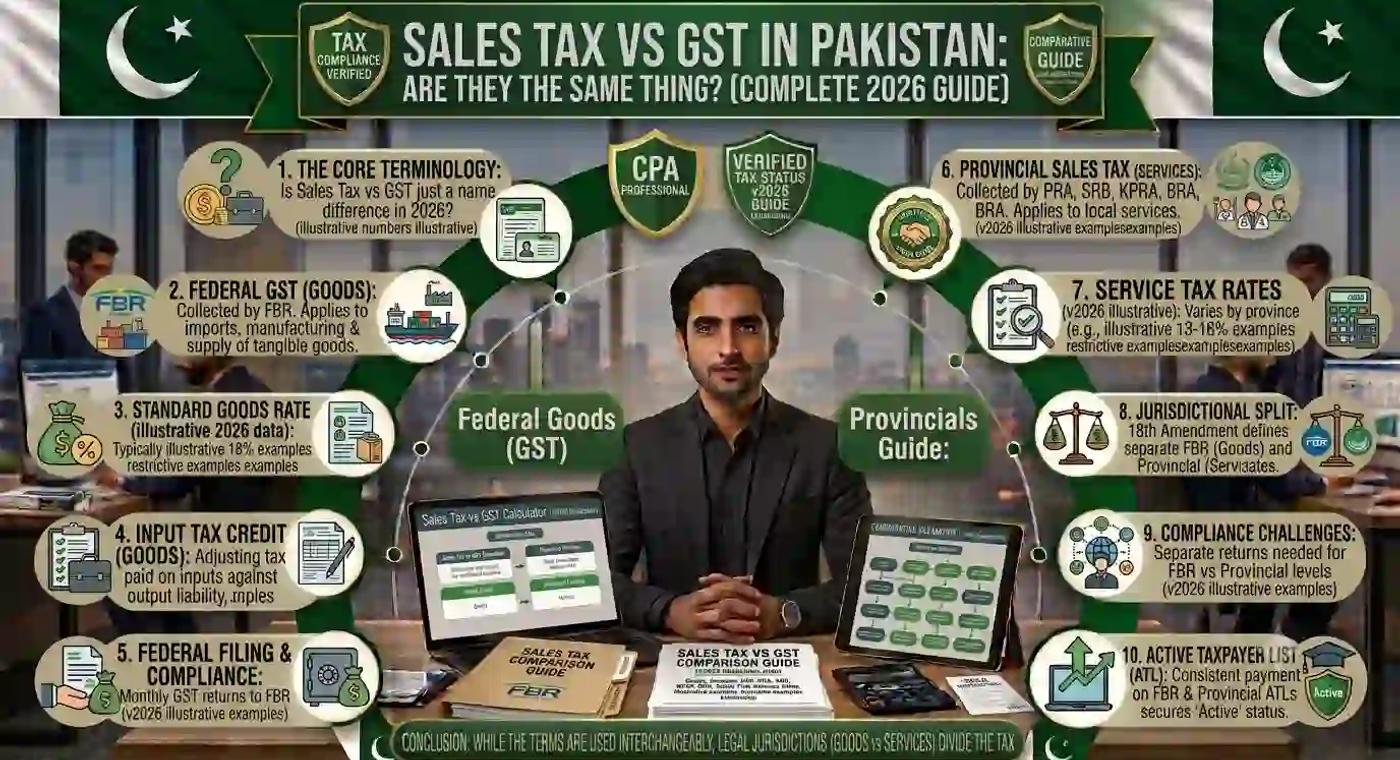
Short answer: No, sales tax and GST are not exactly the same thing in Pakistan, though they work on a similar principle. Sales tax is Pakistan's version of a General Sales Tax (GST) system, but instead of one unified GST like in India or Canada, Pakistan splits taxation between the federal government (which taxes goods) and the provincial governments (which tax services). This creates a dual-layer system that often confuses taxpayers, especially new business owners registering with FBR for the first time.
In this guide, we'll break down exactly how Pakistan's sales tax system works, how it compares to GST models used elsewhere, who collects what, current rates, registration steps, and answers to the most searched questions on this topic. By the end, you'll understand the difference clearly enough to explain it to someone else.
What Is Sales Tax in Pakistan?
Sales tax in Pakistan is an indirect tax charged on the sale of goods and, in most provinces, on services too. It's called "indirect" because the end consumer pays it, but businesses are responsible for collecting and depositing it with the government.
Sales tax in Pakistan is governed primarily by the Sales Tax Act 1990, which lays out registration requirements, exemptions, rates, and penalties. This law applies mainly to goods at the federal level, while services fall under separate provincial legislation.
Here's the key structure:
- Federal sales tax on goods — collected by the Federal Board of Revenue (FBR)
- Provincial sales tax on services — collected separately by:
- Sindh Revenue Board (SRB) for Sindh
- Punjab Revenue Authority (PRA) for Punjab
- Khyber Pakhtunkhwa Revenue Authority (KPRA) for KPK
- Balochistan Revenue Authority (BRA) for Balochistan
This is different from countries where a single GST authority handles both goods and services under one roof.
What Is GST (General Sales Tax)?
GST, or General Sales Tax, is a broader global term for a consumption-based tax applied at each stage of the supply chain — from manufacturer to wholesaler to retailer to consumer. Countries like India, Canada, and Australia use "GST" as the official name for their unified tax system.
In Pakistan, the term "GST" is often used informally to refer to sales tax, since both are conceptually the same — a tax on consumption rather than income. However, Pakistan's official legal terminology is "Sales Tax," not GST. So when people search "GST rate in Pakistan," they're really asking about the current sales tax rate.
Sales Tax vs GST: Key Differences Explained
Let's put this side by side so it's easier to understand.
| Sales Tax vs GST: Key Differences Explained | ||
|---|---|---|
| Feature | Sales Tax (Pakistan) | GST (India/Canada/Australia model) |
| Legal Name | Sales Tax Act 1990 | Goods and Services Tax |
| Collecting Authority | Split: FBR (federal) + provincial boards | Usually one unified authority |
| Scope | Goods (federal) + Services (provincial) | Goods and services together |
| Standard Rate | 18% (goods, federal) | Varies (e.g., 5%–28% in India, slabs) |
| Provincial Variation | Yes — each province sets its own service tax rate | Often standardized nationally |
| Input Tax Credit | Available, but more complex due to dual system | Generally streamlined |
As you can see, the core idea — taxing consumption instead of income — is identical. The difference lies in structure and administration, not the underlying economic concept.
Why Does Pakistan Have a Divided Sales Tax System?
This goes back to Pakistan's constitutional structure. Under the 18th Amendment, taxation on services became a provincial subject, while taxation on goods remained with the federal government. This is why:
- FBR handles sales tax on goods nationwide
- Each province independently handles sales tax on services within its territory
This division is why a restaurant bill in Lahore might show "Punjab Sales Tax on Services," while a bill for the same meal in Karachi shows "Sindh Sales Tax on Services" — different provincial laws, different rates, same underlying concept as GST.
Current Sales Tax and GST Rates in Pakistan (2026)
Rates can change with each Finance Act, so always verify with the official FBR portal before filing. As of the current fiscal year:
- Standard federal sales tax rate on goods: 18%
- Sindh sales tax on services (SRB): Typically 13–15%, varies by service category
- Punjab sales tax on services (PRA): Typically 5–16%, varies by service type
- KPK and Balochistan rates: Vary by service, generally aligned with Sindh and Punjab bands
- Zero-rated goods: Certain exports and essential items are taxed at 0%
- Exempt goods: Some basic food items, medicines, and books are fully exempt
If you regularly calculate sales tax for invoicing or business planning, using an updated Sales Tax Calculator Pakistan saves time and reduces manual errors, especially when provincial and federal rates apply to the same transaction.
Who Needs to Register for Sales Tax in Pakistan?
Not every business is required to register, but most are, especially if they meet certain thresholds. You generally need to register for sales tax if you:
- Manufacture or supply taxable goods
- Provide taxable services in a province with a service tax law
- Import goods for commercial resale
- Cross the annual turnover threshold set by FBR or the relevant provincial authority
- Want to become an active taxpayer to avoid higher withholding tax rates
Once registered, businesses receive a Sales Tax Registration Number (STRN), separate from their NTN (National Tax Number) used for income tax. If you haven't registered yet, our guide on how to become a tax filer in Pakistan walks through the process step-by-step.
How Sales Tax Registration Works
Here's a simplified breakdown of the registration process:
- Determine jurisdiction — Are you selling goods (FBR) or services (provincial authority)?
- Gather documents — CNIC, NTN, business bank account details, utility bill, and business address proof
- Apply through the relevant portal — FBR's IRIS system for goods, or the respective provincial authority's portal for services
- Verification — Authorities may conduct a site visit or biometric verification
- Receive STRN — Once approved, you get your Sales Tax Registration Number
- File monthly returns — Sales tax returns are typically due monthly, along with the applicable payment
If you're unfamiliar with FBR's online system, our FBR IRIS Portal guide explains login steps and common issues taxpayers face.
Sales Tax on Goods vs Sales Tax on Services
This distinction trips up a lot of new business owners, so let's simplify it:
Sales tax on goods (Federal – FBR):
- Applies to manufacturing, import, and supply of physical products
- Standard rate is 18% unless specifically exempted or zero-rated
- Businesses can claim input tax credit for tax already paid on purchases
Sales tax on services (Provincial):
- Applies to services like restaurants, telecom, consultancy, IT services, construction, and more
- Rates differ by province and by service category
- Some services are subject to withholding tax deductions at source
If your business deals in services specifically, our detailed breakdown on sales tax on services across provinces compares rates and rules across Sindh, Punjab, KPK, and Balochistan.
Input Tax vs Output Tax: A Quick Explanation
Understanding this concept clarifies why GST-style systems (including Pakistan's sales tax) avoid double taxation:
- Output tax — the sales tax you charge your customers on sales
- Input tax — the sales tax you already paid on your business purchases
- Net tax payable — output tax minus input tax
This mechanism ensures tax is only paid on the "value added" at each stage, which is exactly the principle GST systems worldwide are built around. It's also why Pakistan's system, despite different names and split authorities, functions similarly to a true GST model.
Sales Tax vs VAT vs GST vs Income Tax
People often lump these terms together, so here's the distinction in plain language:
- Sales Tax (Pakistan) — Tax on sale of goods and services, collected federally and provincially
- GST (global term) — A unified tax on goods and services used by many countries
- VAT (Value Added Tax) — Nearly identical in concept to GST; taxed at each production stage
- Income Tax — A direct tax on your earnings, unrelated to consumption; governed separately under the Income Tax Ordinance 2001
The main distinction to remember: sales tax/GST/VAT are indirect taxes on consumption, while income tax is a direct tax on earnings. Confusing the two can lead to registration errors or missed filing deadlines.
Sales Tax Exemptions and Zero-Rated Goods
Not everything is taxed equally. FBR maintains schedules that define:
- Exempt goods — No sales tax applies at any stage (e.g., certain unprocessed food items, books, and medicines)
- Zero-rated goods — Taxed at 0%, mainly applicable to exports, allowing exporters to claim input tax refunds
- Reduced-rate goods — Certain items taxed at rates lower than the standard 18%
These schedules (Third, Sixth, and others under the Sales Tax Act 1990) are updated periodically through SROs (Statutory Regulatory Orders), so businesses dealing in these categories should check FBR notifications regularly.
Penalties for Non-Registration or Late Filing
Ignoring sales tax obligations can be costly. Common consequences include:
- Fixed monetary penalties for late or non-filing of returns
- Higher withholding tax rates for non-filers compared to active taxpayers
- Default surcharge (interest) on unpaid tax amounts
- Potential suspension of business operations in severe non-compliance cases
- Exclusion from the Active Taxpayer List (ATL), which affects banking, property, and vehicle transactions
Staying on the ATL is important beyond just avoiding penalties — it directly affects the withholding tax rates applied to your property and vehicle transactions too, an area we cover in our piece on withholding tax on property transactions in Pakistan.
How to Calculate Sales Tax in Pakistan (With Example)
Let's walk through a simple example.
Suppose a manufacturer sells goods worth PKR 100,000 and the standard sales tax rate is 18%.
- Sales tax (output tax) = 100,000 × 18% = PKR 18,000
- Total invoice value = 100,000 + 18,000 = PKR 118,000
If this manufacturer already paid PKR 5,000 in input tax on raw materials, then:
- Net sales tax payable to FBR = 18,000 − 5,000 = PKR 13,000
For services, the same principle applies, but you'll need to check the applicable provincial rate (e.g., Sindh vs Punjab) instead of the flat federal rate. Rather than calculating this manually every time, especially across multiple provinces and service categories, using an automated FBR tax calculator is far more reliable and saves significant time for freelancers, retailers, and small business owners alike.
Why Choose Tax Calculators for Sales Tax and GST Calculations
Manual tax calculations are one of the most common sources of compliance errors in Pakistan, particularly for businesses juggling federal and provincial rates simultaneously. Here's why using a dedicated calculator makes sense:
- Accuracy — Removes manual calculation errors on invoices and returns
- Time-saving — Instantly computes tax for goods or services based on current rates
- Provincial flexibility — Adjusts for different rates across Sindh, Punjab, KPK, and Balochistan
- Free and accessible — No software installation or subscription required
- Updated regularly — Reflects the latest Finance Act changes and FBR notifications
If you handle multiple transactions weekly, bookmarking a reliable sales tax calculator can genuinely simplify your bookkeeping process, whether you're a retailer, freelancer, or accountant managing multiple clients.
Sales Tax in Major Pakistani Cities: Regional Notes
Sales tax on services can vary depending on where your business operates, since provincial authorities set their own rates and rules:
- Karachi (Sindh): Governed by SRB; commonly applies to restaurants, telecom, and professional services
- Lahore (Punjab): Governed by PRA; covers similar categories with different rate slabs
- Islamabad (ICT): Federal territory rules apply, often mirroring FBR's structure for services within the capital
- Peshawar (KPK): Governed by KPRA
- Quetta (Balochistan): Governed by BRA
If you operate across multiple cities or provinces, it's worth consulting with a local tax advisor or checking each authority's official notifications, since rates and exemptions are not always identical.
Global Comparison: Pakistan's Sales Tax vs India's GST
Since many people compare Pakistan's system to India's GST, here's a quick contrast:
- India merged nearly all indirect taxes (VAT, service tax, excise) into one unified GST system in 2017, administered through a single GST Council with defined slabs (5%, 12%, 18%, 28%).
- Pakistan retained separate federal and provincial systems, meaning goods and services are taxed under different laws with different collecting authorities.
Both systems aim to tax consumption fairly and avoid cascading taxes, but India's is more centralized, while Pakistan's remains fragmented due to constitutional provincial autonomy over services.
Common Mistakes Businesses Make with Sales Tax
- Assuming "GST" and "sales tax" require separate registrations (they don't — it's the same concept, different name)
- Registering with FBR only, while ignoring provincial service tax obligations
- Missing monthly return deadlines, leading to penalties and ATL removal
- Failing to claim eligible input tax credit, resulting in overpayment
- Not updating invoices when provincial rates change mid-year
Avoiding these mistakes largely comes down to staying updated and using reliable calculation tools rather than relying on outdated rate sheets.
Frequently Asked Questions (FAQs)
Is sales tax and GST the same in Pakistan? Conceptually, yes — both tax consumption rather than income. Legally, Pakistan uses the term "Sales Tax" under the Sales Tax Act 1990, and the system is split between federal (goods) and provincial (services) authorities, unlike a single unified GST model.
What is the current sales tax rate in Pakistan? The standard federal sales tax rate on goods is 18%. Provincial sales tax rates on services vary, generally ranging between 5% and 16%, depending on the province and service type.
Does Pakistan follow a GST model? Yes, in principle. Pakistan's sales tax system follows the same value-added tax logic as GST, but it applies it through separate federal and provincial legislation rather than one national law.
Who collects sales tax in Pakistan — federal or provincial government? Both. FBR collects sales tax on goods at the federal level, while SRB, PRA, KPRA, and BRA collect sales tax on services within their respective provinces.
Is sales tax applicable on services in Pakistan? Yes. Services are taxed under provincial sales tax laws, separate from the federal Sales Tax Act 1990, which mainly governs goods.
What is the penalty for not registering for sales tax? Penalties can include fixed fines, default surcharge on unpaid amounts, higher withholding tax rates, and removal from the Active Taxpayer List, which affects other financial transactions like property and vehicle purchases.
Conclusion: Making Sense of Sales Tax and GST in Pakistan
So, are sales tax and GST the same thing in Pakistan? They share the same underlying principle — taxing consumption rather than income — but Pakistan's system is structurally different from a unified GST model. Sales tax is split between federal authority (FBR) for goods and provincial revenue boards for services, creating a layered system that requires careful compliance from businesses operating across multiple regions.
Understanding this distinction isn't just academic. It affects how you register your business, which authority you file returns with, what rate applies to your invoices, and how you avoid unnecessary penalties.
If you're a business owner, freelancer, or accountant trying to stay compliant without the manual guesswork, now's a good time to put this knowledge into action. Use our free Sales Tax Calculator to instantly calculate your tax obligations, or explore our full range of advanced free tax calculators covering income tax, withholding tax, property tax, and more — all updated for the current fiscal year.
For official rate confirmations and the latest SROs, always cross-check with the Federal Board of Revenue (FBR), Pakistan's primary tax authority, to ensure you're working with the most current figures before filing.
Important disclaimer
This article is for educational planning only. It does not provide professional tax, legal, accounting, payroll, customs, or financial advice. Tax rules can change and final results may depend on your personal facts. Always verify important tax decisions with official sources or a qualified professional.
About the author
This article was written by the Tax Calculators Team, the group behind TaxCalculators.tools. Learn more about our team and editorial process.
Last reviewed: July 22, 2026