If you run a consultancy, an IT firm, a restaurant, a marketing agency, or any service-based business in Pakistan, sales tax on services is not optional — it's a monthly obligation to a provincial authority, not to FBR. Yet most business owners still don't know which authority to register with, what rate applies, or how to calculate the tax correctly on an invoice.
This guide breaks down, province by province, exactly how sales tax on services works in Punjab, Sindh, Khyber Pakhtunkhwa (KPK), and Balochistan in 2026 — including live rates, step-by-step calculation examples, registration requirements, and the difference between sales tax and income tax. By the end, you'll be able to calculate your own service invoice tax correctly and know exactly which portal to file it on.
What Is Sales Tax on Services in Pakistan?
Sales tax on services is a provincial indirect tax charged on the value of a service rendered — not on goods. It's collected by the service provider from the customer and deposited with the relevant provincial revenue authority.
Since Pakistan's 18th Constitutional Amendment moved taxation of services from the federal government to the provinces, each province now runs its own sales tax law and its own revenue authority. This is one of the most confused areas of Pakistani taxation because people assume FBR handles everything — it doesn't.
Federal vs Provincial: Who Collects Sales Tax on Services?
Short answer: FBR collects sales tax on goods and on services rendered in Islamabad Capital Territory (ICT). Every other province collects sales tax on services through its own authority.
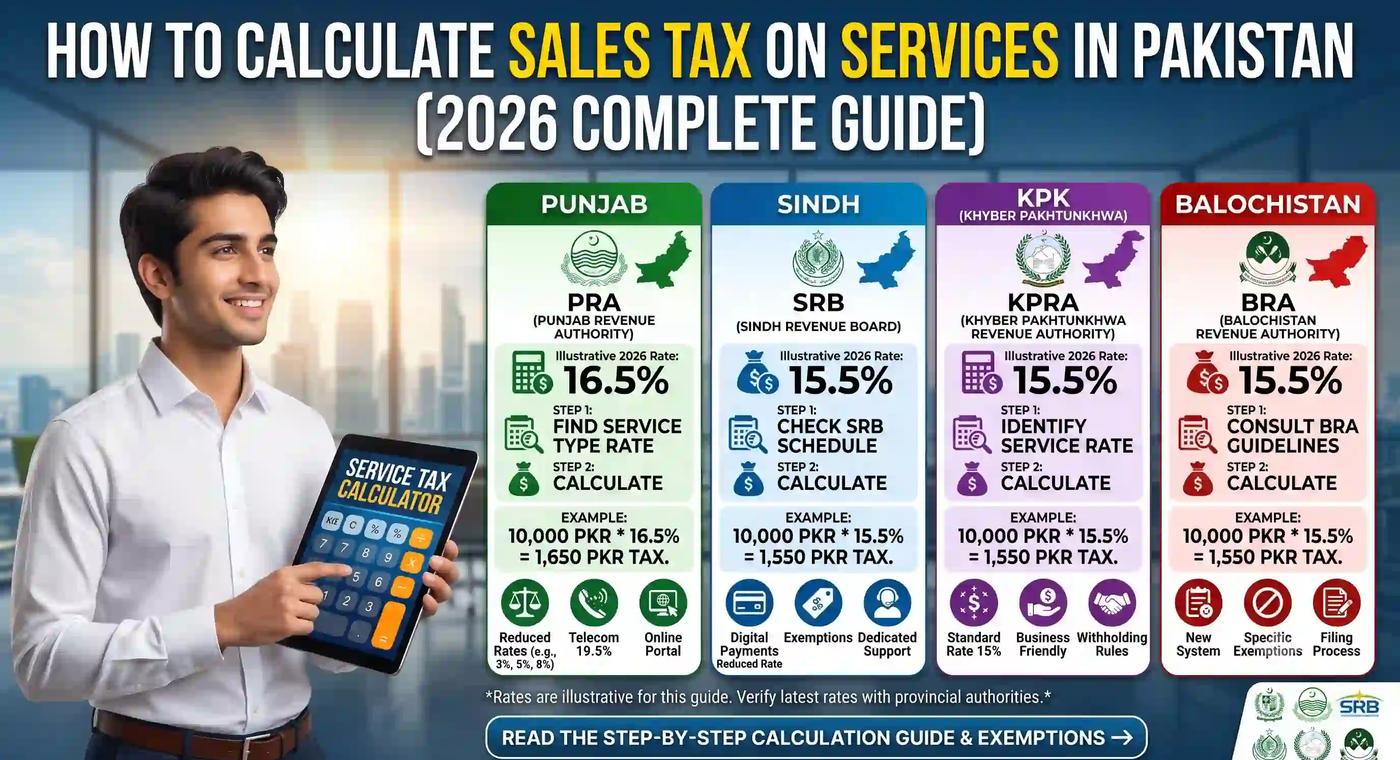
Sales tax on services is provincial in Pakistan — SRB handles Sindh, PRA handles Punjab, KPRA handles KPK, and BRA handles Balochistan. This four-authority system means a single service business operating nationally may need to register, invoice, and file separately in more than one province, depending on where the service is actually rendered or consumed.
| Federal vs Provincial: Who Collects Sales Tax on Services? | |||
|---|---|---|---|
| Province/Region | Authority | Full Name | Portal |
| Punjab | PRA | Punjab Revenue Authority | pra.punjab.gov.pk |
| Sindh | SRB | Sindh Revenue Board | srb.gos.pk |
| Khyber Pakhtunkhwa | KPRA | KP Revenue Authority | kpra.kp.gov.pk |
| Balochistan | BRA | Balochistan Revenue Authority | bra.gob.pk |
| Islamabad (ICT) | FBR | Federal Board of Revenue | iris.fbr.gov.pk |
If your income tax side needs sorting out too, our FBR Tax Calculator and Income Tax Calculator can help you estimate your liability alongside sales tax.
Sales Tax Rates on Services in Punjab, Sindh, KPK & Balochistan (2026)
Here's the current standard rate structure across all four provinces:
| Sales Tax Rates on Services in Punjab, Sindh, KPK & Balochistan (2026) | |||
|---|---|---|---|
| Province | Standard Rate | Telecom Rate | Notable Reduced Rates |
| Punjab | 16% | 19.5% | 5% reduced rate; 15% on carriage of goods |
| Sindh | 15% | 19.5% | 3% on hospitals/clinics; 5–15% tiered rates (beauty parlors, small services) |
| KPK | 15% | 19.5% | 5–15% range depending on the Second Schedule category |
| Balochistan | 15% | 19.5% | Sector-specific exemptions apply |
The general rule is to apply the province's rate: 16% for Punjab and Islamabad, or 15% for Sindh, KP, and Balochistan, with 19.5% used specifically for telecom services. In Punjab specifically, the standard rate is 16% under the Punjab Sales Tax Act 2012, though certain services are taxed at a reduced rate of 5%, and telecom is taxed higher at 19.5%.
For KPK, most services fall under the Second Schedule with rates ranging from 5% to 15%, and some services are fully exempt, with the schedule periodically updated by KPRA to reflect economic changes. Interestingly, KPRA has also moved to support the digital economy — the authority has significantly reduced tax rates for ride-hailing services like Uber and Careem, so always check the current schedule for your exact service category rather than assuming the standard rate applies.
For Balochistan, the BRA charges a standard rate of 15% on services, matching Sindh and KPK.
Important note: These rates change with each Finance Act. Always verify against the current schedule on your provincial authority's website before finalizing an invoice, or use our Sales Tax Calculator to get an up-to-date estimate.
Punjab (PRA) — Sales Tax on Services
Punjab runs the largest and most established provincial sales tax regime. Every taxable service rendered in Punjab, or originating from a Punjab-based provider, falls under PRA jurisdiction — separate from FBR and from SRB, KPRA, and BRA. Registration and monthly filing both happen through PRA's e-portal at pra.punjab.gov.pk.
Sindh (SRB) — Sales Tax on Services
Sindh's rate structure is tiered by sector. Restaurants, marriage halls, professional consultancy, insurance, and advertising services are generally taxed at 15%, while healthcare-related services like hospitals and clinics benefit from a reduced 3% rate. Businesses providing services in Karachi, Hyderabad, or anywhere in Sindh must register with SRB through their online portal at srb.gos.pk.
KPK (KPRA) — Sales Tax on Services
KPRA administers sales tax on services, not goods — while goods fall under FBR, services rendered in KP are taxed under KPRA, and any business providing taxable services in the province must register with KPRA and file returns regularly. This includes services delivered from Peshawar or anywhere else in the province.
Balochistan (BRA) — Sales Tax on Services
BRA is the newest and smallest of the four authorities but follows the same structural logic — a standard 15% rate with sector-specific exemptions for certain categories of services in the province.
How to Calculate Sales Tax on Services — Step by Step
Calculating sales tax on a service invoice is straightforward once you know the applicable rate. Here's the formula:
Sales Tax Amount = Value of Service × Applicable Rate Total Invoice Amount = Value of Service + Sales Tax Amount
Step-by-Step Example (Punjab)
Let's say a marketing agency in Lahore bills a client Rs. 500,000 for a campaign.
- Identify the province of service delivery — Punjab.
- Identify the applicable rate — 16% standard PRA rate.
- Calculate the tax — Rs. 500,000 × 16% = Rs. 80,000.
- Add to invoice value — Rs. 500,000 + Rs. 80,000 = Rs. 580,000 total invoice.
A marketing agency providing Rs 500,000 of services to a client in Punjab would owe PRA at 16%, which comes to Rs 80,000.
Example Across Provinces
| How to Calculate Sales Tax on Services — Step by Step | ||||
|---|---|---|---|---|
| Province | Service Value | Rate | Sales Tax | Total Invoice |
| Punjab | Rs. 500,000 | 16% | Rs. 80,000 | Rs. 580,000 |
| Sindh | Rs. 500,000 | 15% | Rs. 75,000 | Rs. 575,000 |
| KPK | Rs. 500,000 | 15% | Rs. 75,000 | Rs. 575,000 |
| Balochistan | Rs. 500,000 | 15% | Rs. 75,000 | Rs. 575,000 |
Which Province's Rate Applies?
This is where most businesses make mistakes. The province where the service is rendered, or where the recipient is located, usually determines which authority's rate applies — a consulting firm headquartered in Lahore but serving a client in Karachi may have to apply Sindh's rate for that engagement and register with the relevant authority. Don't assume your home province's rate always applies — check the place-of-provision rule for each transaction, especially if you serve clients across multiple provinces.
Use our Sales Tax Calculator to run these numbers automatically for any province and service value.
Sales Tax Registration Process for Service Providers (STRN)
Before you can charge and collect sales tax legally, you need to register with the relevant provincial authority and obtain a Sales Tax Registration Number (STRN).
Step-by-step registration process:
- Get your FBR NTN first. The provincial registration uses your NTN as the foundation, so if you don't already have an NTN, you need to complete FBR registration via the IRIS portal first. Our FBR IRIS Portal Guide walks through this in detail.
- Determine your provincial jurisdiction based on where you render services.
- Compile required documents — CNIC, business registration/proof, bank account details, and business address proof.
- Apply online through the relevant authority's portal (PRA eSST, SRB e-portal, KPRA online portal, or BRA registration system).
- Receive your STRN once verification is complete.
- Start monthly return filing from your first taxable month onward.
Who Must Register?
Registration is generally required if your annual turnover from all sources exceeds PKR 12.5 million, though voluntary registration below this threshold is often advisable because it enables input tax credit claims and reduces effective tax cost. Freelancers and digital service providers aren't automatically exempt either — KPRA, for instance, applies even if your revenue is modest and you're offering digital services like freelancing or IT.
Withholding Sales Tax on Services Explained
Withholding sales tax means the buyer of a service — often a government department, bank, or large company — deducts a portion of the sales tax at source and deposits it directly with the tax authority, rather than paying the full amount to the service provider.
This matters because:
- It reduces your immediate cash inflow from an invoice.
- You must reconcile withheld amounts against your monthly return.
- Rates and thresholds for withholding differ by province and by whether the payer is a government or private entity.
If you regularly deal with withholding on services or property, our Withholding Tax Calculator can help estimate net receivables, and our guide on withholding tax on property transactions covers a related but separate mechanism.
Sales Tax vs Income Tax on Services — Key Differences
These two taxes are frequently confused, but they're fundamentally different:
| Sales Tax vs Income Tax on Services — Key Differences | ||
|---|---|---|
| Feature | Sales Tax | Income Tax |
| Nature | Indirect tax on transaction value | Direct tax on net income/profit |
| Collected by | Provincial authorities (PRA/SRB/KPRA/BRA) + FBR (goods/ICT) | FBR (federal) |
| Who bears it | Passed to the customer | Borne by the earner |
| Filing frequency | Monthly | Annually |
| Applies to | Value of service/goods sold | Total taxable income for the year |
At the federal level, direct taxes include income tax, capital gains tax, and wealth statement obligations, while indirect taxes include sales tax, customs duties, and federal excise duty. A service business typically deals with both simultaneously — sales tax on every invoice, and income tax on annual net profit. See our detailed breakdown in Salary Tax vs Income Tax in Pakistan for more on the direct-tax side.
Exempted & Reduced-Rate Services
Not every service is taxed at the standard rate. Common categories with reduced or zero rates include:
- IT and IT-enabled services (ITeS): These were subject to 16% sales tax since 2015 but were reduced to 5% in 2018, with the definition aligned to the Income Tax Ordinance 2001.
- Healthcare services: Hospitals and clinics often qualify for reduced rates (e.g., 3% in Sindh).
- Religious and charitable organizations: Following the Income Tax Ordinance 2001, religious organizations, charities, NGOs, and international agencies are generally exempted, and Punjab Revenue Authority extends similar exemptions.
- Ride-hailing and digital economy services: Some provinces, like KPK, have introduced significantly reduced rates to support this sector.
- Small/roadside service providers: Categories like individual photographers operating from small roadside setups may be specifically excluded.
Because exemption lists change with each Finance Act, always cross-check the current Second Schedule of your province before assuming a service qualifies.
How to File Sales Tax Return for Services
Once registered, filing becomes a monthly obligation. Here's the general process:
- Log in to your provincial authority's e-portal using your STRN credentials.
- Enter output tax — total sales tax charged on your invoices for the month.
- Enter input tax — sales tax you paid on eligible business purchases (only claimable against standard-rate services, not reduced or zero-rated ones).
- Reconcile any withheld tax deducted by clients during the month.
- Calculate net payable — output tax minus eligible input tax minus withheld amounts already deposited.
- Submit the return and pay before the due date (typically the 15th–18th of the following month, depending on the authority).
- Retain records — invoices, challans, and bank statements — for audit purposes.
Missing deadlines consistently can affect your standing on the FBR Active Taxpayer List, which has downstream consequences even though ATL status is primarily an income-tax filer designation.
Filer vs Non-Filer — Why It Matters for Service Providers
Being an active tax filer isn't just about income tax — it affects your overall cost of doing business, including withholding rates applied to your service income by clients and banks.
- Filers generally face lower withholding tax rates on payments, banking transactions, and contracts.
- Non-filers face higher withholding deductions across the board, which can meaningfully erode margins on service contracts.
- Becoming an active filer requires NTN registration and consistent annual income tax return filing via IRIS.
If you haven't registered yet, our complete walkthrough on How to Become a Tax Filer in Pakistan covers the exact steps, and you can verify your current status through the FBR Active Taxpayer List guide.
Common Mistakes to Avoid
- Applying the wrong province's rate. Always check where the service is actually rendered or consumed, not just where your office is registered.
- Forgetting multi-province registration. If you serve clients in more than one province, you may need more than one STRN.
- Confusing sales tax with income tax when budgeting cash flow — they're separate obligations with separate filing calendars.
- Missing the reduced-rate categories — overcharging or undercharging clients because you didn't check the latest schedule.
- Not claiming eligible input tax — many businesses leave money on the table by failing to track input tax on standard-rate purchases.
- Ignoring withholding tax reconciliation — leading to mismatches between what was deducted and what's reported in the monthly return.
Real-World Example: A Multi-Province Service Business
Consider a digital marketing agency headquartered in Lahore (Punjab) that serves three clients in one month:
- Client A (Lahore, Punjab): Rs. 300,000 service value → 16% PRA rate → Rs. 48,000 tax.
- Client B (Karachi, Sindh): Rs. 400,000 service value → 15% SRB rate → Rs. 60,000 tax.
- Client C (Peshawar, KPK): Rs. 200,000 service value → 15% KPRA rate → Rs. 30,000 tax.
This agency must register with PRA, SRB, and KPRA separately, issue province-specific invoices, and file three separate monthly returns — even though it's a single business entity. This is exactly the kind of complexity that trips up growing service businesses, and it's why understanding place-of-provision rules early saves significant compliance headaches later.
FAQs
What is the sales tax rate on services in Punjab? The standard PRA rate in Punjab is 16%, with a reduced 5% rate for certain services and 19.5% specifically for telecom services.
What is the sales tax rate on services in Sindh? SRB charges a standard rate of 15% on most services, with sector-specific variations such as 3% for hospitals and clinics and 19.5% for telecom.
Is sales tax on services the same across all provinces in Pakistan? No. Punjab and Islamabad apply 16%, while Sindh, KPK, and Balochistan generally apply 15%. Telecom services are taxed at 19.5% nationwide, and specific sectors have their own reduced or exempt rates within each province's schedule.
How do I register for sales tax on services? Get your FBR NTN first through the IRIS portal, then apply for an STRN with the provincial authority (PRA, SRB, KPRA, or BRA) covering the province where you render your services.
Who collects sales tax on services in Pakistan — FBR or provincial authorities? Provincial authorities collect sales tax on services — PRA in Punjab, SRB in Sindh, KPRA in KPK, and BRA in Balochistan. FBR only collects sales tax on services rendered in Islamabad Capital Territory and on goods nationally.
Do freelancers need to pay sales tax on services? Yes, in most cases. Provincial authorities like KPRA apply sales tax obligations to freelancers and digital service providers even at modest revenue levels, though thresholds and voluntary registration options vary by province.
How is sales tax different from income tax in Pakistan? Sales tax is an indirect tax charged on the value of a transaction and filed monthly with a provincial authority; income tax is a direct tax on net annual profit filed annually with FBR.
What happens if I don't file sales tax returns on time? Late or non-filing typically results in penalties, default surcharge, and potential audit exposure, and it can affect your broader tax compliance standing with both provincial and federal authorities.
Conclusion
Sales tax on services in Pakistan isn't a single national rate — it's four separate provincial systems (PRA, SRB, KPRA, BRA), each with its own rate schedule, registration process, and filing calendar, plus FBR's narrower role covering goods and ICT services. Getting the calculation right starts with correctly identifying where your service is rendered, applying that province's current rate, and staying on top of monthly filing deadlines.
If you're still manually calculating sales tax on every invoice, it's worth automating the process. Try our free Sales Tax Calculator to instantly compute the correct provincial tax on any service value, and explore our full suite of Pakistan Tax Calculators to handle income tax, withholding tax, and FBR compliance all in one place.
Important disclaimer
This article is for educational planning only. It does not provide professional tax, legal, accounting, payroll, customs, or financial advice. Tax rules can change and final results may depend on your personal facts. Always verify important tax decisions with official sources or a qualified professional.
About the author
This article was written by the Tax Calculators Team, the group behind TaxCalculators.tools. Learn more about our team and editorial process.
Last reviewed: July 18, 2026