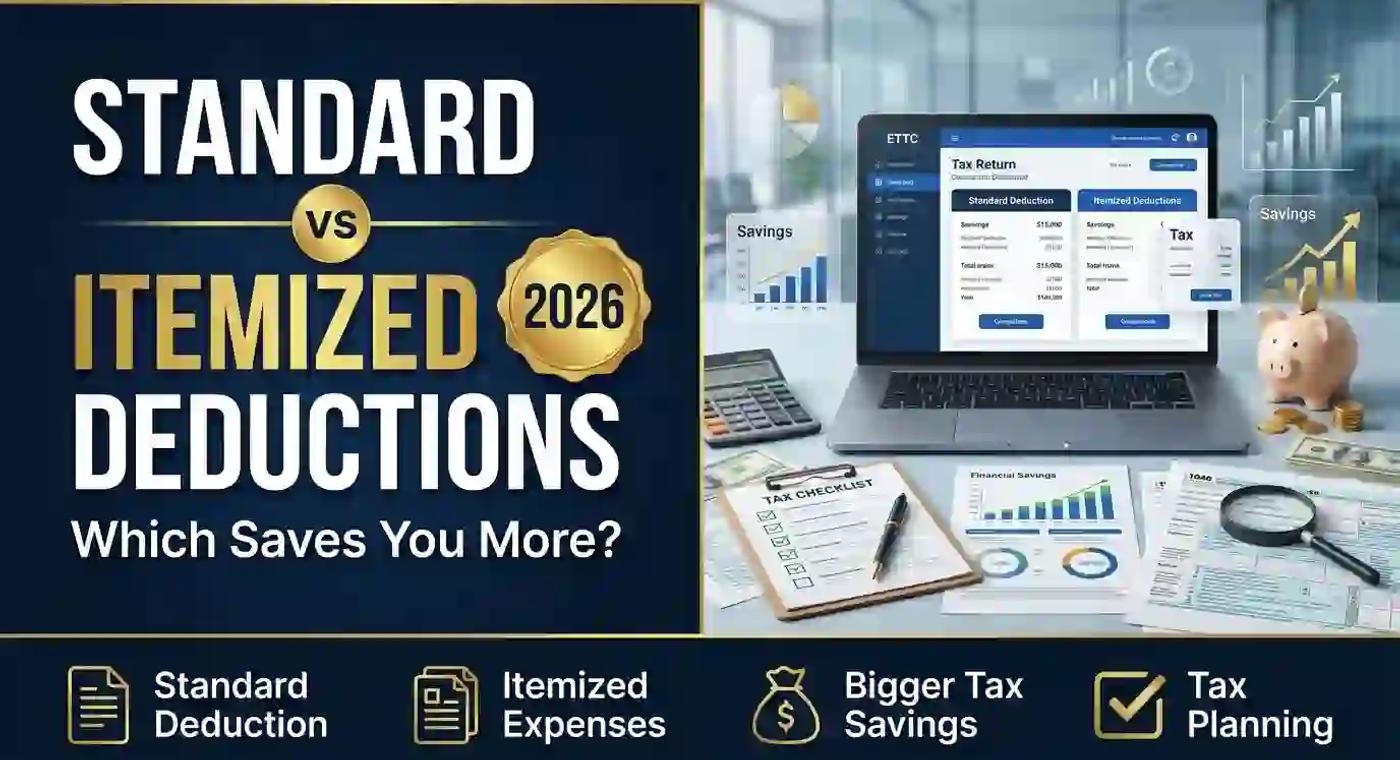
Every tax season boils down to one big decision: take the standard deduction, or itemize? For 2026, that choice matters more than ever, thanks to new inflation adjustments and a fresh set of rules from the One Big Beautiful Bill (OBBB). Choosing wrong could mean leaving hundreds — or thousands — of dollars on the table.
In this guide, you'll get the exact 2026 standard deduction amounts, a full itemized deductions checklist, real comparison math, and a clear framework for deciding which option actually saves you more money this year. Whether you're single, married, a homeowner, or over 65, you'll walk away knowing exactly where you stand.
What Is the Standard Deduction?
The standard deduction is a fixed dollar amount the IRS lets you subtract from your income before your tax bill is calculated — no receipts, no paperwork, no proof required. You simply check a box on Form 1040 and the deduction applies automatically.
It exists to simplify tax filing for the majority of Americans. Roughly 90% of taxpayers choose the standard deduction rather than itemizing, mainly because it's faster, requires zero documentation, and — for most households — actually results in a bigger deduction than tracking individual expenses would.
What Are Itemized Deductions?
Itemized deductions are specific, documented expenses you report on Schedule A of Form 1040 instead of taking the standard deduction. Rather than one flat number, you add up individual costs like mortgage interest, medical bills, and charitable gifts. If that total is higher than your standard deduction, itemizing saves you more.
The catch: you must keep records (receipts, statements, mileage logs) to back up every claim, and you can't take both the standard deduction and itemized deductions in the same year — it's one or the other.
2026 Standard Deduction Amounts (Official IRS Figures)
The IRS confirmed new inflation-adjusted numbers for tax year 2026 (the return you'll file in early 2027). For tax year 2026, the standard deduction increases to $32,200 for married couples filing jointly, while single filers and those married filing separately get $16,100, and heads of household get $24,150.
| 2026 Standard Deduction Amounts (Official IRS Figures) | |
|---|---|
| Filing Status | 2026 Standard Deduction |
| Single | $16,100 |
| Married Filing Separately | $16,100 |
| Head of Household | $24,150 |
| Married Filing Jointly | $32,200 |
2025 vs 2026 Standard Deduction: What Changed
Deduction amounts rise with inflation nearly every year, and 2026 is no exception.
| 2025 vs 2026 Standard Deduction: What Changed | |||
|---|---|---|---|
| Filing Status | 2025 Deduction | 2026 Deduction | Increase |
| Single / MFS | $15,750 | $16,100 | +$350 |
| Head of HouseholdHead of Household | $23,625 | $24,150 | +$525 |
| Married Filing Jointly | $31,500 | $32,200 | +$700 |
That's a modest but meaningful bump — enough to shield a bit more of your income from tax without you doing anything differently.
New for 2026: The Senior Bonus Deduction and Other OBBB Changes
The One Big Beautiful Bill introduced some genuinely new rules that change the standard-vs-itemized math for certain taxpayers in 2026.
1. A temporary $6,000 senior bonus deduction. This bonus deduction is available to individuals age 65 and older, with eligibility set at $75,000 in income for single filers and $150,000 for couples, phasing out above those levels, and it's only available from 2025 through 2028. This stacks on top of the regular standard deduction and the existing additional deduction for taxpayers 65 or older.
2. A new charitable deduction for non-itemizers. Previously, if you took the standard deduction, charitable gifts gave you zero additional tax benefit. That's changed. Non-itemizers can now deduct up to $1,000 (single) or $2,000 (joint) in charitable cash contributions on top of their standard deduction. This is a big deal for casual donors who never itemized before — you no longer have to choose between simplicity and getting credit for giving.
3. Continued extra deduction for age 65+ or blind. On top of the base standard deduction, taxpayers who are 65+ or blind still qualify for an additional per-condition deduction (roughly in the $1,600–$2,000 range depending on filing status, doubled if both 65+ and blind apply). If you're in this group, it's worth running the numbers with a federal income tax calculator to see your exact total deduction stack.
What Can You Itemize in 2026? (Full Schedule A List)
If you choose to itemize, here are the expense categories the IRS allows on Schedule A:
- Mortgage interest — interest paid on qualifying home loans
- State and local taxes (SALT) — income, sales, and property taxes, subject to a cap
- Property taxes — on your primary residence and other real estate
- Medical and dental expenses — the portion exceeding 7.5% of your AGI
- Charitable contributions — cash and non-cash donations to qualified organizations
- Casualty and theft losses — generally only in federally declared disaster areas
- Gambling losses — limited to the amount of gambling winnings reported
- Investment interest expense — interest on money borrowed to buy taxable investments
- Certain unreimbursed business expenses — for specific categories like qualified educators or armed forces reservists
Notably absent from this list in recent years: unreimbursed employee expenses and most miscellaneous itemized deductions, which were suspended for most taxpayers under prior tax law changes and remain limited going into 2026.
The SALT Cap and How It Affects Itemizing
The State and Local Tax (SALT) deduction cap has been one of the biggest itemizing headaches for taxpayers in high-tax states like California, New York, and New Jersey. It limits how much you can deduct in combined state income, sales, and property taxes — regardless of how much you actually paid.
If you live in a high-tax state, this cap alone can push your itemized total below the standard deduction, even if your mortgage interest and property taxes are substantial. Always factor the SALT cap in before assuming itemizing will win.
Standard Deduction vs Itemized Deductions: Which Saves You More?
Here's the core comparison, broken down by scenario:
"If you're a renter with no major medical bills and only modest charitable giving, the standard deduction saves you more."
"If you're a homeowner with a large mortgage and high property taxes, itemizing likely saves you more — but verify against the SALT cap first."
"If you have high out-of-pocket medical expenses exceeding 7.5% of your AGI, itemizing saves you more."
"If you suffered a major disaster loss in a federally declared area, itemizing saves you more."
"If you're a single filer with average expenses, the standard deduction saves you more."
"If you're a retiree age 65+ with modest expenses, the standard deduction plus the senior bonus deduction saves you more."
"If you're a small cash charitable donor who wouldn't otherwise itemize, the standard deduction plus the new $1,000/$2,000 charitable add-on saves you more."
The simple rule: if your total itemized deductions (mortgage interest + SALT-capped taxes + medical over the threshold + charitable gifts + other eligible costs) exceed your standard deduction amount for your filing status, itemize. If not, take the standard deduction — it's free money with no extra paperwork.
How to Calculate Which Option Saves You More (Step-by-Step)
- Find your standard deduction using your filing status from the table above.
- Add up your potential itemized deductions: mortgage interest statement (Form 1098), property tax bills, state income tax withheld, medical bills above 7.5% of AGI, and charitable donation receipts.
- Apply the SALT cap to your combined state and local tax total before adding it in.
- Compare the two totals. Whichever number is higher is the deduction that saves you more tax.
- Factor in bonus deductions — the senior bonus, additional 65+/blind deduction, and the new non-itemizer charitable deduction all apply on top of the standard deduction, which sometimes tips the scale back toward "standard" even for taxpayers who assumed they'd itemize.
- Run the numbers through a calculator rather than estimating by hand — small errors in AGI or SALT caps change the outcome. A tax refund calculator can help you see the real dollar impact of each path before you file.
When Should You Itemize in 2026?
You should seriously consider itemizing if:
- You own a home with a substantial mortgage and are still early in the loan term (more interest paid)
- You live in a state with high income or property taxes and your SALT-capped total plus other deductions still clears the standard deduction
- You had a major medical event and paid significant out-of-pocket costs
- You gave a large one-time charitable donation (property, stock, or a big cash gift)
- You experienced a casualty loss in a federally declared disaster zone
If none of these apply to you, the standard deduction is almost always the simpler and higher-value choice for 2026.
Standard Deduction by State: What to Know
Standard deduction rules discussed above are federal. Many states also offer their own standard deduction, separate from the IRS amounts, and the two don't have to match.
- California sets its own state standard deduction, which is far lower than the federal amount and adjusts separately each year.
- New York offers its own standard deduction structure by filing status.
- North Carolina has a state standard deduction that increases annually and differs from IRS figures.
- Texas has no state income tax, so the state standard deduction question doesn't apply at all — only the federal deduction matters there.
Because state and federal deduction rules diverge, it's worth checking both separately with a state income tax calculator rather than assuming your federal choice automatically applies at the state level.
Standard Deduction vs Itemized Deductions for the Self-Employed
If you're self-employed, this decision interacts with your business deductions differently. Business expenses (home office, equipment, mileage, software) are claimed separately on Schedule C — they reduce your business income directly and are not part of the standard-vs-itemized decision at all. You can take the standard deduction on your personal return and still fully deduct legitimate business expenses on Schedule C. A self-employment tax calculator can help separate these two calculations so you don't accidentally underclaim either one.
Common Mistakes Taxpayers Make With Deductions
- Assuming itemizing always wins because you own a home. With today's higher standard deduction amounts, many homeowners actually come out ahead taking the standard deduction.
- Forgetting the SALT cap when adding up state and local taxes, which inflates the itemized total on paper.
- Not claiming the new non-itemizer charitable deduction — many people still think you need to itemize to get any tax benefit from donations.
- Ignoring the senior bonus deduction if 65 or older, missing out on a meaningful additional reduction in taxable income.
- Mixing up federal and state standard deductions, assuming one automatically determines the other.
- Estimating instead of calculating. Rough guesses often lead to picking the wrong option; running exact numbers through a paycheck tax calculator or full federal income tax calculator removes the guesswork.
Why Use a Tax Calculator Instead of Estimating by Hand
Tax rules for 2026 involve multiple moving parts — updated brackets, a higher standard deduction, the SALT cap, and new bonus deductions that stack differently depending on your age and filing status. Doing this math manually is where most filing mistakes happen.
A dedicated calculator applies the current-year IRS figures automatically, factors in your filing status, and shows you the real comparison between standard and itemized outcomes side by side. If you also want to understand how your income lines up against the latest brackets before you dig into deductions, our guide on 2026 federal tax brackets breaks that down in plain language, and our US federal income tax calculator 2026 guide walks through the full filing process step by step.
You can explore the complete set of tools — from payroll to capital gains — on our US tax calculators hub.
Frequently Asked Questions
What is the standard deduction for 2026? For tax year 2026, it's $16,100 for single filers and those married filing separately, $24,150 for heads of household, and $32,200 for married couples filing jointly.
Is the standard deduction going up in 2026? Yes. It increased from 2025 levels across every filing status due to annual inflation adjustments, plus new temporary bonus deductions from the One Big Beautiful Bill.
Can I take both the standard deduction and itemized deductions? No. You must choose one or the other for a given tax year — they cannot be combined on the same return.
Do I need receipts to itemize deductions? Yes. Every itemized expense — mortgage interest, medical bills, charitable gifts — needs documentation such as receipts, statements, or official forms (like Form 1098) to support the claim if the IRS asks.
What is the SALT deduction cap, and how does it affect itemizing? The SALT cap limits how much combined state income, sales, and property tax you can deduct on Schedule A, regardless of what you actually paid. It disproportionately affects taxpayers in high-tax states and can make itemizing less advantageous than it appears at first glance.
Can I deduct charitable donations without itemizing in 2026? Yes, for the first time in years. Non-itemizers can now deduct up to $1,000 (single) or $2,000 (joint) in cash charitable contributions directly, on top of the standard deduction.
How much extra can seniors deduct in 2026? Taxpayers 65 and older can claim the regular additional standard deduction for age, plus a new temporary $6,000 senior bonus deduction (through 2028) if their income falls under $75,000 (single) or $150,000 (joint), phasing out above those thresholds.
Conclusion: Which Should You Choose in 2026?
For most people, the standard deduction remains the simplest and often the most financially rewarding choice in 2026 — especially with higher amounts, the new senior bonus, and the non-itemizer charitable deduction all working in your favor. But if you're a homeowner with significant mortgage interest, faced major medical costs, or gave a large one-time donation, itemizing might still come out ahead.
The only way to know for certain is to run your actual numbers. Use our free federal income tax calculator to compare both options instantly, see your real 2026 tax outcome, and file with confidence instead of guesswork.
For the official, up-to-date IRS figures referenced in this article, see the IRS 2026 tax inflation adjustments announcement.
Important disclaimer
This article is for educational planning only. It does not provide professional tax, legal, accounting, payroll, customs, or financial advice. Tax rules can change and final results may depend on your personal facts. Always verify important tax decisions with official sources or a qualified professional.