Tax season always brings the same question: what bracket am I actually in, and how much of my paycheck is the IRS really taking? If you've searched "2026 federal tax brackets" hoping for a straight answer instead of a jargon-heavy PDF, you're in the right place.
The good news: tax rates for 2026 haven't changed. You're still looking at seven brackets, from 10% to 37%. What has changed are the income thresholds — the dollar amounts where each rate kicks in — along with a bigger standard deduction and a handful of new deductions from the One Big Beautiful Bill Act (OBBBA). This guide breaks down the exact 2026 tax brackets for every filing status, shows you how to calculate what you'll actually owe, and answers the questions people are typing into Google (and asking AI chatbots) right now.
Key Takeaways (2026 Tax Year)
- Seven tax brackets remain: 10%, 12%, 22%, 24%, 32%, 35%, and 37%
- Top rate (37%) applies above $640,600 (single) and $768,700 (married filing jointly)
- Standard deduction rises to $16,100 (single) and $32,200 (married filing jointly)
- New OBBBA deductions cover tips, overtime, car loan interest, and seniors 65+
- Because brackets widened, most people with flat income will owe slightly less than in 2025
- These brackets apply to income earned in 2026, filed on your return in early 2027
What Are the 2026 Federal Tax Brackets?
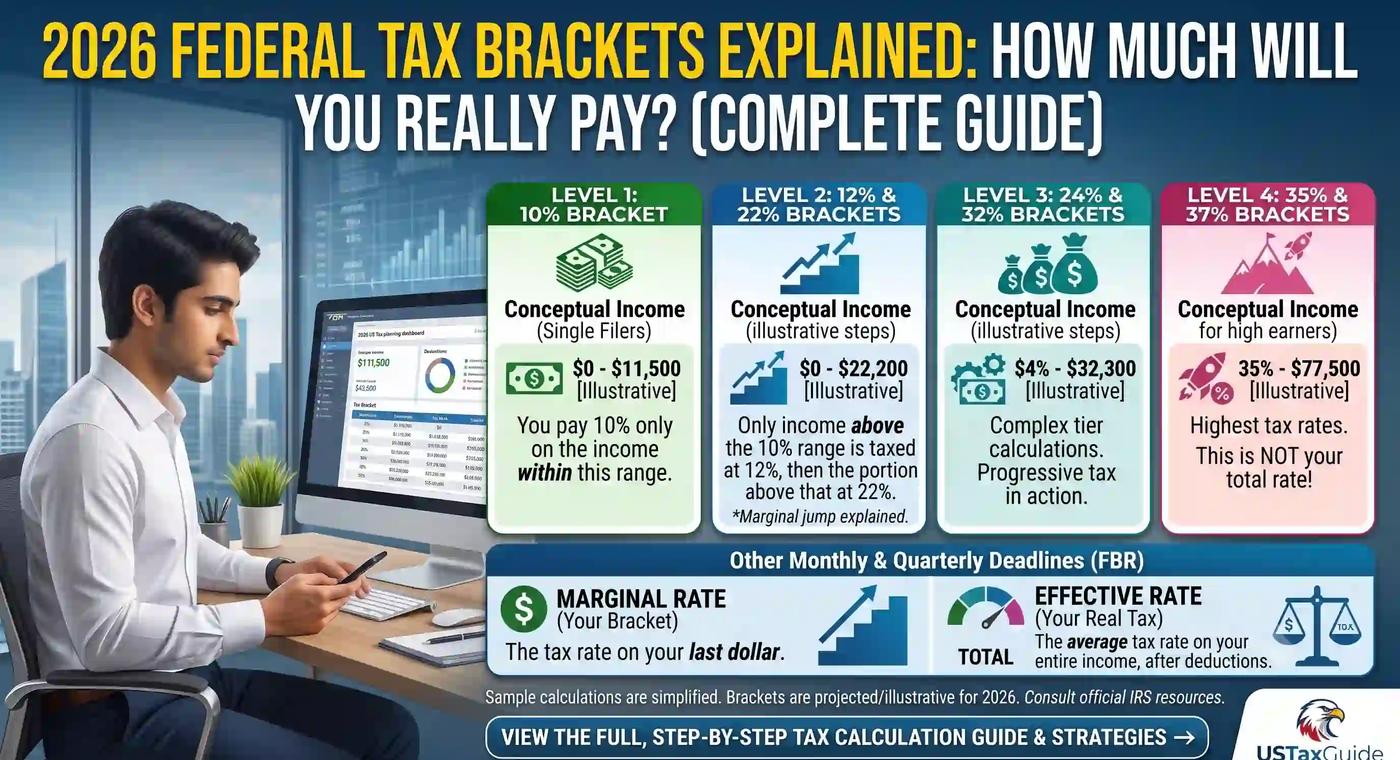
The 2026 federal income tax brackets are the income ranges the IRS uses to determine how much tax you owe at each rate. The U.S. uses a progressive tax system, meaning you don't pay one flat rate on your entire income — instead, different portions ("slices") of your income are taxed at increasing rates as you earn more.
For 2026, the IRS adjusted last year's thresholds upward for inflation, using the Chained Consumer Price Index (C-CPI). Under OBBBA, the two lowest brackets got an extra inflation bump — about a 4% increase — while the upper brackets rose roughly 2.3%.
Here's the full breakdown by filing status.
2026 Tax Brackets: Single Filers
| 2026 Tax Brackets: Single Filers | |
|---|---|
| Rate | Taxable Income Range |
| 10% | $0 – $12,400 |
| 12% | $12,400 – $50,400 |
| 22% | $50,400 – $105,700 |
| 24% | $105,700 – $201,775 |
| 32% | $201,775 – $256,225 |
| 35% | $256,225 – $640,600 |
| 37% | Over $640,600 |
2026 Tax Brackets: Married Filing Jointly
| 2026 Tax Brackets: Married Filing Jointly | |
|---|---|
| Rate | Taxable Income Range |
| 10% | $0 – $24,800 |
| 12% | $24,800 – $100,800 |
| 22% | $100,800 – $211,400 |
| 24% | $211,400 – $403,550 |
| 32% | $403,550 – $512,450 |
| 35% | $512,450 – $768,700 |
| 37% | Over $768,700 |
2026 Tax Brackets: Head of Household
| 2026 Tax Brackets: Head of Household | |
|---|---|
| Rate | Taxable Income Range |
| 10% | $0 – $17,700 |
| 12% | $17,700 – $67,450 |
| 22% | $67,450 – $105,700 |
| 24% | $105,700 – $201,750 |
| 32% | $201,750 – $256,200 |
| 35% | $256,200 – $640,600 |
| 37% | Over $640,600 |
2026 Tax Brackets: Married Filing Separately
| 2026 Tax Brackets: Married Filing Separately | |
|---|---|
| Rate | Taxable Income Range |
| 10% | $0 – $12,400 |
| 12% | $12,400 – $50,400 |
| 22% | $50,400 – $105,700 |
| 24% | $105,700 – $201,775 |
| 32% | $201,775 – $256,225 |
| 35% | $256,225 – $384,350 |
| 37% | Over $384,350 |
Want to skip the manual math? Run your exact numbers through our free Federal Income Tax Calculator — it applies these 2026 brackets automatically and shows your total tax and effective rate in seconds.
How Do Tax Brackets Actually Work?
This is where most people get confused, so let's clear it up with a simple example.
Federal tax brackets are marginal, not flat. That means moving into a higher bracket doesn't mean your entire income gets taxed at that higher rate — only the portion of income that falls inside that bracket does.
Example: Say you're a single filer earning $70,000 in taxable income in 2026.
- The first $12,400 is taxed at 10% → $1,240
- The next chunk, from $12,400 to $50,400, is taxed at 12% → $4,560
- The remaining $19,600 (from $50,400 to $70,000) is taxed at 22% → $4,312
Total tax owed: $10,112
Notice that only the last $19,600 was taxed at 22% — not the whole $70,000. This is the single most misunderstood part of the U.S. tax system, and it's the reason a raise or bonus rarely "pushes you into a worse tax situation" the way people fear.
Marginal Tax Rate vs. Effective Tax Rate
These two terms get used interchangeably, but they mean very different things.
- Marginal tax rate: The rate applied to your last dollar of income — essentially, the bracket you technically fall into.
- Effective tax rate: Your total tax bill divided by your total taxable income — the real, blended percentage you actually pay.
Using the example above, that $70,000 earner has a marginal rate of 22% but an effective rate of just 14.4% ($10,112 ÷ $70,000). Your effective rate is almost always lower than your marginal rate, and it's the number that actually reflects your real tax burden.
Curious what your paycheck withholding looks like against your real liability? Our Paycheck Tax Calculator breaks this down per pay period.
What Is the 2026 Standard Deduction?
Before your income even touches the tax brackets, the IRS lets you subtract a standard deduction. For most filers, this is the simplest way to reduce taxable income without itemizing.
- Single filers: $16,100 (up from $15,750 in 2025)
- Married filing jointly: $32,200 (up from $31,500 in 2025)
- Married filing separately: $16,100 (up from $15,750 in 2025)
- Head of household: $24,150 (up from $23,625 in 2025)
If you're 65 or older, or legally blind, you can claim an additional standard deduction on top of this: $2,050 for unmarried filers, or $1,650 per qualifying condition for married filers.
Standard Deduction vs. Itemized Deduction
Most taxpayers are better off with the standard deduction, since it's simple and doesn't require documentation. Itemizing only makes sense if your deductible expenses — mortgage interest, state and local taxes (capped at $40,400 for 2026), large medical expenses, or charitable giving — exceed your standard deduction amount. If you're unsure which route saves you more, it's worth running both scenarios through a calculator before filing.
New OBBBA Deductions for 2026
The One Big Beautiful Bill Act, signed in mid-2025, made the 2017 tax rate structure permanent and added several new temporary deductions running through 2028. These matter more for many households than the bracket shifts themselves.
- Qualified tips: Deduct up to $25,000; phaseout starts at $150,000 (single) / $300,000 (joint)
- Qualified overtime pay: Deduct up to $12,500 (single) / $25,000 (joint); same phaseout thresholds as tips
- Car loan interest (U.S.-assembled vehicles): Deduct up to $10,000; phaseout starts at $100,000 (single) / $200,000 (joint)
- Senior deduction (age 65+): $6,000 per person; phaseout starts at $75,000 (single) / $150,000 (joint)
- Non-itemizer charitable deduction: $1,000 (single) / $2,000 (joint); no income phaseout
These are available whether or not you itemize, which is a meaningful shift from prior years. If you're a service worker, hourly employee earning overtime, or a senior, it's worth checking whether you qualify — these deductions can outweigh the bracket adjustments entirely.
2026 vs. 2025 Tax Brackets: What Actually Changed?
Short answer: the rates stayed the same, the thresholds moved up. Here's what that means practically.
Because the income ranges widened and the standard deduction increased, someone earning the exact same salary in 2026 as they did in 2025 will generally owe slightly less federal tax. Using our earlier $70,000 example: that same taxable income would have generated about $10,314 in tax under 2025 brackets, versus $10,112 in 2026 — a modest but real difference of roughly $200.
This is standard inflation indexing, not a tax cut in the traditional sense — it exists specifically to prevent "bracket creep," where inflation alone pushes people into higher brackets even though their real purchasing power hasn't grown.
2026 Long-Term Capital Gains Tax Brackets
If you sell investments held longer than a year, they're taxed under a separate, generally lower schedule.
- 0% rate: Up to $49,450 (single) / Up to $98,900 (joint) / Up to $66,200 (head of household)
- 15% rate: $49,450–$545,500 (single) / $98,900–$613,700 (joint) / $66,200–$579,600 (head of household)
- 20% rate: Over $545,500 (single) / Over $613,700 (joint) / Over $579,600 (head of household)
High earners should also note the 3.8% Net Investment Income Tax, which kicks in at $200,000 MAGI for single filers and $250,000 for married filing jointly — thresholds that are not inflation-adjusted, so they capture more taxpayers every year. Estimate your specific liability with our Capital Gains Tax Calculator.
How to Calculate Your 2026 Tax Bracket, Step by Step
- Add up your gross income — wages, self-employment income, interest, and other taxable sources.
- Subtract adjustments and deductions — either the standard deduction ($16,100 single / $32,200 MFJ) or your itemized total — to arrive at taxable income.
- Match your taxable income to your filing status table above to find your marginal bracket.
- Calculate tax owed layer by layer, or use a tool to do it instantly.
If you're self-employed, remember you're also on the hook for self-employment tax separately from income tax — our Self-Employment Tax Calculator handles both together so you're not underestimating what you owe quarterly.
And if you want a full breakdown of your expected refund or balance due, our Tax Refund Calculator factors in your 2026 withholding against your projected liability.
State Taxes: Don't Forget the Other Half of the Equation
Federal brackets are only part of the picture. Depending on where you live, state income tax can add anywhere from 0% to over 13% on top of your federal bill.
States like Texas, Florida, Washington, Nevada, Wyoming, South Dakota, Tennessee, and Alaska currently levy no state income tax, while states like California, New York, New Jersey, and Oregon have their own progressive brackets that stack on top of the federal ones. If you've moved states recently or are comparing offers between states, check your specific state's 2026 brackets with our State Income Tax Calculator before assuming your take-home pay will look the same.
Frequently Asked Questions
What are the 2026 federal tax brackets? There are seven: 10%, 12%, 22%, 24%, 32%, 35%, and 37%. For single filers, the 10% rate covers income up to $12,400, and the top 37% rate applies above $640,600. For married couples filing jointly, those figures are $24,800 and $768,700.
Did tax rates go up in 2026? No. Rates are identical to 2025. What changed are the income thresholds, which rose due to inflation indexing, and the standard deduction, which also increased.
What tax bracket am I in if I earn $100,000? For a single filer, $100,000 of taxable income falls into the 22% bracket (which runs from $50,400 to $105,700) — but your effective rate will be noticeably lower than 22%, since earlier income is taxed at 10% and 12% first.
How much can I earn before hitting the 37% bracket in 2026? Single filers reach the 37% bracket above $640,600. Married couples filing jointly reach it above $768,700.
What's the difference between marginal and effective tax rate? Your marginal rate is what you pay on your next dollar earned. Your effective rate is your total tax divided by your total taxable income — a lower, blended number that reflects your true tax burden.
Is the 2026 standard deduction higher than 2025? Yes. It rose from $15,750 to $16,100 for single filers, and from $31,500 to $32,200 for married couples filing jointly.
When do the 2026 tax brackets take effect? They apply to income earned between January 1 and December 31, 2026, and will be reported on tax returns filed in early 2027 — not on the return you file in 2026 for tax year 2025.
Final Thoughts
The 2026 federal tax brackets aren't a dramatic overhaul — rates are unchanged, and the moving pieces are mostly inflation adjustments plus a set of new OBBBA deductions worth checking if you're a tipped worker, overtime earner, senior, or car buyer. The part that actually matters for your wallet is understanding that these are marginal rates: reaching a higher bracket only affects the income within that bracket, never your entire paycheck.
Rather than estimating by hand, put your real numbers to work. Try our Federal Income Tax Calculator to see your exact 2026 bracket, effective rate, and total liability in under a minute — and explore our full suite of U.S. tax tools for refunds, payroll, capital gains, and self-employment calculations, all built on the latest IRS figures.
Important disclaimer
This article is for educational planning only. It does not provide professional tax, legal, accounting, payroll, customs, or financial advice. Tax rules can change and final results may depend on your personal facts. Always verify important tax decisions with official sources or a qualified professional.
About the author
This article was written by the Tax Calculators Team, the group behind TaxCalculators.tools. Learn more about our team and editorial process.
Last reviewed: July 19, 2026