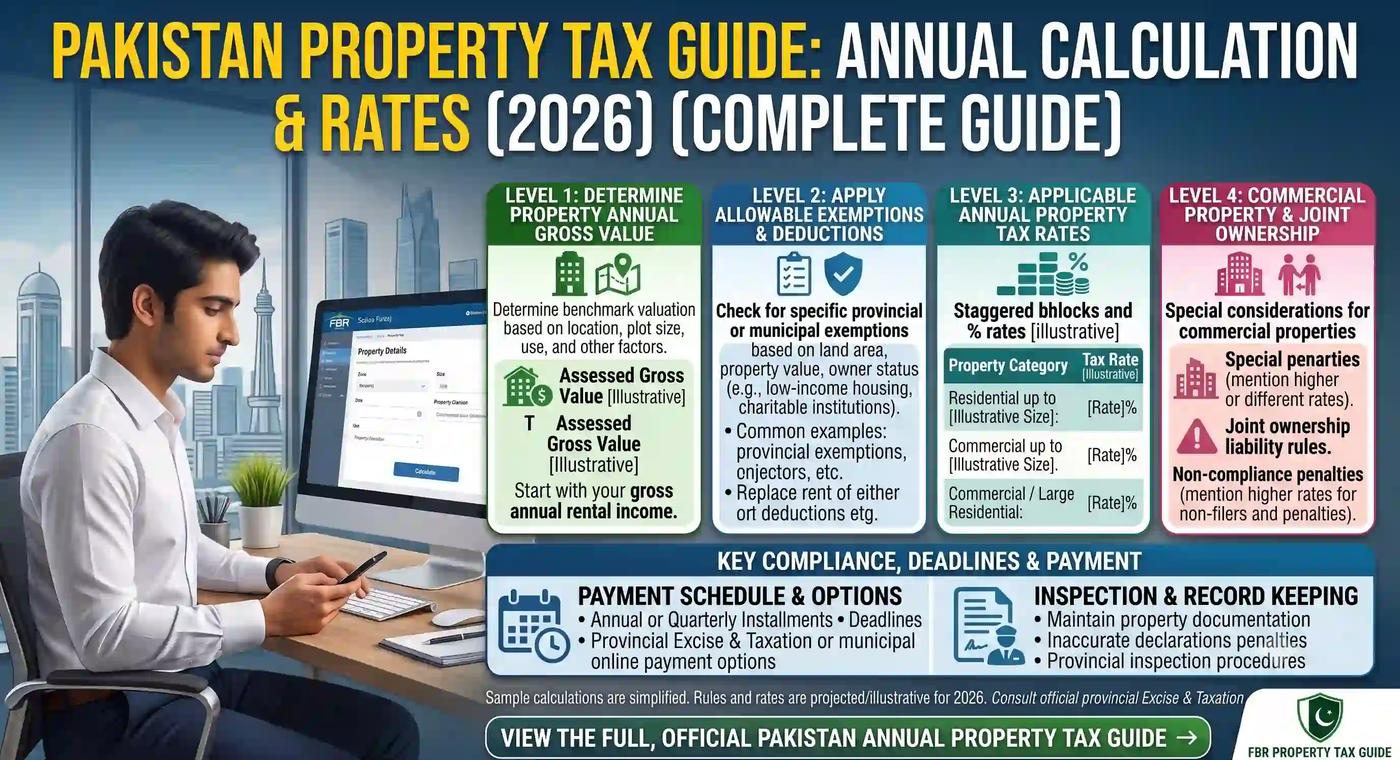
If you own a house, plot, shop, or apartment anywhere in Pakistan, you've probably asked yourself one question every year: "How much property tax do I actually owe?" Annual property tax in Pakistan is calculated by applying a fixed percentage — usually set by the provincial Excise and Taxation Department — to the Annual Rental Value (ARV) or Gross Annual Rental Value (GARV) of your property, which itself is based on location, covered area, and the property's usage type (residential or commercial). The exact amount also depends on your city, whether the property is self-occupied or rented out, and whether any exemption applies to you.
In this guide, we'll break down exactly how annual property tax is worked out in Pakistan, city by city, so you never have to guess again. We'll also show you how to use a Pakistan property tax calculator to get an instant, accurate estimate — no manual math, no confusion, no visiting a tax office.
What Is Property Tax in Pakistan?
Property tax — officially known in most provinces as Urban Immovable Property Tax (UIPT) — is a provincial tax charged annually on immovable property located within urban limits, including cities, cantonment boards, and municipal corporations. It is collected by the Excise and Taxation Department of each province (Punjab, Sindh, Khyber Pakhtunkhwa, and Balochistan) or by the relevant Cantonment Board / Capital Development Authority (CDA) for military and federal areas.
Unlike capital gains tax on property (which is charged only when you sell), property tax is a recurring annual charge simply for owning property — whether you live in it, rent it out, or leave it vacant.
Property tax funds municipal services such as roads, sanitation, street lighting, and local infrastructure, which makes it one of the oldest and most consistently enforced taxes in the country.
Why Property Tax Matters for Every Homeowner in Pakistan
Understanding property tax isn't just about compliance — it directly affects your finances in several ways:
- Avoiding penalties: Unpaid property tax accumulates as arrears with additional surcharge and penalty.
- Legal property transfer: Tax clearance is often required when selling or transferring ownership.
- Rental income planning: If you rent out your property, the ARV-based tax directly reduces your net rental yield.
- Filer status impact: Filers on the FBR's Active Taxpayer List generally benefit from lower withholding tax rates on property transactions compared to non-filers.
- Budgeting: Knowing your annual liability in advance helps you plan household or business expenses.
Because property tax rules differ by province, city, and even by cantonment vs. municipal jurisdiction, it's easy to either overpay or miss a payment deadline — which is exactly why a dedicated property tax calculator for Pakistan is so useful.
How Annual Property Tax Is Calculated in Pakistan (The Formula)
At its core, the property tax calculation formula in Pakistan follows this structure:
Annual Property Tax = Annual Rental Value (ARV) × Applicable Tax Rate (%) − Applicable Rebate/Exemption
Let's break each part down.
1. Annual Rental Value (ARV) / Gross Annual Rental Value (GARV)
The ARV is essentially the estimated yearly rental income your property would generate, even if you don't actually rent it out. It's determined using:
- Location — properties in prime commercial or posh residential areas carry higher notional rental value
- Covered area — measured in square feet or marla/kanal
- Property type — residential, commercial, or industrial
- Construction quality — plot, semi-constructed, or fully built structure
- DC Rate (Deputy Commissioner Rate) or the valuation table notified by the Excise and Taxation Department, which sets a benchmark rental/market value per locality
Each province publishes a property valuation table categorizing localities into zones (A, B, C, D, etc.), with higher-value zones attracting a higher notional rental value per square foot.
2. Applicable Tax Rate
Once ARV is determined, a percentage rate (commonly ranging between roughly 5% and 20% of ARV, depending on province, property category, and any provincial budget revisions) is applied. This rate is revised periodically through provincial budgets, so it's important to check the current rate for the relevant tax year rather than relying on old figures.
3. Exemptions and Rebates
Many owners qualify for a reduced liability or full exemption, including:
- Self-occupied residential houses under a specified covered area threshold
- Properties owned by widows, disabled persons, and retired government servants (in many jurisdictions, subject to specific conditions)
- Government and charitable/religious properties
- Vacant plots (in several jurisdictions, undeveloped plots are taxed differently or exempted until construction)
- Early-payment rebates offered during specific months of the fiscal year
Because exemption categories and thresholds change from year to year and vary by province, always verify your specific case using the Pakistan property tax calculator, which is updated to reflect current-year rules, or your provincial Excise and Taxation portal.
Property Tax Assessment Process — Step by Step
Here's how the Excise and Taxation Department typically assesses and issues your property tax bill:
- Property registration — Your property is registered in departmental records (often referenced by a PT-1 form or property tax record number).
- ARV determination — Based on locality zone, covered area, and usage.
- Rate application — The current year's percentage rate is applied to the ARV.
- Exemption/rebate adjustment — Any applicable deductions are subtracted.
- Challan generation — An official property tax challan (bill) is generated, often available for download online.
- Payment — Paid via designated banks, e-tax portals, or authorized payment apps.
- Record update — Payment is reflected against the property record for future reference and clearance purposes.
Property Tax Rates in Pakistan — Province-Wise Overview
Because Pakistan's property tax system is provincial (not federal), rates and rules differ across regions. Below is a general structural comparison — always confirm current-year rates through your provincial department or the calculator tool, since these are revised periodically in provincial budgets.
| Property Tax Rates in Pakistan — Province-Wise Overview | |||
|---|---|---|---|
| Province/Region | Governing Body | Basis of Tax | Typical Frequency of Rate Revision |
| Punjab | Excise, Taxation & Narcotics Control Department, Punjab | ARV-based, zone classification | Annual budget cycle |
| Sindh | Sindh Excise, Taxation & Narcotics Control Department | ARV-based, zone classification | Annual budget cycle |
| Khyber Pakhtunkhwa | KP Excise & Taxation Department | ARV/covered-area based | Annual budget cycle |
| Islamabad (ICT) | Capital Development Authority (CDA) | Covered area & category-based | Periodic CDA notification |
| Cantonment Areas | Respective Cantonment Board (Military Lands & Cantonments) | ARV/covered-area based | Set by Cantonment Board |
For a full breakdown of current DC rates and valuation zones, see our detailed guide: FBR Property Tax & DC Rates in Pakistan 2026.
City-Wise Property Tax Guide
Property Tax in Lahore
Lahore's property tax is administered by the Punjab Excise and Taxation Department and, separately, by Lahore Cantonment Board for cantonment areas like DHA, Cantt, and Walton. Rates depend on the locality zone (DHA, Gulberg, Model Town typically fall in higher valuation zones than peripheral housing schemes). Residents can check dues and download challans through the Punjab e-tax portal.
Property Tax in Karachi
Karachi property owners deal with either the Sindh Excise and Taxation Department (for civilian areas) or Karachi Cantonment Boards (DHA Karachi, Clifton Cantt, Faisal Cantt, etc.). Because Karachi has a wide range of property values across areas like Clifton, DHA, and older parts of the city, ARV zones vary significantly, directly affecting your final bill.
Property Tax in Islamabad
In the federal capital, the CDA manages property tax collection based on covered area and sector classification rather than a pure ARV model, though the underlying principle — a percentage-based annual charge — remains similar.
Property Tax in Rawalpindi
Rawalpindi properties fall under Punjab's Excise and Taxation Department, with Rawalpindi Cantonment Board handling cantonment zones separately, similar to Lahore's dual structure.
Property Tax in Faisalabad, Multan, Peshawar, Gujranwala, Sialkot, and Quetta
Each of these cities follows its respective provincial framework — Punjab for Faisalabad, Multan, Gujranwala, and Sialkot; KP for Peshawar; and Balochistan for Quetta — with local valuation tables adjusting the ARV according to each city's zones.
For a KP-specific breakdown, read our dedicated guide: KPK Property Tax Calculator Guide, or use the KPK Property Tax Calculator directly for an instant estimate.
Property Tax vs. Capital Value Tax vs. Capital Gains Tax — What's the Difference?
This is one of the most common points of confusion, so let's clear it up:
- Property Tax (UIPT) — An annual, recurring provincial tax on owning immovable property, based on ARV.
- Capital Value Tax (CVT) — Historically charged at the time of acquisition/transfer of certain property types, based on the recorded value of the property (rules and applicability have evolved over the years and vary by province/federal jurisdiction).
- Capital Gains Tax (CGT) — A federal tax charged by the FBR on the profit earned when you sell property, calculated on the difference between purchase and sale price, and affected by your filer/non-filer status and holding period.
- Withholding Tax on Property Transactions — Advance tax deducted at the time of property purchase or sale under sections like 236C and 236K, adjustable against your final tax liability.
For a deeper dive into sale-related taxes, check out: Capital Gains Tax on Property Sale in Pakistan and Withholding Tax on Property Transactions in Pakistan.
Filer vs. Non-Filer: Does It Affect Property Tax?
While annual property tax itself (UIPT) is generally charged the same regardless of filer status, your filer status with the FBR does significantly affect other property-related taxes — particularly withholding tax on purchase/sale and capital gains tax. Non-filers typically face higher withholding tax rates on property transactions compared to filers on the Active Taxpayer List (ATL).
If you're unsure of your status, you can review our guide on How to Become a Tax Filer in Pakistan and check your standing using the FBR Active Taxpayer List (ATL) Status Check guide.
Illustrative Example: How Property Tax Is Calculated
Let's walk through a simplified, illustrative example (actual figures will vary based on your city's current valuation table and rate):
Suppose:
- A residential property in a mid-value locality zone
- Covered area: 5 Marla
- Notional monthly rental value (as per valuation table): PKR 15,000
- Annual Rental Value (ARV) = PKR 15,000 × 12 = PKR 180,000
- Applicable tax rate (example): 10% of ARV
- Annual Property Tax = PKR 180,000 × 10% = PKR 18,000
- If a self-occupied rebate of, say, 10% applies: PKR 18,000 − PKR 1,800 = PKR 16,200 payable
This is a simplified illustration to explain the mechanism — actual ARV tables, rates, and rebate percentages differ by province, city zone, and current fiscal-year notification. That's precisely why using a live, updated property tax calculator is far more reliable than manual estimation.
How to Check and Pay Property Tax Online in Pakistan
Most provinces now offer digital property tax portals, making it far easier than the old process of visiting tax offices in person. General steps include:
- Visit your provincial Excise and Taxation e-tax portal (e.g., Punjab's e-Pay Punjab or Sindh's e-tax system)
- Enter your Property Tax Number (PT-1) or search by owner name/address
- View outstanding dues, past payment history, and current-year assessment
- Download or print your property tax challan
- Pay via designated bank, ATM, mobile banking, or online payment gateway
- Save the payment receipt for future property transfer or legal purposes
For federal capital residents, CDA's dedicated online verification portal serves the same function — our guide on Excise and Taxation Islamabad Online Verification & Tax Payment walks through this process in detail.
What Happens If You Don't Pay Property Tax?
Failure to pay property tax on time in Pakistan can result in:
- Surcharge/penalty accumulating on the outstanding amount
- Arrears carried forward to the next fiscal year with compounding liability
- Legal notices from the Excise and Taxation Department
- Complications during property transfer or sale, since tax clearance is often a prerequisite
- In persistent default cases, recovery proceedings initiated under relevant provincial property tax laws (such as the Punjab Urban Immovable Property Tax Act, 1958, and its provincial equivalents)
Paying on time — or availing early-payment rebates where offered — is almost always financially smarter than allowing dues to accumulate.
Common Mistakes Property Owners Make
- Assuming property tax and capital gains tax are the same thing
- Not checking whether their self-occupied exemption has already been applied
- Missing early-payment rebate windows
- Failing to update ownership records after inheritance or purchase, leading to bills issued in a previous owner's name
- Not verifying zone classification, which can result in overpayment if the property was wrongly categorized
Tips to Legally Reduce Your Property Tax Burden
- Confirm you're claiming every applicable exemption or rebate (self-occupied, senior citizen, widow, disabled person categories where applicable)
- Pay within early-bird rebate periods announced by provincial departments
- Verify your property's zone classification isn't overstated compared to comparable neighboring properties
- Keep your filer status active, since it reduces withholding tax burden on related property transactions
- Use an updated Pakistan property tax calculator every fiscal year, since rates and valuation tables change with provincial budgets
Why Choose a Dedicated Property Tax Calculator
Manually calculating property tax means tracking down current DC rates, ARV tables, applicable percentages, and rebate rules for your exact city and zone — a process that can take hours and still lead to errors. A purpose-built online property tax calculator solves this by:
- Automatically applying the correct, current-year rate structure
- Adjusting for your city and zone
- Factoring in self-occupied vs. rented status
- Giving you an instant, shareable estimate before you ever visit a tax office
For related tax planning, you can also explore our FBR Tax Calculator and full guide on FBR Tax Calculator 2026 to understand how your overall tax picture fits together.
For official, authoritative rate confirmations, always cross-check with the Federal Board of Revenue (FBR) and your relevant provincial Excise and Taxation Department website before making final payments.
Frequently Asked Questions (FAQs)
1. What is property tax in Pakistan? Property tax in Pakistan, formally called Urban Immovable Property Tax (UIPT), is an annual provincial tax charged on immovable property based on its Annual Rental Value (ARV), location zone, and usage type.
2. How is annual property tax calculated in Pakistan? It's calculated by multiplying the Annual Rental Value (ARV) of the property by the applicable tax rate percentage set by the provincial Excise and Taxation Department, then subtracting any eligible exemptions or rebates.
3. Who is exempt from property tax in Pakistan? Common exemption categories include small self-occupied residential houses below a certain covered area, properties owned by widows or disabled persons, government buildings, and religious/charitable institutions — though exact thresholds vary by province and year.
4. Is property tax the same as capital value tax or capital gains tax? No. Property tax is an annual ownership-based charge, while capital value tax and capital gains tax relate to property acquisition or sale transactions, not ongoing ownership.
5. How do I pay property tax online in Pakistan? You can pay through your province's e-tax portal (such as Punjab's or Sindh's Excise and Taxation online system) by locating your property using its PT-1 number, downloading the challan, and paying via bank or digital payment gateway.
6. What happens if I don't pay property tax on time? Unpaid property tax accrues surcharge and penalties, becomes arrears in the following year, and can create legal complications when you try to sell or transfer the property.
7. Does a vacant plot attract property tax in Pakistan? In many jurisdictions, undeveloped or vacant plots are taxed differently from constructed properties, and some are exempt until construction begins — but this varies by city and should be confirmed locally.
8. How often is property tax paid in Pakistan? Property tax is assessed and paid annually, though some provinces allow installment payments or offer rebates for early full payment within a specific window.
Conclusion: Take the Guesswork Out of Property Tax
Annual property tax in Pakistan doesn't have to feel confusing or unpredictable. Once you understand that it boils down to Annual Rental Value × Tax Rate − Exemptions, and that the specific numbers depend on your city, zone, and property type, the whole system becomes far easier to navigate.
Rather than digging through outdated valuation tables or making a trip to the tax office, get an instant, accurate estimate tailored to your property using our free Pakistan Property Tax Calculator. It's updated for current provincial rates, works for residential and commercial properties alike, and takes less than a minute to use.
👉 Calculate your annual property tax now and stay ahead of every deadline, rebate window, and provincial rate change — all in one place.
Important disclaimer
This article is for educational planning only. It does not provide professional tax, legal, accounting, payroll, customs, or financial advice. Tax rules can change and final results may depend on your personal facts. Always verify important tax decisions with official sources or a qualified professional.
About the author
This article was written by the Tax Calculators Team, the group behind TaxCalculators.tools. Learn more about our team and editorial process.
Last reviewed: July 20, 2026