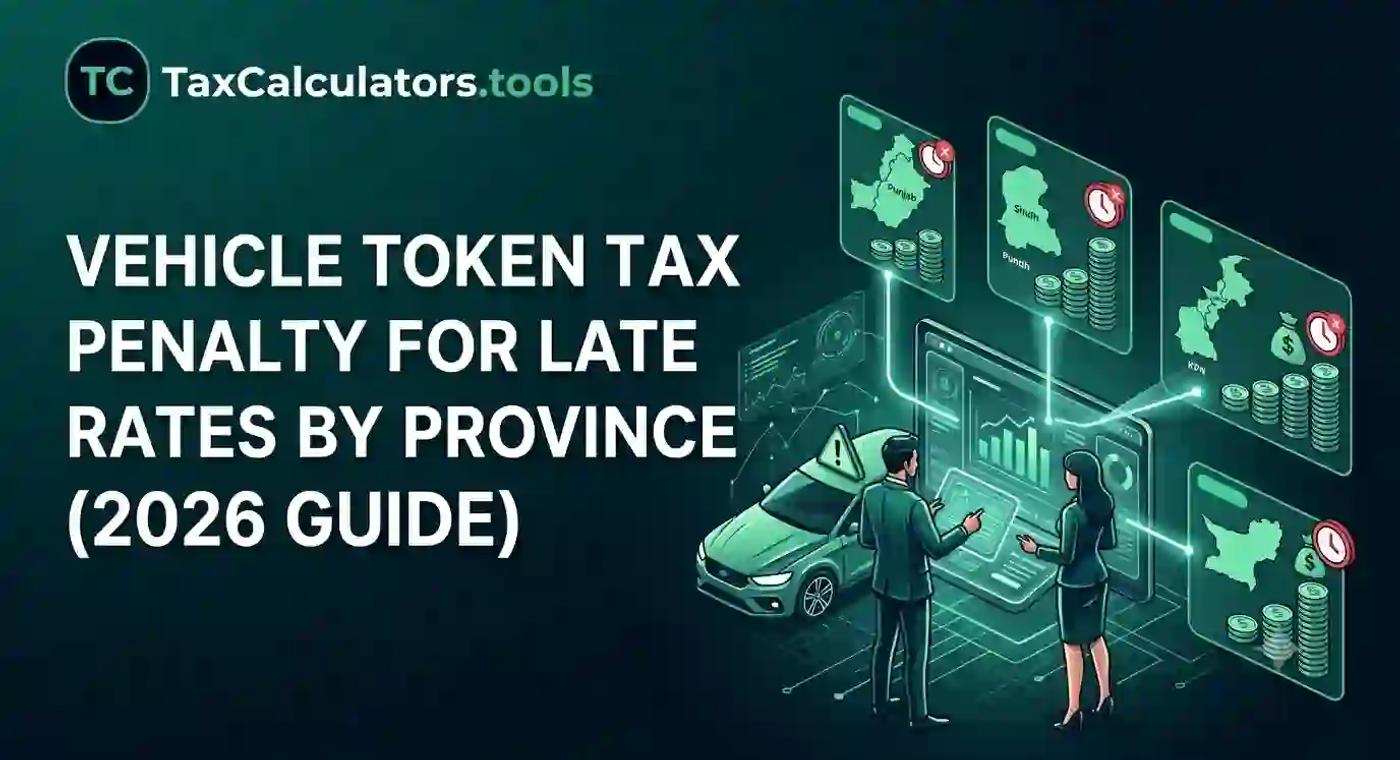
Missing your vehicle token tax deadline in Pakistan isn't just an inconvenience — it triggers a penalty that grows the longer you wait, and the rules aren't the same everywhere. Punjab calculates its surcharge differently from Sindh, Islamabad has moved to a value-based system, and Khyber Pakhtunkhwa and Balochistan run their own separate schedules. If you own a car, bike, or commercial vehicle anywhere in Pakistan, understanding exactly how your province penalizes late token tax payment can save you real money and keep your vehicle out of trouble at a police checkpoint.
This guide breaks down vehicle token tax penalty rates by province, explains how the fines are calculated, and shows you exactly how to check and clear your dues online — before the surcharge eats into your wallet any further.
What Is Vehicle Token Tax?
Vehicle token tax is an annual (or, for smaller vehicles, one-time lifetime) fee that every registered vehicle owner in Pakistan must pay to their provincial Excise and Taxation Department. It's what keeps your car or bike legally allowed on the road for the financial year, which runs from July 1 to June 30.
The tax amount depends on a mix of factors:
- Engine capacity (cc) — smaller engines generally pay less
- Invoice or market value — increasingly used for higher-cc vehicles, especially in Punjab and Islamabad
- Vehicle category — private car, motorcycle, rickshaw, commercial loader, or luxury vehicle
- Filer or non-filer status — FBR-registered tax filers usually pay a lower rate than non-filers
- Province of registration — each of Pakistan's provinces and territories sets its own rates and rules
Once your token expires and you don't renew it on time, the excise department treats you as a defaulter, and that's when the penalty clock starts.
Why the Late Payment Penalty Matters
A late token tax fine isn't just a minor add-on. Depending on your province and how long you delay, penalties can range from a small flat fee to a charge that rivals — or even exceeds — the original tax amount. Beyond the extra cost, an overdue token tax can:
- Block you from transferring ownership or selling the vehicle
- Cause your vehicle to fail verification on MTMIS or the relevant provincial portal
- Lead to your vehicle being stopped, fined, or in serious cases impounded by traffic police
- Complicate future filing if you're building a compliance history with FBR
Because of this, checking your due date and paying on time (or as close to it as possible) is one of the simplest ways to protect both your finances and your vehicle's legal status.
How Token Tax Penalties Are Generally Calculated
While each province has its own formula, most follow one of three basic penalty structures:
- Percentage-based surcharge — a percentage of your outstanding tax is added, often increasing in tiers the longer you delay (common in Punjab and Sindh).
- Flat recurring fee — a fixed rupee amount is charged per month or per quarter that the tax remains unpaid.
- Escalating enforcement penalties — during periodic compliance drives, provinces have announced sharply higher surcharges (sometimes matching 100% of the due tax) to push defaulters toward payment before the fiscal year closes.
Because provincial finance bills are revised almost every year — and because enforcement campaigns can temporarily raise penalties beyond the standard schedule — the exact percentage or rupee figure you'll be charged can shift from one budget cycle to the next. Always confirm the current rate on your provincial excise department's official portal before assuming a number you found online is still accurate.
Vehicle Token Tax Penalty Rates by Province
Punjab Token Tax Penalty
Punjab runs the most digitized token tax system in the country through the ePay Punjab app, and its penalty structure is tiered based on how late your payment is:
- A lower surcharge typically applies if you pay within roughly 30 days of the deadline
- A higher surcharge applies once the delay stretches beyond 30 days
- Under the province's 2026-27 Finance Bill, the way late surcharges are collected is shifting from a monthly basis to a quarterly basis, which changes how quickly the fine compounds
- Punjab also runs periodic compliance drives; during one recent enforcement push, the Excise, Taxation and Narcotics Control Department warned long-term defaulters of a substantially higher penalty surcharge alongside the risk of on-the-spot vehicle seizure
On the positive side, Punjab rewards early filers: motorists who clear their annual token tax before the August 31 cutoff can receive a rebate on the total amount, which is essentially the opposite of a penalty — a discount for paying ahead of time.
Bottom line for Punjab: the earlier you pay, the more you save; the longer you wait, the steeper the surcharge climbs, and Punjab is currently the province most actively enforcing recovery from long-term defaulters.
Sindh Token Tax Penalty
Sindh's Excise, Taxation & Narcotics Control Department administers vehicle tax under the Motor Vehicle Taxation Act, 1958, through the Sindh Excise Tax Portal (there's no dedicated mobile app yet, unlike Punjab or Islamabad).
For late token tax payment, Sindh applies a penalty that grows with the length of delay — vehicle owners who miss the deadline typically start facing fines once the payment is roughly a month overdue, with the surcharge continuing to increase for extended non-payment. Separately, delayed new vehicle registration (a different process from annual token tax renewal) carries its own escalating fine schedule that can run into tens of thousands of rupees for very long delays.
Because Sindh's exact surcharge percentage can vary by district office and vehicle category, it's worth generating your payment slip (PSID) on the official portal first — the system will show your outstanding dues, including any accrued penalty, before you pay.
Khyber Pakhtunkhwa (KPK) Token Tax Penalty
KPK's Excise, Taxation and Narcotics Control Department manages token tax collection, with online checking and payment increasingly available through the ZAMA KP app alongside the department's Motor Vehicle Records portal.
As in other provinces, failing to renew your token on time in KPK results in a penalty and puts your vehicle at risk of being flagged during police checks or impounded for prolonged non-payment. KPK also offers meaningful savings for tax filers — for example, filers on higher-cc vehicles can pay roughly half of what non-filers are charged — so staying on the Active Taxpayer List (ATL) indirectly reduces your exposure to larger penalty amounts, since the base tax (and therefore the percentage-based fine on top of it) is lower to begin with.
Islamabad (ICT) Token Tax Penalty
The Islamabad Capital Territory overhauled its token tax structure under the Finance Act 2026, replacing the old flat engine-capacity rates with an invoice-value-based system for vehicles above 1,000cc, while smaller cars remain on a fixed rate. This change, effective from July 1, 2026, means the rupee amount your penalty is calculated against has also shifted for many vehicle owners.
In Islamabad, once your token tax becomes overdue, the Excise and Taxation Department adds a late payment penalty that increases the longer the vehicle stays unregistered for the year, and an expired token puts you at risk of impoundment if stopped by traffic police. Payments and penalty calculations are handled through the City Islamabad App or the ONE App (by NITB), where the system automatically factors in any applicable late fine when you generate your challan.
Balochistan Token Tax Penalty
Balochistan's token tax schedule is largely flat-rate and governed by the Excise, Taxation and Anti-Narcotics Department. Its digital infrastructure is still the least developed of the four provinces — there's no dedicated mobile app yet, and coverage on the online tax calculator can be inconsistent depending on your district, so many vehicle owners still rely on their local excise office to confirm exact dues and penalties.
Balochistan does offer meaningful concessions, such as rebates on electric motorcycles and rickshaws, but for standard petrol vehicles, missing your renewal deadline still results in an added late fee on top of the annual tax. If your district's online portal doesn't pull up your record, visiting the excise office directly remains the most reliable way to confirm your exact penalty amount.
Azad Kashmir (AJK) and Gilgit-Baltistan
AJK and Gilgit-Baltistan operate their own, smaller-scale excise and taxation systems, generally modeled on structures similar to Punjab and KPK but with lower base rates and less digitization. If you're registered in either territory, the safest approach is to contact your local Motor Registration Authority (MRA) directly, since online rate schedules for these regions are updated less frequently than the larger provinces.
Token Tax Penalty Comparison at a Glance
Punjab
Payment Platform: ePay Punjab App
General Penalty Pattern: Tiered surcharge, rising after ~30 days late
Notable 2026 Update: Shift to quarterly surcharge billing; 10% early-payment rebate before Aug 31
Sindh
Payment Platform: Sindh Excise Web Portal
General Penalty Pattern: Increasing fine the longer the delay
Notable 2026 Update: No dedicated app yet; PSID-based system
KPK
Payment Platform: ZAMA KP App / MVR Portal
General Penalty Pattern: Standard late fee plus impoundment risk
Notable 2026 Update: Filer discounts reduce base tax and penalty exposure
Islamabad (ICT)
Payment Platform: City Islamabad App / ONE App
General Penalty Pattern: Escalating penalty added to challan
Notable 2026 Update: Moved to invoice-value-based token tax from July 2026
Balochistan
Payment Platform: Excise Balochistan Web Calculator
General Penalty Pattern: Flat late fee added to annual tax
Notable 2026 Update: Least digitized; office visits often still required
Rates and formulas are revised in almost every provincial budget cycle, so treat this table as a general guide and always confirm the current figure on your province's official excise portal or by using an updated token tax calculator before you pay.
Filer vs. Non-Filer: Does It Affect Your Penalty?
Yes, indirectly. Across most provinces, non-filers pay a higher base token tax and a higher advance/withholding tax at the time of registration or transfer compared to FBR-registered filers. Since late payment penalties are usually calculated as a percentage of the outstanding tax, a non-filer's fine ends up larger in rupee terms even if the percentage rate is technically the same.
If you haven't filed your income tax return yet, becoming an active filer is one of the more overlooked ways to reduce your long-term vehicle tax burden — both the annual amount and the penalty if you're ever late.
How to Check Your Vehicle Token Tax Dues Online
Before you can pay, you need to know exactly what you owe, including any accrued penalty. The process is broadly similar across provinces:
- Punjab: Open the ePay Punjab app, enter your vehicle registration number, and it displays outstanding token tax plus any pending fines.
- Sindh: Visit the Sindh Excise Tax Portal, enter your registration number and mobile number, and let the system calculate your dues.
- Islamabad: Use the City Islamabad App or ONE App, sign in with your CNIC, and enter your vehicle number to see the current amount, including penalties.
- KPK: Use the ZAMA KP app or the KPK Motor Vehicle Records portal to check your status.
- Balochistan: Use the Excise Balochistan online calculator, or visit your nearest excise office if the portal doesn't return your vehicle's record.
For a faster province-by-province estimate, you can also run your vehicle details through our vehicle token tax calculator, which helps you estimate your base tax before you head to the official portal to confirm the final figure and generate your PSID.
How to Pay Overdue Token Tax: Step-by-Step
- Confirm your dues using your province's official app or web portal.
- Generate a PSID (Payment Slip ID) — this unique reference number links your vehicle to the amount owed, including any penalty.
- Choose a payment channel — most provinces support 1Link, ATM withdrawal-linked payment, mobile banking apps, or over-the-counter payment at partner bank branches.
- Complete the payment and save the digital or printed receipt.
- Verify the update on the excise portal a day or two later to confirm your vehicle's record now shows the token as current.
Skipping the receipt-saving step is a common mistake — always keep proof of payment in case there's a delay in the system reflecting your cleared status.
Practical Tips to Avoid Late Token Tax Penalties
- Mark your renewal date as soon as you receive your vehicle's registration or previous receipt — most provinces run on the July–June fiscal year, so renewal windows are predictable.
- Take advantage of early-payment rebates where available, such as Punjab's discount for payments made before the August cutoff.
- Register for e-Pay or app-based reminders if your province offers them.
- Check your filer status on the FBR Active Taxpayer List — staying active as a filer reduces both your base tax and the rupee value of any future penalty.
- Avoid unofficial agents who claim to "waive" penalties for a fee; only your provincial excise department can legally adjust or waive a fine.
- Pay slightly ahead of the deadline, not exactly on it — server slowdowns are common in the final days before provincial cutoffs, and a missed payment due to a technical delay can still trigger a penalty.
Can a Token Tax Penalty Be Waived?
Provinces occasionally announce amnesty schemes or penalty waivers, usually tied to a specific compliance drive or budget announcement, allowing defaulters to clear only the base tax without the accumulated surcharge for a limited window. These schemes are not permanent and are announced case-by-case — there's no standing rule that guarantees a waiver. If you're significantly behind on payment, it's worth checking your provincial excise department's latest notifications before assuming the full penalty is unavoidable, since a waiver window may currently be open.
Frequently Asked Questions
What is the penalty for late token tax payment in Pakistan? It depends on your province. Most provinces apply an increasing surcharge the longer the tax remains unpaid — some use a percentage of the due amount, others use a flat recurring fee per month or quarter. Punjab and Sindh both scale penalties based on how many days or months you've missed the deadline.
Which province has the highest token tax penalty? There's no single fixed answer, since rates change with each provincial budget and enforcement drives can temporarily raise penalties well above the standard schedule. Punjab's recent compliance campaigns, for instance, pushed surcharges on long-term defaulters far higher than the routine tiered rate. Always check your specific province's current notification rather than relying on last year's figure.
Can token tax penalty be waived in Pakistan? Sometimes, through temporary amnesty schemes announced by a provincial excise department. These aren't automatic or permanent, so you'd need to confirm whether a waiver window is currently active in your province.
Is token tax paid annually or as a lifetime payment? It depends on the vehicle. Smaller-cc cars and motorcycles in several provinces qualify for a one-time lifetime token tax, while most private cars above a certain engine capacity are taxed annually.
Does the penalty differ for filers and non-filers? The percentage structure is generally the same, but because non-filers pay a higher base token tax, their penalty amount in rupees ends up higher too. Filing your income tax return and staying on the FBR Active Taxpayer List reduces this exposure.
How can I check my vehicle's token tax status online? Use your province's official app or portal — ePay Punjab, the Sindh Excise Tax Portal, ZAMA KP, the City Islamabad App, or the Balochistan Excise calculator — by entering your vehicle registration number.
Final Thoughts
Vehicle token tax penalty rates vary meaningfully across Pakistan's provinces, and with budgets, finance bills, and enforcement drives changing the numbers almost every year, the safest habit is simple: check your dues early, pay before your province's deadline, and confirm the exact current penalty on the official portal rather than relying on last year's rate.
If you want a quick starting estimate before you generate your official PSID, our vehicle token tax calculator can help you work out your approximate annual tax by province, engine capacity, and filer status — so you know roughly what to expect before you pay.
For more province-specific guidance, you may also find these helpful:
- How to Pay Vehicle Token Tax Online in Pakistan
- Punjab Vehicle Verification & Token Tax Guide
- Sindh Vehicle Verification & Token Tax Guide
- Excise and Taxation Islamabad: Online Verification & Payment
- Vehicle Verification & Token Tax Comparison Across Pakistan
Official sources for current rates: KPK Excise, Taxation & Narcotics Control Department, Balochistan Excise, Taxation and Anti-Narcotics Department, and ICT Administration – Excise & Taxation.
Important disclaimer
This article is for educational planning only. It does not provide professional tax, legal, accounting, payroll, customs, or financial advice. Tax rules can change and final results may depend on your personal facts. Always verify important tax decisions with official sources or a qualified professional.
About the author
This article was written by the Tax Calculators Team, the group behind TaxCalculators.tools. Learn more about our team and editorial process.
Last reviewed: July 25, 2026