If you've ever looked at an invoice in Pakistan and wondered why the tax rate on a restaurant bill in Karachi looks different from one in Lahore, you're not imagining things. Sales tax in Pakistan isn't one single number — it's a patchwork of federal and provincial rates that change depending on what you're buying, where you're buying it, and who's selling it.
This guide breaks down exactly how Pakistan's sales tax and GST system works in 2026 — the federal rate on goods, the provincial rates on services, who administers what, and how you can calculate your exact liability in seconds using a Pakistan Sales Tax Calculator instead of doing it by hand. Whether you're a shop owner, a freelancer, an IT exporter, or just someone trying to understand your receipt, this is the only page you'll need.
What Is Sales Tax in Pakistan? (GST Explained Simply)
Sales tax is a consumption tax charged on the supply of goods and, in many cases, services. Most people in Pakistan call it "GST" (General Sales Tax), and you'll see both terms on invoices, news reports, and shopping receipts — they refer to the same thing in everyday use.
Technically, Pakistan's sales tax works like a Value Added Tax (VAT). Tax is collected at every stage of the supply chain, but registered businesses can claim back the tax they already paid on their own purchases (called input tax). Only the final consumer ends up bearing the full cost. This system was introduced through the Sales Tax Act, 1990, and is administered federally by the Federal Board of Revenue (FBR) for goods.
Here's the part that trips most people up: sales tax on services is not federal. Since the 18th Constitutional Amendment in 2010 devolved this power to the provinces, each province now runs its own revenue authority, sets its own rates, and issues its own registration numbers.
Why Sales Tax Matters for Every Pakistani Business in 2026
Getting your sales tax obligations wrong isn't a small mistake — it's an expensive one. FBR and the provincial authorities have tightened enforcement significantly since 2023, using data-matching systems, third-party bank data, and automated notices through the IRIS portal.
Here's why this matters more in 2026 than ever before:
- Digital enforcement is real-time. Tier-1 retailers must integrate with FBR's Point of Sale (POS) system, meaning every sale is reported instantly.
- Penalties are steep. Late filing alone can cost Rs. 10,000 per month or 5% of tax payable, whichever is higher.
- Multi-province businesses face double complexity. If you sell services across Punjab, Sindh, KPK, and Balochistan, you may need separate registrations with each authority.
- Consumers are watching too. With QR-coded receipts and the FBR Tax Asaan app, customers can verify invoices and even win prizes — pushing more businesses toward full compliance.
Understanding your exact rate — and calculating it correctly every time — isn't optional anymore. It's basic business hygiene.
FBR vs Provincial Revenue Authorities: Who Taxes What
This is the single most misunderstood part of Pakistan's tax system, so let's make it simple.
FBR (Federal Board of Revenue) handles:
- Sales tax on goods (manufacturing, imports, retail products)
- Customs duties and federal excise duty
- Sales tax on ICT (Islamabad) services
Provincial Revenue Authorities handle sales tax on services within their territory:
- Punjab Revenue Authority (PRA) — services in Punjab
- Sindh Revenue Board (SRB) — services in Sindh
- Khyber Pakhtunkhwa Revenue Authority (KPRA) — services in KPK
- Balochistan Revenue Authority (BRA) — services in Balochistan
So if you run a restaurant, a courier company, an IT consultancy, or a marriage hall, you likely register with your provincial authority — not FBR. If your business sells both goods and services, you may need to register with both systems simultaneously, which requires careful handling to avoid double taxation on your inputs.
You can read a deeper breakdown of this federal-provincial split in our guide on the FBR IRIS Portal, which explains exactly where each registration happens.
GST Rates by Province in Pakistan (2026): Full Breakdown
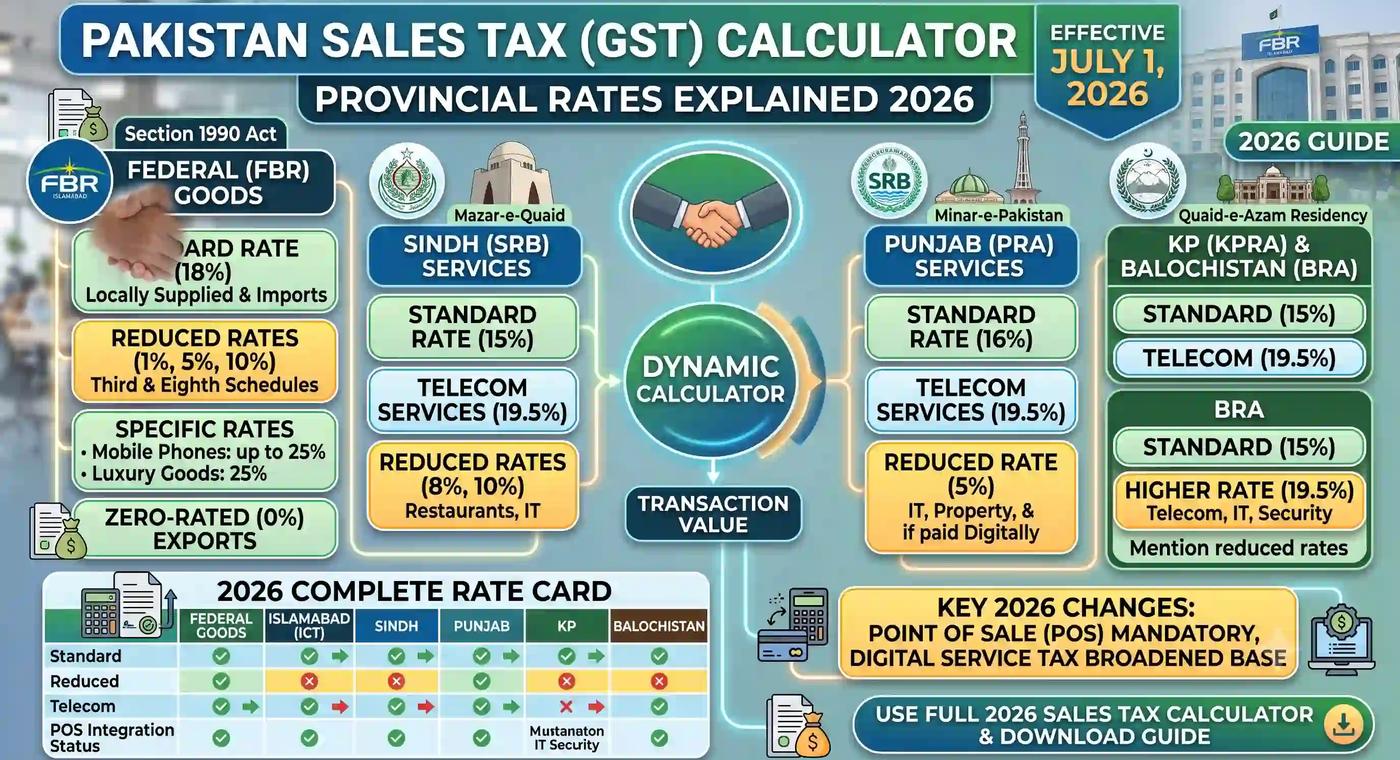
Here's the complete province-by-province rate table for 2026, based on the Finance Act 2026 and current provincial revenue authority notifications.
| GST Rates by Province in Pakistan (2026): Full Breakdown | |||
|---|---|---|---|
| Province/Region | Authority | Standard Rate | Notes |
| Federal (Goods) | FBR | 18% | Standard rate on most goods nationwide |
| Punjab | PRA | 16% | Reduced rates for select sectors |
| Sindh | SRB | 15% (up from 13%) | Telecom taxed higher at 19.5% |
| Khyber Pakhtunkhwa | KPRA | 15% | Standard rate on most services |
| Balochistan | BRA | 15% | Standard rate on most services |
| Islamabad (ICT) | FBR | 15–16% | IT/ITES services often reduced to 5% |
| Gilgit-Baltistan | — | 0% | No sales tax on services currently |
A few important notes behind these numbers:
- Telecommunication services are taxed higher than the standard rate almost everywhere — 19.5% in Sindh, for example.
- IT and IT-enabled services (ITeS) have historically enjoyed reduced rates (as low as 5%) to support the export-oriented tech sector, though the base legal rate under the Income Tax Ordinance framework is higher.
- Hospitals and clinics often get reduced rates (around 3%) in several provinces.
- Pharmaceuticals (medicaments) were reintroduced at the standard 18% rate after previously enjoying a reduced 1% rate — a reminder that these numbers shift with every Finance Act.
Punjab Sales Tax Rate (PRA) 2026
Punjab's standard sales tax on services rate is 16%, administered by the Punjab Revenue Authority under the Punjab Sales Tax on Services Act, 2012. Registration runs through the eSST portal, and your PRA registration builds on the NTN you already hold with FBR.
Sindh Sales Tax Rate (SRB) 2026
Sindh charges 15% on most services (increased from the earlier 13% rate), with the Sindh Revenue Board overseeing collection. Telecom services are the notable exception at 19.5%, while hospitals and clinics get reduced treatment near 3%.
Khyber Pakhtunkhwa Sales Tax Rate (KPRA) 2026
KPK's standard services rate sits at 15%, collected by the Khyber Pakhtunkhwa Revenue Authority. Like other provinces, sector-specific carve-outs apply for IT, healthcare, and education-related services.
Balochistan Sales Tax Rate (BRA) 2026
Balochistan also applies a 15% standard rate on services through the Balochistan Revenue Authority, keeping it broadly harmonised with KPK and Sindh.
Islamabad (ICT) Sales Tax Rate 2026
Since Islamabad isn't a province, services here fall under FBR's jurisdiction rather than a provincial authority, typically at 15–16%, with IT/ITeS services often reduced.
Gilgit-Baltistan Sales Tax Status
Gilgit-Baltistan currently applies 0% sales tax on services — making it the only region in the country without this levy, largely due to its distinct constitutional status.
Real-World Example: How Sales Tax Changes Across Provinces
Here's where this actually gets interesting. Imagine a Lahore-based marketing agency signs two identical contracts worth Rs. 500,000 each:
- Client in Punjab: PRA rate of 16% applies → Rs. 80,000 in tax
- Client in Sindh: SRB rate of 15% applies → Rs. 75,000 in tax
Same agency, same service, same invoice amount — but two different tax authorities, two different rates, and potentially two different registrations required. This "place of provision of service" principle — where the service is rendered or where the recipient is located — is exactly where most multi-province businesses get tripped up.
This is precisely the kind of scenario where a Sales Tax Calculator saves you from a costly manual error.
How to Calculate Sales Tax in Pakistan (Step-by-Step)
Here's the practical formula, whether you're calculating goods tax or services tax:
Sales Tax = Taxable Value × Applicable Rate
Step-by-step:
- Identify what you're selling — a good (FBR-taxed) or a service (provincially taxed).
- Determine the applicable province — based on where the service is rendered or consumed.
- Confirm the correct rate — standard, reduced, or zero-rated.
- Apply the formula to your invoice value.
- Subtract input tax you've already paid on business purchases to arrive at your net payable amount.
Example: A Karachi electronics retailer sells a laptop worth Rs. 100,000.
- FBR standard rate: 18%
- Sales tax = Rs. 100,000 × 18% = Rs. 18,000
- If the retailer already paid Rs. 10,000 in input tax on purchasing that stock, net payable to FBR = Rs. 8,000
This input-output mechanism is the backbone of Pakistan's VAT-style system, and it's exactly why manual calculation gets messy fast when you're juggling multiple transactions and rates.
Why Choose Tax Calculators Instead of Manual Calculation
Doing this math by hand across dozens of invoices, multiple provinces, and shifting Finance Act updates is where errors creep in — and errors cost money through penalties or missed input tax credits.
That's why we built Why Choose Tax Calculators — a free suite of tools designed specifically around Pakistan's tax structure:
- Instantly applies the correct FBR or provincial rate
- Updates automatically when the Finance Act changes rates
- Separates goods tax from services tax so you never mix up jurisdictions
- Works alongside our other tools like the FBR Tax Calculator and Income Tax Calculator for a complete tax picture
If you want to explore the full range of what's available, check out our Advanced Free Tax Calculators built for Pakistani and US taxpayers alike.
Sales Tax Registration: STRN, NTN and IRIS Portal Explained
Before you can legally charge or claim sales tax, you need to register.
NTN (National Tax Number): Your basic tax identity with FBR. If you don't have one yet, registration typically takes 24–48 hours through the IRIS portal.
STRN (Sales Tax Registration Number): Issued once you register specifically for sales tax with FBR. It's sometimes still called the "GSTIN" in older documents, though STRN is the correct modern term.
Provincial Registration: If you provide services, you'll also register with your relevant provincial authority (PRA, SRB, KPRA, or BRA), usually using your existing NTN as the foundation.
Our detailed walkthrough on the FBR IRIS Login Guide covers the exact registration steps, common errors, and how to recover access if you forget your credentials.
Input Tax, Output Tax and Tax Credit — Explained Simply
Two terms confuse almost every new business owner:
- Output tax — the sales tax you charge and collect from your customers.
- Input tax — the sales tax you paid on your own business purchases.
You pay the government the difference between the two. This is called claiming input tax credit, and it's the entire point of a VAT-style system — it prevents the same value from being taxed twice as it moves through the supply chain.
A word of caution: claiming input tax from a supplier who is blacklisted or suspended by FBR will always reverse later during audit. Keep every purchase invoice with a valid STRN clearly printed.
Filing Sales Tax Returns: Deadlines and Penalties
Sales tax returns in Pakistan are filed monthly through the IRIS portal, generally due by the 18th of each month (with the sales tax payment itself often due by the 15th).
Even if you had zero business activity, you still need to file a nil return — log into IRIS, select the relevant month, enter zero across all fields, and submit.
Penalty structure to keep in mind:
- Failure to register: Rs. 10,000–50,000 fine plus unpaid tax liability
- Late filing: Rs. 10,000 per month or 5% of tax payable, whichever is higher
- Incorrect return: Penalty up to 100% of the tax short-paid
- Failure to issue a tax invoice: Up to Rs. 25,000 per violation
- Fraud or evasion: Criminal prosecution, up to 3 years imprisonment
For a step-by-step compliance calendar, our guide on the Income Tax Return Deadline in Pakistan is a useful companion, since many filing habits overlap between income tax and sales tax obligations.
Zero-Rated and Exempt Supplies
Not everything is taxed at the standard rate. Two categories matter most:
Zero-rated supplies: Exporters charge 0% GST on their exports and can claim a full refund of input taxes paid on raw materials, processed through FBR's FASTER refund system for faster turnaround.
Exempt and special-zone supplies: Certain goods and locations get exemptions entirely. For example, supplies within the Gwadar Free Zone by businesses established there are exempt from sales tax for 23 years, and machinery or equipment imported exclusively for use within the zone or for exports also qualifies for exemption — subject to strict documentation and FBR approval.
If you're an exporter or freelancer billing overseas clients, understanding zero-rating can materially improve your cash flow versus assuming you owe standard tax on international sales.
Common Sales Tax Mistakes Businesses Make
Based on patterns seen across FBR and provincial audits, these mistakes come up again and again:
- Treating a service as a "good" (or vice versa) and paying the wrong authority entirely
- Forgetting the additional "further tax" (commonly 4%) on supplies made to unregistered buyers
- Not carrying forward opening balances correctly from the previous month's return
- Filing one annexure but forgetting a matching one, causing the whole return to fail submission
- Issuing informal, hand-written receipts without a valid STRN — which invalidates the invoice for both parties
Every one of these is avoidable with a proper calculator and a monthly compliance checklist — see our related guide on FBR Tax Slabs 2026-2027 Updates for how these interact with your overall tax position.
The Future of Sales Tax in Pakistan: Digital Compliance Trends
Pakistan's sales tax system is moving unmistakably toward full digitization:
- POS integration is expanding beyond Tier-1 retailers as FBR pushes for real-time reporting across more sectors.
- QR-code invoice verification through the Tax Asaan app is turning ordinary consumers into an informal compliance-monitoring layer.
- Cross-provincial data sharing between FBR and provincial authorities is closing the loopholes that multi-province businesses once relied on.
- Automated notices driven by third-party data matching mean silence from FBR no longer means you're unnoticed.
If there's one takeaway for 2026, it's this: manual, spreadsheet-based sales tax tracking is becoming a genuine liability. Businesses that adopt calculator-based, audit-ready workflows now will face far less friction as enforcement tightens further.
Frequently Asked Questions (FAQs)
What is the sales tax rate in Pakistan in 2026? The standard federal sales tax rate on goods is 18%, while provincial rates on services range between 15% and 16% depending on the province, with telecom services taxed higher at around 19.5%.
Is sales tax the same as GST in Pakistan? Yes. "GST" and "sales tax" refer to the same tax in Pakistan and are used interchangeably on invoices, receipts, and in everyday conversation.
Who administers sales tax on services in Pakistan? Provincial revenue authorities administer services tax: PRA in Punjab, SRB in Sindh, KPRA in Khyber Pakhtunkhwa, and BRA in Balochistan. FBR handles services only in Islamabad (ICT) and goods nationwide.
How is sales tax different in Punjab and Sindh? Punjab's standard services rate is 16% through PRA, while Sindh's standard rate is 15% through SRB (with telecom at 19.5%). The correct rate depends on where the service is rendered or the client is based.
What is STRN and how do I get it? STRN (Sales Tax Registration Number) is issued by FBR once you register for sales tax. You need an NTN first, then apply through the IRIS portal to receive your STRN.
Does Gilgit-Baltistan charge sales tax? No. Gilgit-Baltistan currently applies 0% sales tax on services, unlike every other province and territory in Pakistan.
Conclusion: Take the Guesswork Out of Your Sales Tax
Pakistan's sales tax system is genuinely complex — a federal rate for goods, four different provincial rates for services, sector-specific exceptions, and a compliance calendar that punishes even small mistakes. But once you understand the framework — who taxes what, where your obligation sits, and how input-output tax actually works — it stops being intimidating.
The smartest move you can make in 2026 isn't memorizing every rate table. It's using a tool that applies the correct rate for you, every single time.
Use our Advance Free Sales Tax Calculator offered by Tax Calculators to get your exact liability in seconds — whether you're billing a client in Lahore, Karachi, Peshawar, or Quetta. And if you're just starting your compliance journey, our guide on How to Become a Tax Filer in Pakistan is the natural next step.
Important disclaimer
This article is for educational planning only. It does not provide professional tax, legal, accounting, payroll, customs, or financial advice. Tax rules can change and final results may depend on your personal facts. Always verify important tax decisions with official sources or a qualified professional.
About the author
This article was written by the Tax Calculators Team, the group behind TaxCalculators.tools. Learn more about our team and editorial process.
Last reviewed: July 15, 2026